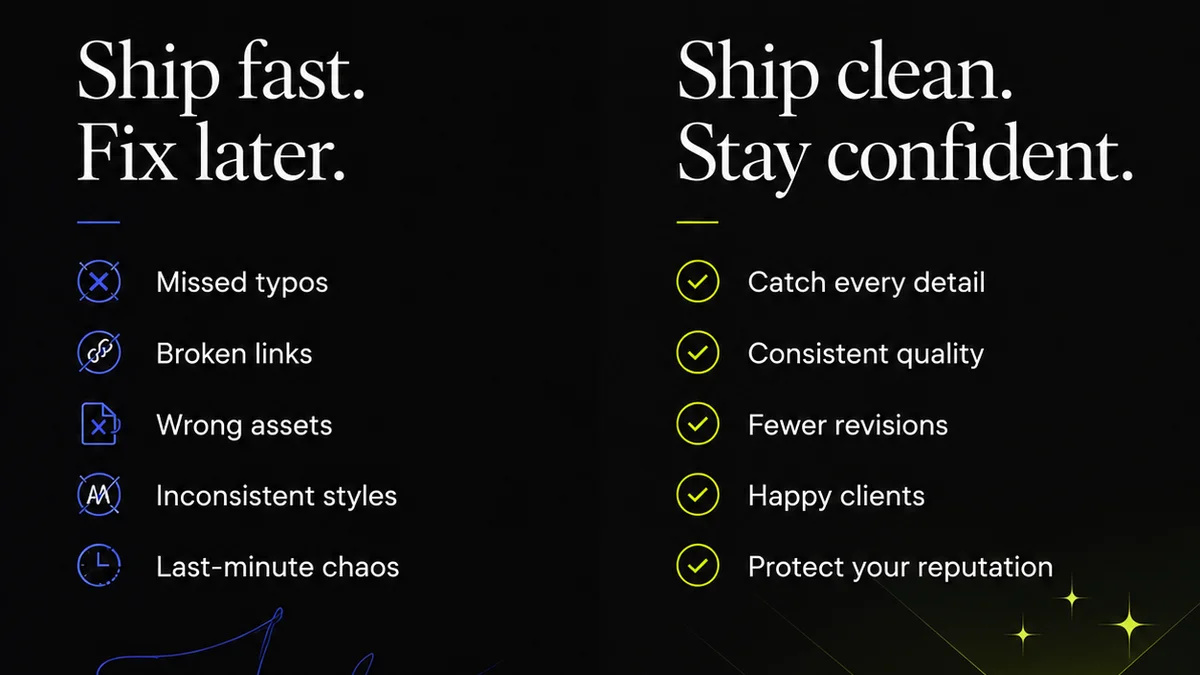
Everyone talks about publication Quality Assurance (QA). They picture a checklist. A final sign-off before hitting 'send'.
None of that is wrong. But it’s incomplete.
The hard truth? Publication QA isn't a gatekeeper. It's the foundation of client confidence and a driver of operational excellence. When done right, it’s not an afterthought; it’s woven into the fabric of your agency’s process.
1. The Myth of the 'Final' Review
Many agencies view QA as the last step. A quick once-over. A formality before the big reveal.
This mindset leads to rushed checks, missed errors, and a stressed-out team. It assumes that everything before this point was perfect. Which, as we know, is rarely the case.
Publication QA should be an ongoing process, not a single event.
The Cost of Complacency
What happens when QA is an afterthought?
- Client finds errors post-launch.
- Reputational damage.
- Costly re-work.
- Eroded trust.
- Team burnout.
These aren't just inconveniences. They're direct hits to your bottom line and your agency's future.
2. Redefining Quality: What Are We Actually Checking?
Publication QA isn't just about typos. It's a holistic assessment of the creative output against client objectives and established standards.
Think broader. Think deeper.
Functional Integrity
Does it work as intended? For digital assets, this means:
- Cross-browser compatibility.
- Mobile responsiveness.
- Link accuracy and functionality.
- Form submission and data capture.
- Performance metrics (load times, etc.).
Brand and Creative Alignment
Does it look and feel right? This involves:
- Adherence to brand guidelines (logos, colors, typography).
- Consistency in tone and messaging.
- Visual hierarchy and user experience (UX).
- Alignment with the original brief and client goals.
Technical and Accessibility Standards
Is it built to last and serve everyone? Consider:
- Code validity and best practices.
- Accessibility compliance (e.g., WCAG standards).
- File format and resolution appropriateness.
- Security considerations.
Each of these areas requires specific expertise and a clear understanding of the project's context.
3. Building QA into the Workflow, Not Onto It
The most effective QA isn't a separate phase; it's integrated at every stage of a project.
This means shifting from a reactive 'fix it before launch' mentality to a proactive 'prevent errors from the start' approach.
Early and Often Reviews
Start QA from the moment a brief is received.
- Concept review: Does the core idea meet the brief?
- Design mockups: Are they on-brand and technically feasible?
- Development builds: Are core features functioning as expected?
- Content integration: Is copy accurate and properly formatted?
Each checkpoint acts as a mini-QA, catching issues when they are cheapest and easiest to fix.
Defined Roles and Responsationsibilities
Who owns QA? It shouldn't fall solely on the project manager or the most junior team member.
Clear ownership ensures accountability. This might involve:
- Dedicated QA specialists for larger projects.
- Peer reviews at key milestones.
- Client-side review protocols that are clear and structured.
Everyone on the team has a role to play in maintaining quality.
Leveraging Tools for Consistency
Manual checks are prone to human error. Technology can bridge the gaps.
Automated testing tools can handle repetitive functional checks. Version control systems track changes meticulously. Project management platforms provide a central hub for feedback and approvals.
The key is to use tools that enhance, not replace, human judgment.
4. The Client as a Partner in Quality
Clients often feel like QA is solely the agency's job. They provide feedback, but the onus is on you to get it right.
This can be a source of friction. The client might miss critical details, or their feedback might be vague.
Reframe the client's role. They are the ultimate arbiters of their brand and business goals. Their input is invaluable, but it needs structure.
Structured Feedback Loops
Provide clients with clear guidelines on how and when to provide feedback. Use annotation tools for precise feedback on visuals. Set clear deadlines for review periods.
Educate and Align
Ensure clients understand the project scope and the iterative nature of creative work. Educate them on what constitutes critical feedback versus subjective preference.
When clients understand the process, they become more effective partners in achieving a high-quality outcome.
5. Where Revue Fits In
Managing feedback, revisions, and approvals across multiple stakeholders can quickly become chaotic. This is where a dedicated platform like Revue becomes essential for robust publication QA.
Revue centralizes client feedback, making it actionable and trackable. Instead of sifting through endless email threads or Slack messages, all comments are consolidated in one place, linked directly to the creative asset.
This visibility is crucial. You can see the history of revisions, understand the rationale behind changes, and ensure that all feedback has been addressed. For QA, this means:
- Centralized Accountability: All feedback is logged, so no comments get lost.
- Clear Revision History: Track every change and approval, understanding who signed off on what and when.
- Streamlined Approval Process: Formalize the sign-off process, ensuring all stakeholders have given their explicit approval.
- Reduced Ambiguity: Visual annotation tools minimize misunderstandings about specific elements.
By providing a single source of truth for all project communication and approvals, Revue helps ensure that the final output meets both your agency's standards and the client's expectations.
6. The Human Element: Judgment, Not Just Checks
Technology and processes are critical. But they can't replace human judgment.
A good QA process involves critical thinking. It means understanding the 'why' behind the 'what'.
Context is King
A typo in a legal disclaimer is more critical than one in a blog post. A broken link on a checkout page is a disaster. Understanding the context and potential impact of an error is paramount.
Proactive Problem-Solving
Great QA teams don't just find errors; they anticipate them. They look for potential issues based on past projects and industry best practices.
They ask: 'What could go wrong here?'
Continuous Improvement
QA isn't static. After each project, review the QA process itself. What worked well? What could be improved?
Use post-mortems to identify recurring issues and refine your checklists, tools, and training.
Final Thought
Is your publication QA a last-minute scramble or a strategic advantage? The difference lies in treating quality not as a destination, but as the journey itself.
Frequently asked questions
What is the difference between QA and UAT?
Quality Assurance (QA) is typically performed by the internal team to ensure the product meets technical and functional requirements before it's released to users. User Acceptance Testing (UAT) is performed by the end-user or client to confirm the product meets their business needs and expectations in a real-world scenario.
How can I make client feedback more effective for QA?
Provide clients with structured feedback templates, use annotation tools for precise comments, set clear deadlines for reviews, and educate them on the project scope and what constitutes critical feedback versus subjective preference. Centralizing this feedback in a platform like Revue can significantly improve clarity and reduce miscommunication.
What are the most common publication QA mistakes agencies make?
The most common mistake is treating QA as a final, rushed step rather than an integrated process. Other mistakes include unclear roles and responsibilities, relying solely on manual checks without automation, and failing to account for accessibility and cross-platform compatibility.
How does a tool like Revue help with publication QA?
Revue centralizes client feedback, tracks revisions and approvals, and provides a clear audit trail. This reduces ambiguity, ensures no feedback is missed, and streamlines the sign-off process, making it easier to maintain quality standards throughout the project lifecycle.