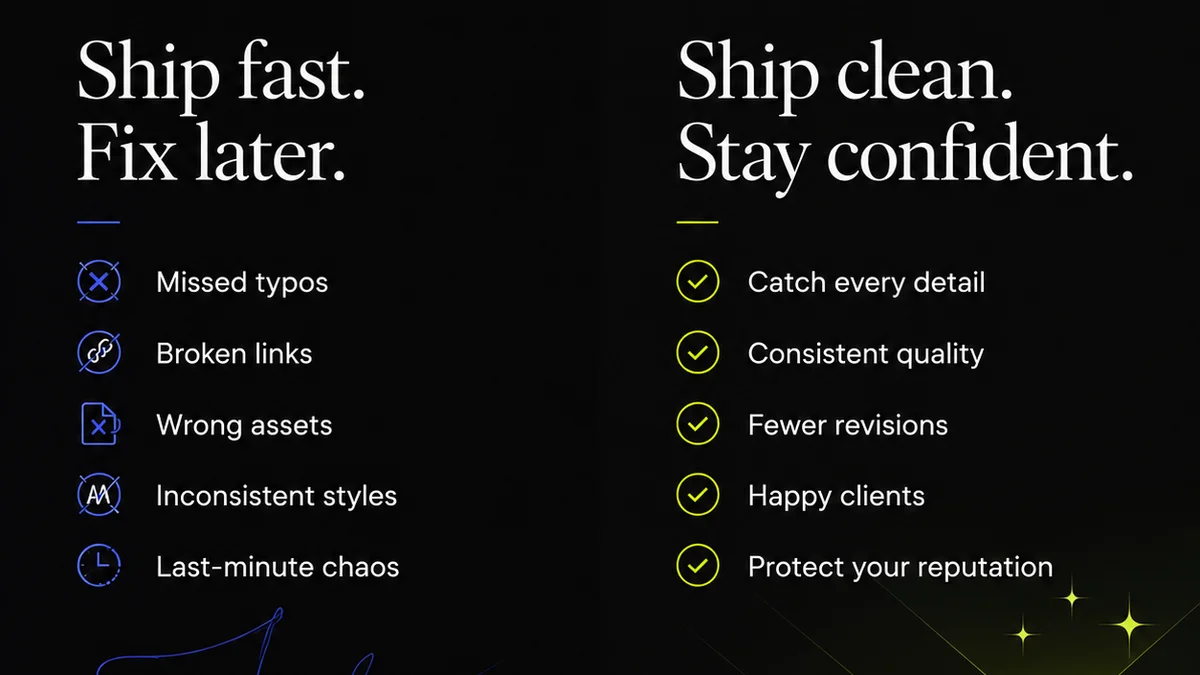
Everyone talks about quality assurance (QA) for publications in 2026. They point to AI checkers, automated proofreading tools, and endless checklists. None of that is wrong. But it’s incomplete.
The real future of publication QA isn't about more technology. It's about integrating quality checks seamlessly into your creative workflow, before the final export even happens.
1. The Illusion of 'Final' Checks
The common assumption is that QA is a distinct phase. A gatekeeper at the end of the process. Something you do right before hitting 'send' or 'publish'.
This approach is a relic of slower production cycles. In today's fast-paced agency world, it's a bottleneck waiting to happen.
This 'batch and check' mentality creates several problems:
- Late-stage errors mean costly rework.
- Missed deadlines become the norm.
- Team morale plummets under constant pressure.
- Client frustration simmers.
The hard truth? QA shouldn't be a separate event. It must be an embedded, continuous activity throughout the entire creative process.
2. Shifting QA Left: Proactive Quality Control
Moving QA 'left' means integrating checks earlier and more often. It’s about building quality in, not inspecting it out.
This requires a mindset shift from your entire team, not just a dedicated QA person.
Content Quality Starts with Clarity
Before any visual design or layout begins, the content itself needs to be solid. This means:
- Establishing clear content briefs.
- Ensuring all copy is approved before design starts.
- Verifying factual accuracy and tone of voice early.
This isn't a 'writing' task; it's a 'project management' task that impacts design quality.
Design Systems as Quality Anchors
A well-defined design system is your first line of defense for visual consistency and usability. It enforces standards automatically.
When components are reusable and documented:
- Designers aren't reinventing the wheel.
- Brand guidelines are inherently followed.
- Accessibility considerations are baked into elements.
Think of your design system as a living QA document. If it's maintained, your output will be more consistent.
Accessibility: No Longer an Afterthought
Web Content Accessibility Guidelines (WCAG) are not optional. They are legal requirements and ethical imperatives.
In 2026, accessibility QA must be integrated from the start.
- Color contrast checks during design.
- Keyboard navigation testing during development.
- Screen reader compatibility as a standard check.
Tools can help, but understanding the principles is key. Resources like the W3C Web Accessibility Initiative provide essential guidance.
Usability Testing: Real Users, Real Feedback
Prototypes and early builds should be tested with actual users. This catches usability issues that internal reviews might miss.
This isn't just for complex applications. Even marketing collateral can benefit.
- Observe how users interact with your designs.
- Identify points of confusion or frustration.
- Gather qualitative data to inform design decisions.
Platforms like the Nielsen Norman Group offer practical insights into effective testing methods.
3. Leveraging Technology Wisely
Technology *is* part of the solution, but not the whole solution. It's an enhancer, not a replacement for human judgment.
AI for Pattern Detection
AI tools are excellent at spotting patterns. They can flag:
- Inconsistent typography.
- Color palette deviations.
- Potential accessibility issues (like low contrast).
- Grammar and spelling errors at scale.
These tools should augment, not automate, the QA process. They free up human reviewers for more complex tasks.
Automated Functional Testing
For digital publications (websites, apps, interactive PDFs), automated functional testing is crucial.
This includes:
- Link validation.
- Form submission tests.
- Cross-browser compatibility checks.
These are repetitive tasks that computers excel at, ensuring a baseline of functionality.
Version Control and Audit Trails
Knowing what changed, when, and by whom is a form of QA. It prevents accidental overwrites and provides accountability.
Robust version control systems are essential for tracking revisions and reverting to previous states if needed.
This is especially critical when multiple stakeholders are involved in the review process.
4. The Human Element: Judgment and Context
Technology can't replicate human judgment or understand nuanced brand context.
This is where seasoned reviewers and creative directors shine.
Contextual Review
Does the final piece align with the client's strategic goals? Does it resonate with the target audience? Does it feel 'on-brand' beyond the literal guidelines?
These are questions only a human can answer.
Brand Voice and Tone
Automated grammar checkers miss sarcasm, subtle humor, or the specific cadence of a brand's voice. A human reviewer catches these.
Ensuring the publication *sounds* right is as important as it *looks* right.
Strategic Alignment
Is the publication effectively communicating the intended message? Is the call to action clear? Does it support the broader marketing campaign?
This high-level strategic QA is vital and cannot be automated.
Where Revue Fits In
Managing publication QA in 2026 means centralizing feedback and streamlining revisions. This is precisely where Revue excels.
Instead of scattered email threads, ambiguous Slack messages, or confusing spreadsheet comments, Revue provides a single source of truth for client feedback.
- Centralized Feedback: All comments, markups, and approvals live on the asset itself. No more hunting for feedback across multiple platforms.
- Revision Visibility: Track every version, every change, and every stakeholder's input. This creates an invaluable audit trail and ensures nothing gets lost.
- Streamlined Approvals: Formalize the approval process, reducing back-and-forth and clarifying sign-offs.
- Integrated Quality Checks: By embedding feedback and approvals within the workflow, you reduce the need for a separate, late-stage QA bottleneck. Issues are identified and resolved as they arise, not weeks later.
Revue helps bridge the gap between creative execution and client sign-off, ensuring quality is maintained throughout the process.
5. Building a Culture of Quality
Ultimately, the most effective QA is a team-wide commitment.
It's about fostering an environment where everyone feels responsible for the final output.
Training and Empowerment
Ensure your team understands QA principles, accessibility standards, and brand guidelines. Empower them to flag issues without fear.
Clear Roles and Responsibilities
While quality is a team effort, define who is responsible for what at different stages. This prevents confusion and dropped balls.
Continuous Improvement
Regularly review your QA processes. What worked? What didn't? Use retrospectives to identify areas for improvement.
This iterative approach ensures your QA practices evolve with your team and your clients' needs.
Final Thought
As we look towards publication QA in 2026 and beyond, the focus will continue to shift from reactive checking to proactive integration. The agencies that thrive will be those that embed quality into the very fabric of their creative process, leveraging technology as a partner, not a replacement, for human expertise and judgment.
Are your current QA processes built for speed, clarity, and continuous improvement, or are they still stuck in the past?
Frequently asked questions
What is 'shifting QA left' in publication workflows?
Shifting QA left means integrating quality assurance checks earlier and more frequently in the creative process, rather than treating it as a final, separate step before publication. This proactive approach helps catch errors and inconsistencies sooner, reducing rework and improving efficiency.
How can design systems improve publication QA?
Design systems act as built-in quality anchors by providing reusable components and enforcing consistent brand guidelines, typography, and spacing. When designers adhere to a well-maintained design system, visual and functional consistency is maintained across publications, reducing the need for manual checks.
Is AI replacing human QA specialists?
AI tools are excellent for pattern detection, flagging common errors like typos, grammatical mistakes, and basic accessibility issues. However, they cannot replicate human judgment, contextual understanding, or nuanced brand voice. AI should be seen as a tool to augment, not replace, human QA professionals, freeing them for more complex review tasks.
What role does client feedback play in modern QA?
Client feedback is integral. Modern QA processes aim to centralize and streamline this feedback, ensuring it's clear, actionable, and addressed promptly. Platforms that facilitate clear communication and version tracking are key to managing client input effectively throughout the publication lifecycle.