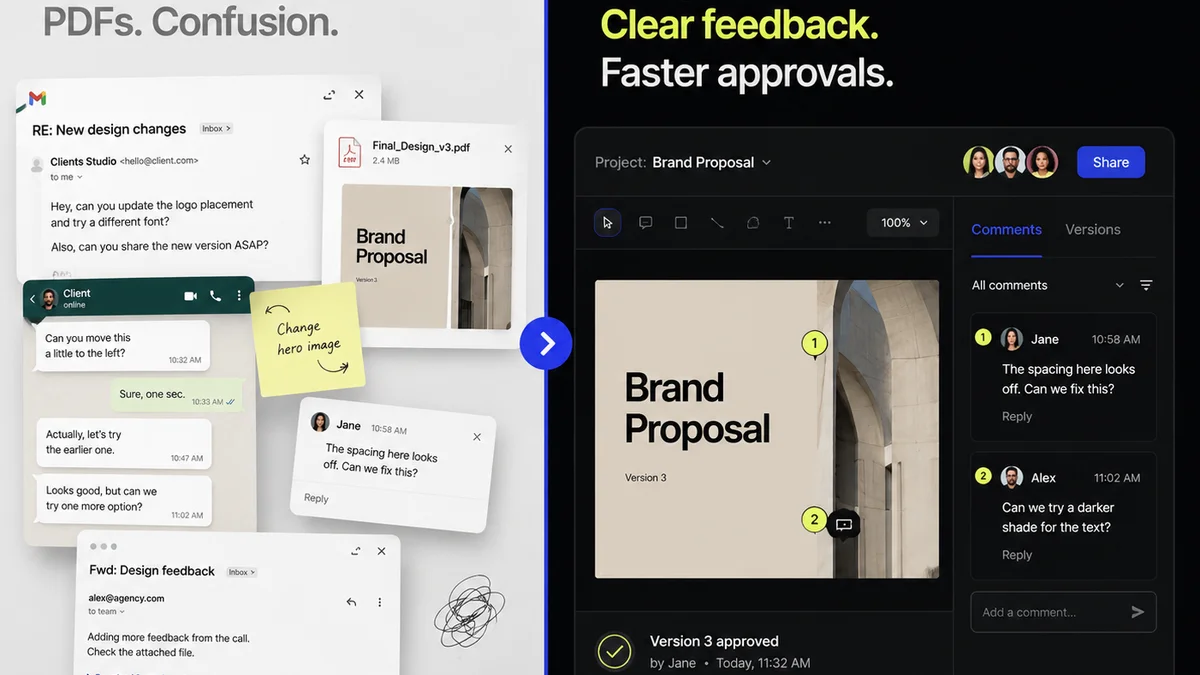
Everyone talks about creative workflow. They focus on the shiny bits: brainstorming, ideation, the final polish. They assume that once the creative is *done*, the hard part is over.
None of that is wrong. But it’s incomplete.
The real differentiator for top agencies isn't just speed in creation. It's mastery in publication workflow. It’s how they handle the messy middle: client feedback, endless revisions, and the final sign-off. This is where projects either soar or sink.
The hard truth? A brilliant creative concept is worthless if it gets bogged down in a broken publication process. World-class agencies don't just *do* creative; they *manage* its journey to completion. They build systems that turn potential bottlenecks into predictable steps.
1. The Myth of 'Final' Feedback
You've heard it. You've lived it. The client says, 'Just one last thing...' and the project scope explodes. This isn't a client problem; it's a process problem.
Assumption: Clients know what they want, and their feedback is always constructive.
Hard truth: Clients often don't know what they want until they see it, and their feedback can be subjective, contradictory, or vague. Their job is business results; yours is creative execution. These are different lenses.
The Feedback Loop from Hell
Think about the typical cycle:
- Creative delivered.
- Client provides feedback, often via email chain or a flurry of Slack messages.
- Agency interprets feedback, makes changes.
- New version delivered.
- Client provides *more* feedback, possibly contradicting earlier points.
- Repeat.
This is inefficient. It breeds confusion. It kills morale. And it almost always increases costs and delays timelines.
Establishing Clear Feedback Gates
World-class agencies don't wait for feedback to become a problem. They build structure around it.
This starts with defining clear feedback stages. Before delivery, agree on:
- When feedback will be collected (e.g., after initial concept, after revision round 1).
- Who provides feedback (a single point of contact is ideal).
- How feedback will be submitted (a centralized tool, a structured form).
- What is being reviewed (e.g., 'Reviewing for adherence to brief and visual hierarchy,' not 'Does it look good?').
This isn't about stifling input. It's about channeling it productively. It sets expectations and provides a framework for constructive critique.
2. Revision Management: Beyond 'Track Changes'
Revision management is more than just tracking edits. It's about understanding the *why* behind each change and ensuring it aligns with the original brief and business goals.
Assumption: Managing revisions is simply about making requested edits.
Hard truth: Unmanaged revisions are a primary driver of scope creep, budget overruns, and missed deadlines. They can also degrade the creative quality.
The Cost of Uncontrolled Revisions
Every revision cycle adds overhead:
- Designer's time to implement changes.
- Project manager's time to coordinate and track.
- Client's time to review and respond.
- Potential for introducing new errors.
- Risk of straying from the agreed-upon strategy.
When revisions are ad-hoc, it's easy for them to snowball. A small tweak here, a 'quick' addition there, and suddenly you're working on a completely different project than the one you pitched.
Quantifying Revisions and Scope
Top agencies treat revisions as a quantifiable part of the project scope. This means:
- Defining the number of revision rounds included in the initial proposal.
- Clearly outlining what constitutes a 'revision' versus a 'new request.' (e.g., changing copy is a revision; adding a new section is a new request).
- Establishing a process for out-of-scope requests. This usually involves a change order, a re-quote, and a new timeline.
This isn't about nickel-and-diming clients. It's about professional project management and protecting the integrity of the project and your agency's resources.
3. Approval Bottlenecks: The Silent Project Killer
The final approval. It sounds like the finish line. But for many agencies, it's a black hole where projects go to die, or at least, to linger indefinitely.
Assumption: Once creative is 'approved,' the project is done.
Hard truth: The approval process is often the most vulnerable part of the publication workflow, prone to delays, ambiguity, and last-minute changes that can derail everything.
Why Approvals Get Stuck
Common culprits include:
- Lack of a clear decision-maker. Multiple stakeholders weighing in without a designated approver.
- Vague approval criteria. 'Looks good' isn't a criterion.
- Delays in response. Internal client processes can be slow.
- Fear of making the final call. Stakeholders might defer to others.
These bottlenecks don't just delay launch dates. They create uncertainty, impact cash flow, and strain client relationships.
Streamlining the Sign-Off
World-class agencies implement systems to expedite approvals:
- Designated Approvers: Insist on a single, empowered individual responsible for final sign-off.
- Clear Deliverables: Ensure the final deliverable matches the agreed-upon scope and brief.
- Timed Review Periods: Set clear deadlines for feedback and approval (e.g., 'Client to provide final approval within 48 hours of submission').
- Visual Proofing Tools: Use platforms that allow for clear, annotated feedback directly on the creative asset, reducing misinterpretation.
The goal is to make the approval process as frictionless and transparent as possible. It’s about moving from 'waiting for approval' to 'managing the approval window.'
4. Quality Assurance: The Last Line of Defense
Before anything goes live, there's a critical phase often overlooked in the rush: quality assurance (QA). This is your agency's final gate for accuracy, functionality, and brand consistency.
Assumption: QA is just a quick check for typos.
Hard truth: A robust QA process prevents costly errors, protects brand reputation, and ensures the final output meets all technical and strategic requirements.
The Perils of Skipping QA
What happens when QA is an afterthought?
- Incorrect links leading to broken user journeys.
- Typos and grammatical errors that undermine credibility.
- Inconsistent branding across different elements.
- Technical glitches that frustrate users.
- Failure to meet accessibility standards, leading to potential legal issues.
These aren't minor oversights. They can lead to lost revenue, damaged brand perception, and even legal repercussions. For example, non-compliance with web accessibility guidelines can result in significant fines.
Building a QA Checklist
A structured QA process is non-negotiable. Develop comprehensive checklists tailored to the project type:
- Content Accuracy: Verify all text, data, and pricing.
- Brand Consistency: Check logos, colors, fonts, and tone of voice.
- Functionality Testing: Ensure all links, buttons, forms, and interactive elements work as expected across relevant devices and browsers.
- Technical Checks: Review file formats, image optimization, and load times.
- Accessibility Audit: Confirm compliance with WCAG standards where applicable.
- Adherence to Brief: A final check against the original strategic objectives.
This systematic approach ensures that every piece of work leaving your agency meets the highest standards before it ever reaches the public eye.
Where Revue Fits In
Managing publication workflow effectively requires visibility and control. Juggling feedback via scattered emails, tracking revisions in spreadsheets, and chasing approvals through endless chat threads is a recipe for disaster.
This is precisely why tools like Revue are built. They centralize client feedback, providing a single source of truth for all communication and annotations related to a project.
With Revue, you can:
- Consolidate Feedback: All comments and annotations live on the asset itself, eliminating misinterpretations and lost messages.
- Track Revisions: See the history of changes, understand what was modified, and by whom. This provides clear audit trails.
- Manage Approvals: Streamline the sign-off process with clear status indicators and notifications, reducing bottlenecks.
- Ensure Quality: A structured workflow with clear stages helps maintain oversight and facilitates thorough QA checks before final delivery.
By bringing structure to the chaotic middle of the creative process, Revue helps agencies move faster, reduce errors, and deliver exceptional work consistently.
Final Thought
The difference between an agency that thrives and one that merely survives often comes down to process. Specifically, how well they manage the journey of creative work from concept to final publication.
Are you treating publication workflow as an afterthought, or as the strategic advantage it truly is?
Frequently asked questions
What is the biggest mistake agencies make with publication workflow?
The biggest mistake is treating publication workflow as an afterthought or a simple administrative task. Top agencies understand that a robust, structured workflow for feedback, revisions, and approvals is critical for delivering quality work on time and on budget. They build systems to manage this messy middle, rather than hoping for the best.
How can agencies prevent scope creep during revisions?
Agencies can prevent scope creep by clearly defining the number of revision rounds included in the initial proposal, establishing what constitutes a 'revision' versus a 'new request,' and implementing a formal process for handling out-of-scope requests, typically involving change orders and re-quoting.
Why is a single point of contact for client feedback important?
A single point of contact for client feedback ensures clarity and consistency. It prevents contradictory feedback from multiple stakeholders, reduces misinterpretations, and streamlines the revision process. This designated approver is accountable for delivering consolidated, actionable feedback.
How does a centralized tool like Revue help with publication workflow?
Centralized tools like Revue consolidate all client feedback, annotations, and revision history in one place. This eliminates scattered communication, provides clear audit trails, streamlines the approval process, and improves visibility for the entire team, leading to fewer errors and faster project completion.