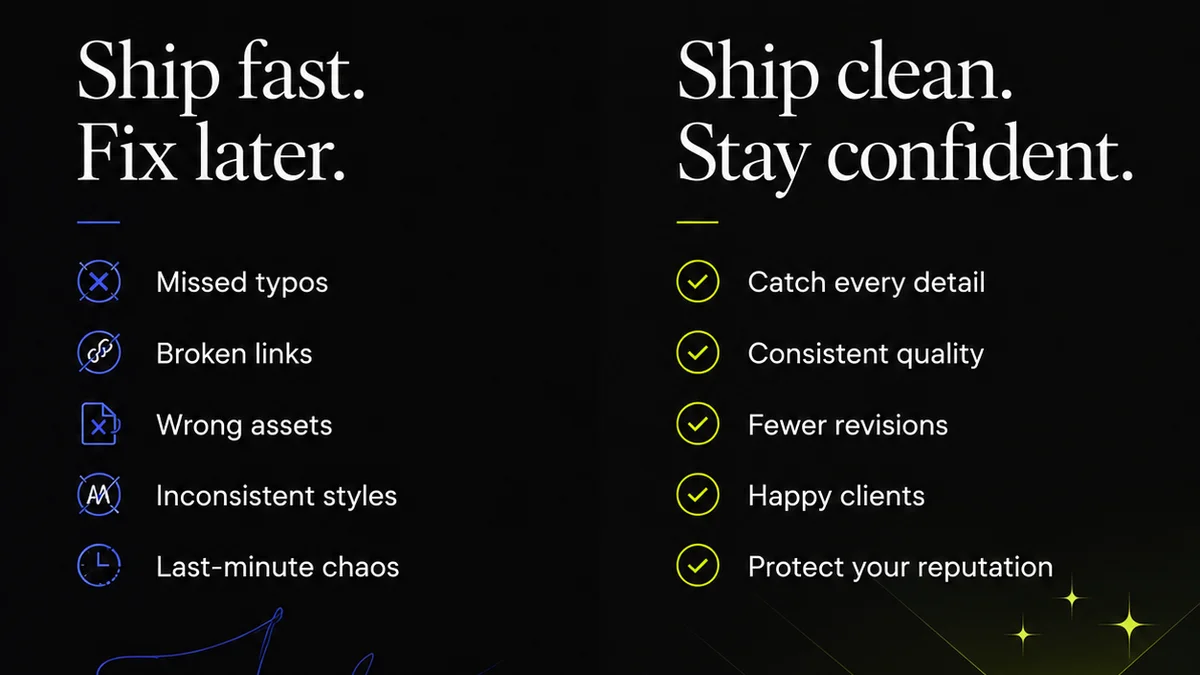
Everyone agrees that delivering high-quality work is the goal. You’ve got your design process, your client communication strategy, your final review steps. You deliver polished, pixel-perfect assets. Nobody wants to ship junk.
None of that is wrong. But it’s incomplete.
The hard truth is that quality assurance isn’t a final checkpoint; it’s a continuous thread that needs weaving through every stage of a design project. Treating it as an afterthought is a surefire way to introduce errors, waste time, and damage client relationships.
1. The Myth of the 'Final Check'
Many teams operate under the assumption that a dedicated QA phase at the end of a project is sufficient. They believe that once the design is 'done,' a quick once-over will catch any stray pixels or typos.
This approach is fundamentally flawed.
By the time you reach a 'final check,' the project is already nearing completion. Any issues discovered then are often costly and time-consuming to fix. They might require significant rework, pushing deadlines and increasing budgets.
The Cost of Late Discovery
Consider the ripple effect:
- A forgotten brand guideline can mean redoing entire sections.
- A subtle accessibility error might necessitate a complete overhaul of interactive elements.
- A misplaced comma in crucial copy can lead to embarrassing client comms or even legal issues.
These aren't minor inconveniences; they are project derailers. The 'final check' often becomes a frantic scramble, not a quality assurance step.
2. Embedding QA into the Workflow
True quality assurance means integrating checks and balances from the very beginning. It’s about building quality into the process, not bolting it on at the end.
This requires a shift in mindset. QA becomes everyone's responsibility, not just the final reviewer's.
Discovery and Briefing
Quality starts with understanding. Does the brief accurately reflect the client's needs and goals? Are there ambiguities?
Actionable Step: During the initial brief-taking, actively probe for clarity. Ask 'why' multiple times. Document assumptions and get client sign-off on the core objectives. A clear brief is the first layer of QA.
Concepting and Ideation
Even in the messy early stages, quality considerations matter. Are the concepts aligned with the brief? Are they technically feasible?
Actionable Step: Hold internal concept reviews. Get a second pair of eyes on the initial directions before presenting them to the client. This isn't about critique; it's about alignment and identifying potential pitfalls early.
Design and Development
This is where most people think of QA, but it should be iterative.
Actionable Step: Implement regular, smaller reviews throughout the design process. For web projects, this means checking responsiveness on different devices as you go, not just at the end. For branding, it means checking logo variations and application consistency early.
Content and Copy
Often overlooked, copy is a critical part of the design. Typos, grammatical errors, or off-brand messaging can undermine even the best visuals.
Actionable Step: Integrate copy review with design review. Ensure the content is proofread independently *before* it's placed into final designs. Use tools like Grammarly or have a dedicated copy editor involved.
Technical Checks
Depending on the project, this could involve anything from checking file formats and naming conventions to verifying code and accessibility standards.
Actionable Step: Create checklists for common technical requirements. Make them part of the handover process for each deliverable, not just the final one.
3. Building a QA Culture
Shifting to an integrated QA process requires more than just new steps; it requires a cultural change within your team.
Everyone needs to feel empowered and responsible for quality.
Clear Roles and Responsibilities
While QA is a team effort, defining who is responsible for what aspect can prevent things from slipping through the cracks.
Example: The designer might be responsible for ensuring design system adherence. The project manager might be responsible for checking against the brief. The copywriter is responsible for proofreading their own text, and a second person for final proofing.
Checklists and Templates
Standardized checklists are invaluable. They ensure consistency and act as a memory aid for complex projects.
Actionable Step: Develop project-specific checklists. For a website project, this might include:
- Browser compatibility (Chrome, Firefox, Safari, Edge)
- Device responsiveness (Desktop, Tablet, Mobile)
- Link functionality
- Form submission
- Image optimization
- Accessibility (alt text, contrast ratios)
- Content accuracy and grammar
These aren't meant to be exhaustive, but to cover the most common failure points.
Feedback Loops
Encourage constructive feedback at all stages. Make it safe for team members to point out potential issues without fear of reprisal.
Actionable Step: Frame feedback sessions around improvement, not blame. Use phrases like, "What if we tried X?" or "I noticed this, how can we address it?"
Documentation and Learning
Every project, especially those with issues, is a learning opportunity.
Actionable Step: After project completion, conduct a brief post-mortem focused on quality. What went well? What could have been caught earlier? Document these learnings and update your processes and checklists accordingly.
4. Where Revue Fits In
Managing feedback and revisions can quickly become a bottleneck for quality assurance. Scattered emails, version control nightmares, and unclear client comments lead to mistakes and missed details.
Revue streamlines this entire process, making integrated QA more achievable.
Centralized Feedback
Instead of clients leaving comments across emails, Slack messages, and various file-sharing platforms, Revue provides a single source of truth for all feedback.
This means every comment is logged, visible, and tied to a specific version of the creative asset. No more hunting for that one crucial piece of feedback buried in an old email thread.
Clear Revision and Approval Trails
Revue tracks every revision and approval. You can see exactly who approved what, when, and what feedback was addressed (or not addressed).
This transparency is a form of QA in itself. It ensures that decisions are documented and that the team is working from the latest, approved version. It prevents scope creep disguised as 'minor tweaks' that introduce new errors.
Visibility into Quality Checks
You can use Revue to manage your internal quality checks as well. Upload a version, assign internal reviewers, and track their sign-offs.
This allows you to formalize your internal QA process, ensuring that key checks are completed by designated team members before the asset is sent to the client for final approval. It builds a clear audit trail for your quality efforts.
5. The Long Game: Client Trust
Treating QA as an afterthought isn't just inefficient; it erodes trust.
Clients hire you for your expertise and your ability to deliver reliable, high-quality results. When you consistently deliver work with errors, you undermine that confidence.
This doesn't mean you'll never have errors. Even the best teams make mistakes. But a proactive, integrated QA process minimizes the frequency and severity of those errors.
Consistency is Key
The real benefit of embedding QA is consistency. Clients learn to expect a certain level of polish and accuracy from your agency, project after project.
This builds a reputation for reliability, which is invaluable in a competitive market. It leads to repeat business and strong referrals.
Efficiency Through Prevention
Think of QA not as an added cost, but as an investment in efficiency. Catching a problem early saves far more time and money than fixing it late.
The cost of rework, client dissatisfaction, and missed deadlines far outweighs the investment in a robust, integrated QA process. It's about working smarter, not just harder.
Final Thought
So, is quality assurance just a final step? Or is it the bedrock of exceptional creative delivery?
The answer lies not just in the final product, but in the diligence applied at every stage. How are you ensuring quality isn't just an aspiration, but a fundamental part of your team's daily practice?
Frequently asked questions
What is the difference between QA and final review?
A final review is a last look before delivery, often catching only the most obvious errors. Quality Assurance (QA), when integrated, is a continuous process of checks and balances built into every stage of a project to prevent errors from occurring in the first place.
How can small agencies implement better QA?
Start with simple checklists tailored to your common project types. Empower team members to flag potential issues during internal reviews. Prioritize clarity in client briefs and documentation. Use tools like Revue to centralize feedback and track revisions, reducing the chance of miscommunication.
Who is responsible for QA in a design project?
Ideally, everyone on the team shares responsibility for quality. Specific roles can be assigned for different aspects (e.g., designer for brand adherence, copywriter for proofreading), but fostering a team culture where quality is paramount is key.
How does client feedback impact QA?
Unmanaged client feedback is a major source of errors. Centralizing feedback in a tool like Revue ensures all comments are captured, tracked, and addressed systematically, preventing crucial feedback from being missed or misinterpreted, which is a critical part of QA.