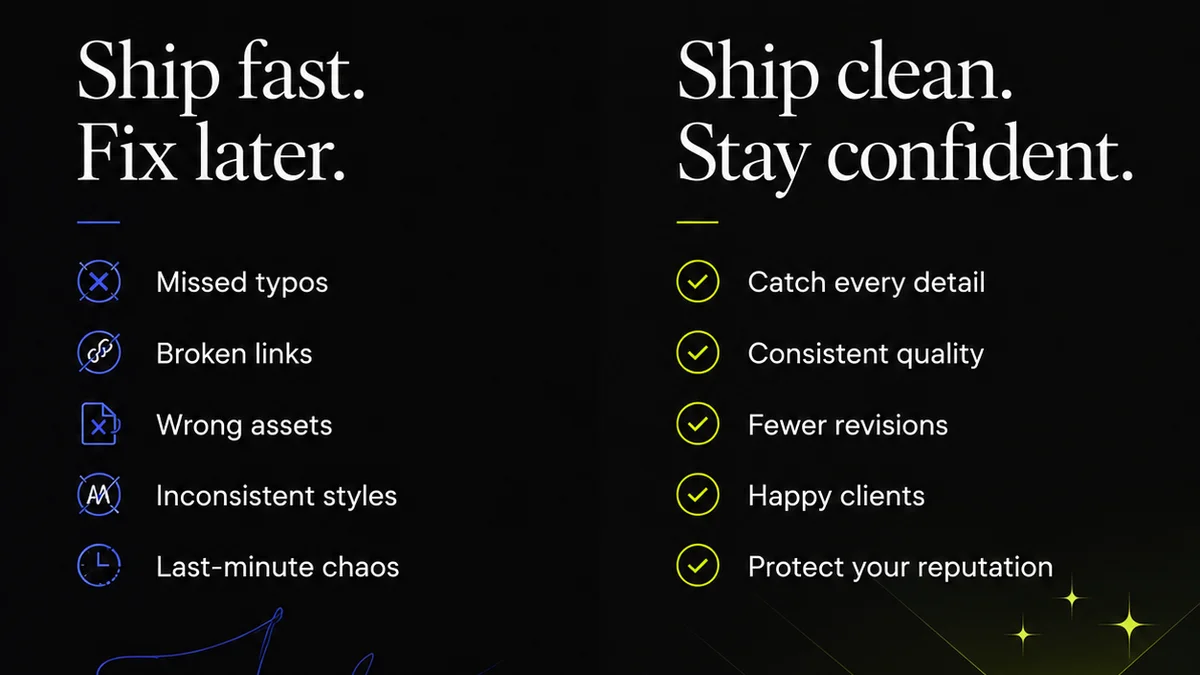
Everyone talks about quality. It’s the holy grail of agency work. But most checklists for quality management are just that: lists. They’re filled with things like ‘proofread copy,’ ‘check brand guidelines,’ and ‘ensure correct specs.’
None of that is wrong. But it’s incomplete. It’s like a chef having a list of ingredients but no recipe. You can have the best ingredients in the world, but without a process, you won’t make a great meal. You’ll make a mess.
The real truth about quality management in a creative agency isn’t about checking boxes. It’s about building a system. A system that catches errors, streamlines approvals, and consistently delivers work that makes clients happy and your team proud.
It’s about operational rigor. And that’s what we’ll break down.
1. Defining Quality: Beyond 'Good Enough'
What does quality even mean for your agency? It’s not just subjective aesthetics. It’s a measurable outcome tied to client objectives and your own standards.
The Client's Definition
Your client hired you for a reason. Their definition of quality is tied to ROI, brand perception, lead generation, or whatever their business goal is. Does the creative work directly serve that goal?
Your Agency's Definition
This is about your reputation and your internal standards. Are you delivering technically sound work? Is it on-brand? Is it innovative? Does it meet the brief perfectly?
The Audience's Definition
Ultimately, the end-user or consumer experiences the work. Is it clear? Is it engaging? Does it solve their problem or fulfill their need?
A robust quality management process aligns all three definitions.
2. Process is King: The Foundation of Consistency
You can’t wing quality. It needs a repeatable, documented process. This isn’t about stifling creativity; it’s about creating guardrails so creativity can thrive without breaking things.
The Briefing Process
Quality starts at the very beginning. A clear, comprehensive brief is non-negotiable. If the brief is vague, the output will be too. What goes in must be clear.
- Clear objectives (SMART goals if possible)
- Defined target audience
- Key messaging
- Mandatories and constraints (legal, brand, technical)
- Deliverables and formats
- Success metrics
Internal Reviews & Checkpoints
Don't wait for the client to find the flaws. Build in multiple internal review stages. These aren't just final checks; they're checkpoints throughout the creative lifecycle.
- Concept review
- Design iteration review
- Copy review
- Technical/pre-production review
Each stage should have a clear owner and defined criteria for sign-off.
Client Feedback Loops
This is where most agencies stumble. Unstructured feedback leads to scope creep and diluted quality. You need a system for collecting, organizing, and acting on client feedback.
- Centralized feedback channel (avoiding scattered emails/chats)
- Clear process for consolidating and prioritizing feedback
- Defining what constitutes a 'revision' vs. a 'new request'
- Setting expectations on feedback turnaround time
This protects your team and ensures client input is managed effectively.
Quality Assurance (QA) Testing
Before anything goes live or to the client for final approval, it needs a thorough QA pass. This is distinct from creative review.
- Technical QA (functionality, broken links, responsiveness, browser compatibility)
- Content QA (typos, grammar, factual accuracy, consistency)
- Brand QA (correct logos, colors, fonts, tone of voice)
- Legal/Compliance QA (disclaimers, terms, regulatory adherence)
This is where you catch the details that can tarnish an otherwise great piece of work.
3. Tools and Technology: Enabling the Process
You can have the best process in the world, but without the right tools, it’s hard to execute consistently, especially as you scale.
Centralized Asset Management
Where are your brand assets? Are they easily accessible and up-to-date? Using a single source of truth for logos, fonts, and templates prevents the use of outdated or incorrect materials.
Project Management Software
This is table stakes for any agency. It keeps tasks organized, timelines visible, and responsibilities clear. But it needs to be configured to support your quality checkpoints.
Dedicated Feedback Platforms
Email chains and Slack messages are chaos. A platform designed for creative feedback allows for annotation, version control, and clear communication, reducing misinterpretation and speeding up approvals.
Automated Testing Tools
For digital projects, automated testing can catch many technical issues quickly, freeing up human QA for more complex problems. Think accessibility checkers or basic code linters.
The right tech stack supports your workflow, not dictates it.
4. People and Culture: The Human Element
Technology and process are only as good as the people using them. A culture that values quality is essential.
Clear Roles and Responsibilities
Who owns quality at each stage? Is it the project manager, the creative lead, a dedicated QA specialist, or a combination? Clarity prevents things from falling through the cracks.
Training and Onboarding
New hires need to understand your quality standards and processes from day one. Ongoing training keeps everyone sharp and up-to-date on best practices.
Psychological Safety
Team members must feel safe pointing out potential quality issues without fear of blame. A blameless post-mortem culture helps identify systemic problems rather than individual failings.
Encourage questions. Foster a proactive mindset. Make quality a shared responsibility.
5. Continuous Improvement: Never Stop Refining
Quality management isn't a set-it-and-forget-it activity. The landscape changes, clients evolve, and your agency grows. You need to adapt.
Post-Project Reviews (Retrospectives)
After every significant project, conduct a review. What went well? What didn’t? Specifically, where did quality slip, and why?
Data Analysis
Track key metrics. How many revisions were needed? How many bugs were found post-launch? What was the client satisfaction score related to the final output?
Use this data to identify trends and areas for process improvement.
Client Feedback on the Process
Don't just ask clients about the creative. Ask them about the experience. Was the feedback process smooth? Were they clear on timelines? Their insights are invaluable.
Staying Updated
Are there new accessibility standards? Emerging best practices in UX? Changes in platform requirements? Your quality standards need to evolve with the industry.
For example, Web Content Accessibility Guidelines (WCAG) are constantly updated, requiring ongoing attention for digital products.
Where Revue Fits In
Managing quality across multiple clients and projects is a complex orchestration. Scattered feedback, unclear revision histories, and missed checkpoints are the enemy of consistent quality.
Revue provides a centralized hub for client feedback and approvals. It brings clarity to the revision process, ensuring that every piece of feedback is captured, tracked, and addressed within the context of the project.
This visibility helps teams manage scope, understand the evolution of a creative asset, and perform more effective quality checks before final delivery. It’s about making the entire quality management loop more efficient and less error-prone.
Final Thought
Is your agency chasing quality, or is it building it? The difference lies in moving from ad-hoc checks to a systematic, ingrained approach. It’s about process, people, and continuous refinement. It’s the hard work that pays off in consistent excellence.
Frequently asked questions
What are the key components of a quality management system for a creative agency?
A robust system includes clear definitions of quality, a well-documented process from briefing to QA, appropriate technology tools, a culture that values quality, and a commitment to continuous improvement through reviews and data analysis.
How can agencies effectively manage client feedback to maintain quality?
Establish a centralized feedback channel, clearly define what constitutes a revision versus a new request, prioritize feedback based on project goals, and set clear expectations for feedback turnaround times. Using a dedicated platform can significantly help.
What is the difference between creative review and quality assurance (QA)?
Creative review focuses on the strategic and aesthetic aspects of the work, ensuring it meets the brief and brand standards. Quality Assurance (QA) is a more technical and detail-oriented process focused on functionality, accuracy, compliance, and error detection before final delivery.
How does technology support quality management in an agency?
Technology supports quality management by providing centralized asset libraries, robust project management, dedicated platforms for feedback and approvals, and automated testing tools. These enable consistency, visibility, and efficiency across projects.