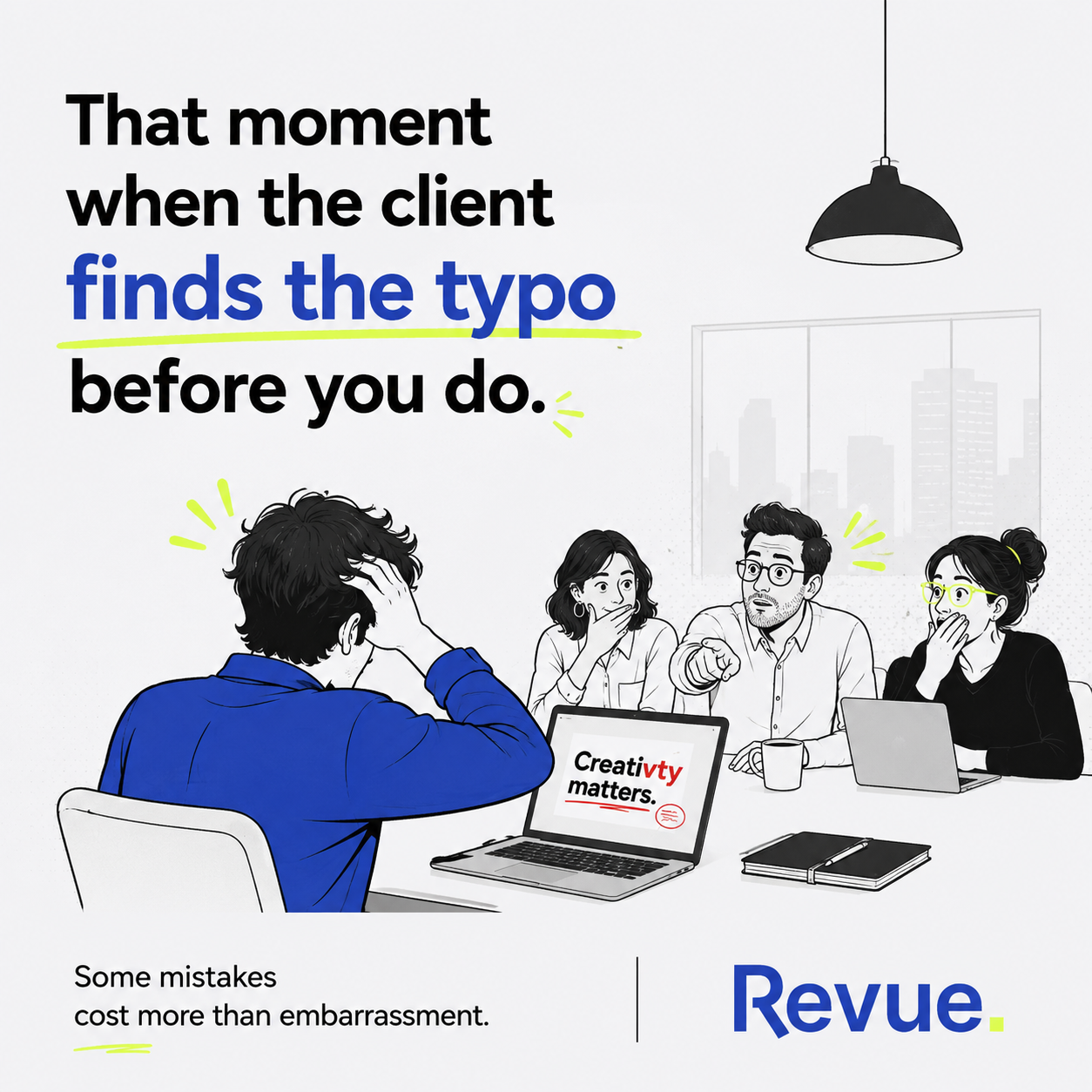
Every creative team has heard some version of it.
“Just one quick change before we send it.”
“Can we swap the headline?”
“Let’s move the CTA.”
“Can you update the logo placement?”
“Actually, leadership wants to see one more option.”
On the surface, none of these requests sound catastrophic. They sound small. Reasonable. Manageable. Sometimes they’re framed as tiny tweaks that should only take “five minutes.”
That framing is exactly why last-minute design changes are so dangerous.
Because the visible change is often not the real cost. The real cost sits underneath it — in the chain reaction it creates across files, feedback loops, approvals, exports, quality checks, timelines, and team focus.
A last-minute change rarely stays isolated. It reopens work that was already moving toward closure. It interrupts production rhythm. It forces people to context-switch. It creates risk that the wrong version gets sent, that a previous fix gets overwritten, or that a new error slips in because the team is moving too fast to check properly.
And when this happens repeatedly, it stops being a minor inconvenience and becomes an operational pattern.
That’s the uncomfortable truth creative teams need to face: last-minute design changes are not expensive because the change itself is large. They’re expensive because they destabilize the system around the work.
If your agency or in-house team constantly feels rushed, reactive, and trapped in avoidable rework, last-minute changes are probably doing more damage than you think.
The Problem Isn’t Change. It’s Late Change.
Let’s be clear: design work is iterative by nature.
Clients change their minds. Stakeholders bring new information. campaigns evolve. Messaging shifts. A new business priority appears. Sometimes the change genuinely improves the work. Sometimes it’s necessary.
So the problem is not that creative work changes.
The problem is when it changes.
A design change requested early in the process is usually manageable. It can be absorbed before the work is deeply adapted, approved, exported, or handed off. A design change requested at the end of the process is different. By then, the work has usually already accumulated dependencies:
internal approvals may already be done
multiple asset versions may already exist
copy may already be locked in other formats
handoff files may already be prepared
production timelines may already be set
the team may already be focused on something else
At that stage, even a “small” change can ripple through the entire system.
That is why the same request costs very different amounts depending on when it appears.
Why Last-Minute Design Changes Are So Expensive
Most teams underestimate the cost because they calculate only the visible execution time:
“How long will it take to move the logo?”
“How long to change the headline?”
“How long to update the color?”
That’s the wrong lens.
The real cost includes everything the change forces the team to do around the edit itself. And that’s where margin, time, and momentum get destroyed.
1. They Reopen Work That Was Already Operationally Closed
The biggest problem with last-minute changes is that they drag completed work back into motion.
A design that was already reviewed now needs to be reopened.
A file that was ready for export now needs to be edited again.
A version that was approved now becomes unstable.
A deliverable that was about to leave the team now re-enters the workflow.
That sounds simple until you realize what it actually means operationally:
the designer has to stop current work and reload context
the latest file has to be identified and reopened
prior approvals may need to be reconsidered
updated exports may need to be regenerated
the team may need to reshare the file for confirmation
dependent deliverables may need to be updated too
The cost isn’t just “making a change.” It’s reversing closure.
And every time a team has to reverse closure, efficiency drops.
2. They Create Rework Across Multiple Assets
Last-minute changes are rarely isolated to one file.
A headline update on the key visual may also affect:
social media adaptations
paid ad variants
web banners
email headers
print collateral
sales decks
landing page mockups
motion graphics or video thumbnails
A logo placement change in one asset may need to be reflected across an entire campaign system. A color change may require multiple exports. A copy edit may need to be checked in every resized or localized version.
This is where teams get blindsided. They think they’re approving one change when they’re actually triggering a multi-asset rework cycle.
And if there isn’t a strong system for tracking dependencies, something gets missed.
3. They Break Team Focus and Force Context Switching
Creative teams do their best work when they can stay inside the logic of a project long enough to move it forward cleanly.
Last-minute changes break that rhythm.
A designer who has mentally moved on to another project has to reopen an old file and reload all the context: what was approved, what version is current, what constraints already exist, what feedback has already been incorporated, and what not to break while making the update.
That context-switching cost is real. It slows execution, increases cognitive fatigue, and makes mistakes more likely.
Multiply that across an agency or internal design team and the effect compounds:
more interrupted deep work
slower output on other active projects
more mental load on designers and reviewers
more fragmented attention across the team
The design change may take 15 minutes. The disruption around it can cost far more.
4. They Increase the Risk of New Errors
The faster a team is forced to revise work late in the process, the higher the risk that something breaks.
A last-minute change can easily introduce:
inconsistent spacing
incorrect typography
misaligned elements
outdated copy in one adaptation
wrong export dimensions
accidental deletion of an approved fix
brand inconsistencies across versions
outdated file links or attachments being shared
This is why late changes are not just a scheduling problem. They’re a quality problem.
The team is often making updates under pressure, with less time for a full review, on work that already had a lot of moving pieces. That is exactly when preventable mistakes slip through.
And when they do, the team pays twice: once for the late change, and again for the correction that follows.
5. They Trigger Approval Chaos
A design that was already approved has a status. Everyone knows where it stands.
The moment a last-minute change comes in, that clarity disappears.
Now the team has to answer new questions:
does this need full reapproval or just a quick sign-off?
who needs to see the updated version?
does the previous approval still count?
do all stakeholders need to review again?
has the client seen the correct file?
are we sure the latest version includes all earlier changes too?
This is where workflows start wobbling.
If the agency or creative team doesn’t have clear review and approval rules, last-minute changes create ambiguity fast. The same work can end up bouncing between stakeholders, gathering duplicate comments, or waiting in limbo because no one is sure whether it’s truly final.
That’s how “one quick tweak” turns into another half-day of coordination.
6. They Distort Project Profitability
Agencies especially make a major mistake here: they treat last-minute design changes as harmless service behavior rather than operational cost.
So they absorb them.
No one logs the extra coordination.
No one prices the reopened work.
No one tracks the knock-on impact on the rest of the project.
No one measures how often “quick changes” force additional review rounds or QA time.
The result is predictable: the project looks profitable at the estimate stage and much less profitable in reality.
This is one of the reasons agencies feel busy but under-margined. A meaningful share of the work is happening in these late-cycle exceptions that nobody scopes properly.
If the team wants to protect profitability, last-minute changes cannot be treated as free.
7. They Push Delay Into Other Projects Too
A late change doesn’t just affect the file being edited. It affects whatever the team member was supposed to be doing next.
If a designer pauses Project B to reopen Project A, Project B slows down. If an account manager has to chase urgent approval on a revised asset, something else gets less attention. If a creative director has to jump into a last-minute review, another project may wait longer for feedback.
That’s the hidden cost of late changes: they steal time from work that was already planned.
So even if the updated design still gets delivered “on time,” the team may have quietly delayed other work to make it happen. That delay rarely shows up cleanly in a project report, but it absolutely shows up in capacity, stress, and missed momentum.
8. They Reward Weak Planning and Weak Approval Discipline
This is the part most teams don’t want to admit.
Last-minute changes often happen because the workflow allowed them to happen.
Maybe stakeholders were not aligned early enough.
Maybe the approval stage wasn’t actually treated as a decision point.
Maybe feedback was too scattered to surface concerns sooner.
Maybe the brief was weak.
Maybe nobody defined what “final approval” really meant.
Maybe leadership keeps stepping in late because the team has normalized it.
In other words, a lot of last-minute design changes are not random bad luck. They are symptoms of weak systems upstream.
That’s why the right response isn’t just “let’s work faster when changes come in.” The right response is to ask why the change is showing up this late in the first place.
What Last-Minute Changes Actually Cost
If you want a more honest view of the damage, stop asking only, “How long does this edit take?”
Ask instead:
How many files does this change affect?
Does this reopen an already approved deliverable?
Who has to stop other work to make it happen?
Does this trigger another review or sign-off cycle?
Does it increase QA risk before delivery?
Does it delay another project in the pipeline?
Is this still within scope, or are we quietly absorbing unplanned work?
Why wasn’t this surfaced earlier?
That’s how you measure the real cost.
Because the cost of a late design change is not just production time. It’s rework + coordination + risk + delay + lost focus + quality exposure.
How Teams Reduce the Damage of Last-Minute Changes
You won’t eliminate late changes entirely. But you can stop them from wrecking the workflow.
1. Create Clear Approval Gates
Define when concept approval, content approval, design approval, and final sign-off happen — and what changes are allowed after each stage.
2. Centralize Feedback Earlier
The later feedback surfaces, the more expensive it becomes. Teams need a single review layer where comments arrive early, visibly, and in context.
3. Track Asset Dependencies
If one change affects ten adaptations, that should be visible before the team says yes casually.
4. Protect the Meaning of “Approved”
If “approved” still means the work can be reopened freely at any moment, approval has no operational value.
5. Build Quality Checks Into Revision Work
Late edits should still pass a QA layer before being sent out again. Otherwise the team is trading speed for preventable mistakes.
6. Treat Reopened Work as a Cost, Not a Courtesy
If a late change triggers extra work, it should be tracked. Agencies especially need visibility into how much margin disappears inside “quick changes.”
7. Fix the Upstream Causes
If the same stakeholders keep changing things late, or the same types of edits keep surfacing after approval, that’s a process problem, not just a people problem.
Where Revue Fits In
Revue is relevant here because last-minute design changes become expensive mainly in the review-and-approval layer.
That’s where teams lose control:
feedback arrives too late or too scattered
revisions reopen already-approved work
version clarity breaks down
the team struggles to track what changed and what still needs sign-off
rushed edits increase the chance of design inconsistencies slipping through
Revue helps reduce that chaos by giving teams more structure around:
centralized feedback and annotations
clearer review workflows
visibility across revisions and approvals
better control over what changed and when
quality checks for static creative work before final delivery
It doesn’t eliminate change. It helps teams absorb change without letting the workflow collapse around it.
Final Thought: The Change Is Small. The Damage Usually Isn’t.
That’s the trap.
Last-minute design changes look cheap because the request itself is often small. A headline tweak. A logo shift. A color update. One more option.
But creative operations don’t pay for requests in isolation. They pay for the disruption those requests create across the system.
And if your team keeps absorbing that disruption without structure, it will keep losing time, quality, and profit in ways that never show up clearly on the surface.
So the next time someone says, “It’s just one quick change,” ask a better question:
Quick for whom — and expensive where?
Because that’s where the real cost lives.
Frequently asked questions
1. Why are last-minute design changes so expensive?
Because the cost isn’t just the edit itself. Last-minute changes reopen approved work, trigger rework across assets, create approval confusion, increase QA risk, and interrupt planned work across the team.
2. Do last-minute design changes always hurt project profitability?
Not always, but they often do when the team absorbs them without tracking the extra review time, revision effort, approval cycles, and knock-on delays created by the change.
3. What problems do late design changes create for agencies?
Late changes can cause rework, missed deadlines, version confusion, repeated approvals, preventable design errors, and margin leakage—especially when feedback and approvals are already fragmented.
4. How can creative teams reduce last-minute change chaos?
Teams can reduce the chaos by setting clear approval gates, centralizing feedback earlier, tracking dependencies across assets, protecting the meaning of “approved,” and building QA into late revisions.
5. Why do last-minute changes increase the risk of mistakes?
Because they usually happen under time pressure, after work has already been approved or adapted. That makes it easier to miss spacing issues, outdated copy, wrong exports, or broken consistency across versions.
6. Are last-minute design changes a client problem or a process problem?
Sometimes both. Clients or stakeholders may request changes late, but if that happens repeatedly, it usually points to weak approval discipline, unclear review stages, or poor feedback management upstream.
7. How should agencies handle last-minute design changes commercially?
Agencies should track reopened work, define what happens after final approval, clarify what counts as out-of-scope revisions, and stop treating repeated late changes as free service work.