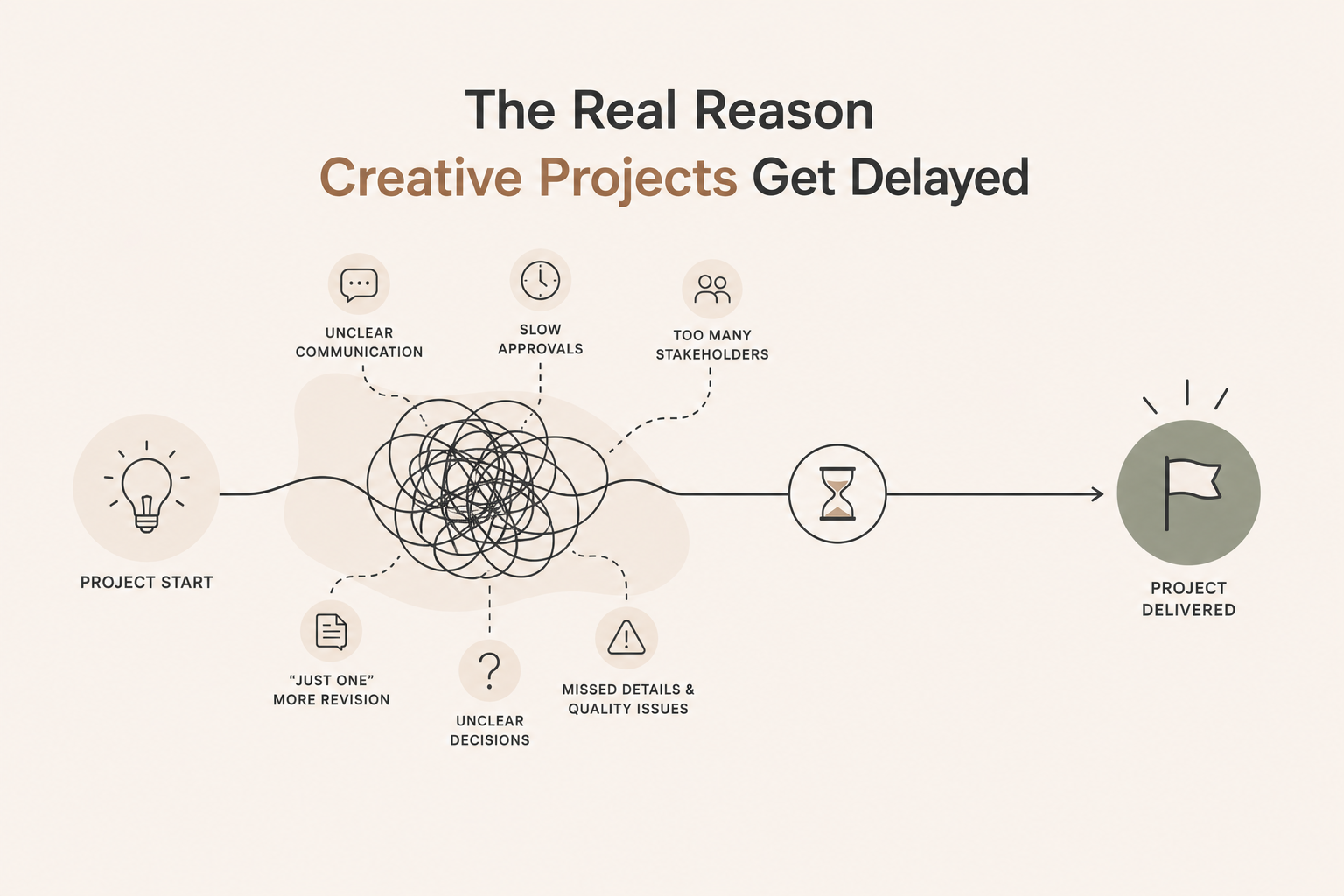
When a creative project misses a deadline, most people blame the obvious things.
The designer took too long.
The client responded late.
The workload was too high.
The timeline was unrealistic.
While these factors can contribute, they are rarely the true cause.
The real reason creative projects get delayed is usually much less visible.
It's not the work itself.
It's the workflow surrounding the work.
Creative projects don't fail because of a lack of creativity.
They fail because communication, approvals, feedback, quality control, and decision-making break down along the way.
The Myth That Creative Work Is the Bottleneck
Many agencies assume design production consumes most project time.
In reality, the actual creation phase is often only a fraction of the total timeline.
A typical project may involve:
Briefing
Research
Design
Internal reviews
Client reviews
Revisions
Approvals
Quality checks
Asset preparation
Delivery
Design work moves quickly.
The waiting often doesn't.
Projects frequently spend more time in review and approval queues than in active creation.
The Hidden Delays Nobody Tracks
The most damaging delays are rarely visible on project plans.
Waiting for Feedback
A design is submitted.
The team waits.
A day becomes three days.
Three days become a week.
The project appears active but no meaningful progress is occurring.
Waiting for Approvals
The work is complete.
The team is ready to proceed.
The client needs internal alignment.
Leadership is unavailable.
Stakeholders haven't reviewed the file.
The timeline stops moving.
Waiting for Decisions
Many projects don't suffer from a lack of work.
They suffer from a lack of decisions.
Without clear ownership, teams wait for guidance before taking action.
Why Communication Causes More Delays Than Design
Most project delays begin with communication issues.
Examples include:
Unclear briefs
Missing requirements
Undocumented decisions
Lost feedback
Contradictory instructions
A small misunderstanding early in a project often becomes a major delay later.
The cost of clarification increases as projects progress.
Revision Cycles Are Silent Timeline Killers
Every revision affects more than the design itself.
One revision can trigger:
Additional reviews
New stakeholder feedback
Updated approvals
Additional quality checks
New versions
What appears to be a simple change often expands into multiple workflow steps.
This is why revision loops are one of the largest contributors to project delays.
The Approval Bottleneck
Many agencies optimize production.
Few optimize approvals.
As projects move closer to completion:
Stakeholder involvement increases
Decision-making slows
Risk sensitivity grows
Projects often spend their final weeks waiting for approvals rather than producing work.
This is why a project can feel "almost done" for an unexpectedly long time.
The Problem With Too Many Stakeholders
More stakeholders rarely create faster decisions.
Instead, they create:
More opinions
More review rounds
More conflicting feedback
More approval layers
Without clear ownership, decision-making becomes fragmented.
The project slows.
Why Quality Issues Create Delays
Small errors create surprisingly large consequences.
Examples include:
Typography inconsistencies
Alignment issues
Missing assets
Incorrect dimensions
Outdated versions
When these issues are discovered late, projects often return to earlier workflow stages.
A mistake found during final review may require:
Corrections
Internal review
Client review
Re-approval
One error can create days of additional work.
The Cost of Operational Chaos
Many agencies underestimate how much operational inefficiency impacts delivery.
Common symptoms include:
Scattered Communication
Feedback spread across multiple platforms creates confusion.
Poor Visibility
Teams don't know:
What is pending
What is approved
What requires action
Version Confusion
People work on outdated files.
Changes are missed.
Errors increase.
Unclear Ownership
Nobody knows who is responsible for moving the project forward.
Why Creative Teams Blame Capacity
When deadlines slip, agencies often assume they need more people.
Sometimes they do.
But many delays occur even in fully staffed teams.
Adding designers doesn't solve:
Approval bottlenecks
Miscommunication
Revision loops
Workflow inefficiencies
More capacity cannot fix broken processes.
How High-Performing Agencies Deliver Faster
The most efficient agencies focus on workflow, not just output.
Structured Briefs
Clear project objectives reduce misunderstandings.
Centralized Feedback
All comments exist in one location.
This reduces confusion and accelerates reviews.
Defined Approval Processes
Stakeholders know:
What requires approval
Who approves
When decisions are needed
Quality Control Systems
Errors are caught before reaching clients.
This reduces rework and prevents timeline disruptions.
Workflow Visibility
Everyone understands project status at all times.
This improves accountability and reduces delays.
The Role of Creative Workflow Tools
Modern agencies increasingly rely on workflow and review platforms to improve delivery speed.
These systems help teams:
Manage feedback
Track approvals
Document decisions
Compare versions
Reduce communication friction
The goal isn't simply better organization.
The goal is eliminating the invisible delays that slow projects down.
Why Deadlines Are Usually a Process Problem
When projects miss deadlines, agencies often focus on symptoms.
The real issue is usually the process underneath.
Delayed projects are often the result of:
Poor communication
Slow approvals
Excessive revisions
Weak quality control
Lack of workflow visibility
Creative work is only one part of the equation.
Operations determine how efficiently that work moves from idea to delivery.
Conclusion
The real reason creative projects get delayed isn't usually creativity.
It's everything surrounding creativity.
Projects slow down because of unclear communication, fragmented feedback, approval bottlenecks, revision loops, and operational inefficiencies.
The agencies that consistently deliver on time aren't necessarily the fastest designers.
They're the teams with the strongest systems.
Because great creative work requires more than talent.
It requires workflows that allow talent to move forward without friction.
Frequently asked questions
1. What is the biggest reason creative projects get delayed?
The biggest cause is usually workflow inefficiency rather than design execution. Delays often stem from approvals, communication breakdowns, revision cycles, and unclear decision-making.
2. How do client approvals affect project timelines?
Client approvals are one of the most common bottlenecks in creative projects. Delayed reviews, multiple stakeholders, and unclear approval authority can significantly extend delivery timelines.
3. Why do revision cycles cause project delays?
Each revision often triggers additional reviews, approvals, quality checks, and stakeholder feedback. As revision rounds increase, project timelines expand exponentially.
4. How can agencies reduce project delays?
Agencies can reduce delays by centralizing feedback, defining approval workflows, improving quality control, documenting decisions, and creating better project visibility.
5. Do workflow tools help improve project delivery speed?
Yes. Creative workflow tools help teams manage reviews, approvals, revisions, and communication more efficiently, reducing bottlenecks and improving project timelines.