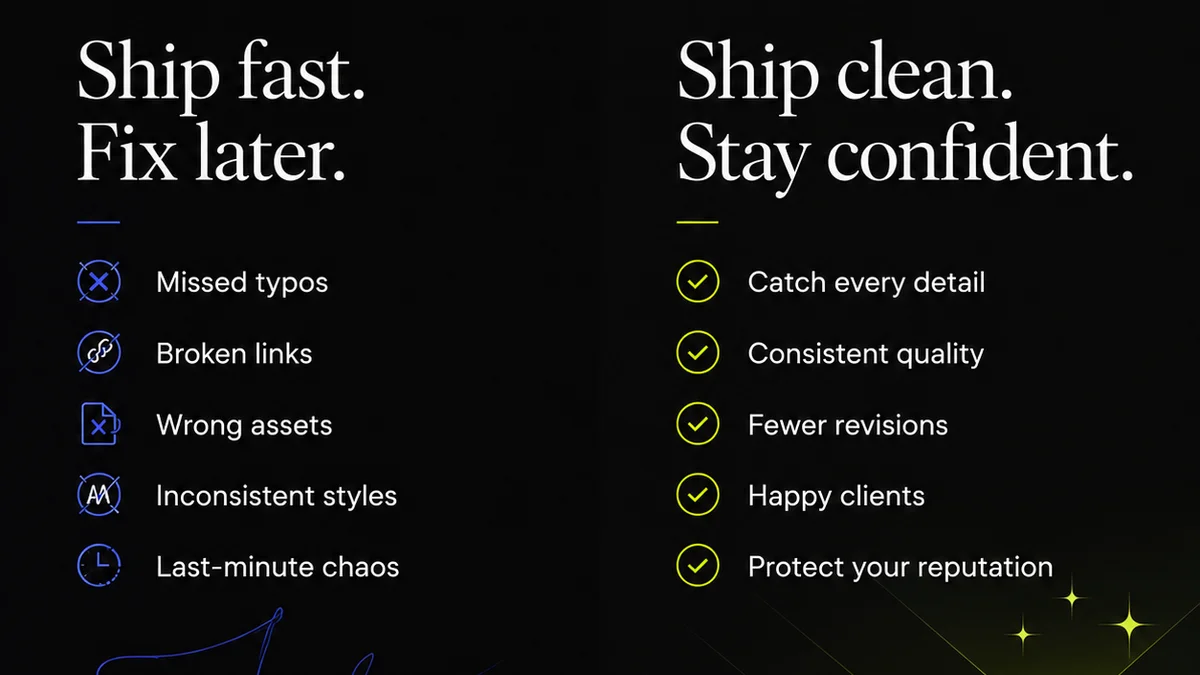
You’ve heard it a million times: “We need faster approvals.” Agency owners, creative directors, clients – everyone wants the wheels to turn quicker. It’s the siren song of efficiency.
And the common advice? Streamline communication. Use clearer briefs. Set tighter deadlines. None of that is wrong. But it’s incomplete.
The real hard truth is that simply shouting for speed is the fastest way to kill quality. True acceleration comes from fixing the *broken processes* that cause delays in the first place. It’s about building systems, not just demanding urgency.
1. The Bottleneck Isn't Always Who You Think
When a project stalls, the blame often falls on the client. They’re slow. They’re indecisive. They’re not giving clear feedback.
Sure, clients can be challenging. But if *every* project hits this wall, the problem isn't them. It's your internal workflow.
Where do things actually get stuck?
- Is feedback coming in late, after the team has moved on?
- Is feedback vague, requiring multiple rounds of clarification?
- Are revisions happening on the wrong version?
- Is the final sign-off buried under an avalanche of emails?
- Are multiple stakeholders giving conflicting notes?
Identifying the *real* choke points is step one. You can't fix what you don't understand.
2. Feedback: From Art to Science
Vague feedback is the enemy of speed and quality. “Make it pop.” “I don’t like it.” “Needs more energy.” This isn't feedback; it's noise.
The goal isn't just to *get* feedback, but to get *actionable* feedback.
Train Your Clients (Gently)
This sounds like a big ask, but it’s essential. You need to guide your clients toward providing useful input.
- Provide a clear feedback structure: Use a tool that allows for annotation directly on the asset. This pins comments to specific areas.
- Ask targeted questions: Instead of “What do you think?”, try “Does the headline clearly communicate X?” or “Is the call-to-action prominent enough?”
- Educate them on revision rounds: Explain that each round of feedback incurs time. Help them consolidate notes for fewer, more impactful rounds.
- Define “done”: What does final approval look like? Ensure everyone agrees on the criteria *before* the work begins.
When feedback is specific and tied to objectives, revisions are faster and more accurate. Less guesswork, fewer revisions.
3. The Myth of the “Quick Revision”
Clients often think a “small tweak” takes minutes. They don’t see the ripple effect.
A “quick change” might mean:
- Pulling the file from the archive.
- Opening the correct software and version.
- Making the change.
- Exporting a new version.
- Uploading the new version.
- Notifying stakeholders.
- Waiting for the next round of feedback.
This process, even for a minor change, can take hours and disrupt the team’s flow. A single “quick revision” can derail a day’s productivity.
Standardize Your Revision Process
Treat every revision request with a structured approach. This prevents scope creep and manages expectations.
- Establish revision limits: Clearly define how many rounds of revisions are included in the scope.
- Track all changes: Maintain a log of what was changed, when, and by whom. This provides accountability and a clear history.
- Centralize communication: Don't let feedback requests get lost in Slack or email chains. All feedback and decisions should live in one place.
By treating revisions as a defined process, you gain control. You stop the endless churn of small, disruptive changes.
4. Visibility is Key to Velocity
Projects slow down when people don’t know what’s happening. Is it with the client? With the designer? Stuck in legal?
Lack of visibility breeds impatience and assumptions.
When everyone can see the status of a project in real-time, things move more smoothly.
- Clear status updates: Everyone involved should know where the project is in the workflow at any given moment.
- Anticipate the next step: Knowing what’s coming up allows teams to prepare. Designers can start thinking about the next phase, account managers can prep client comms.
- Identify delays proactively: If a project has been sitting with one stakeholder for too long, it becomes visible. You can then intervene before it becomes a major issue.
Transparency builds trust and reduces the need for constant check-ins, freeing up valuable time.
5. Quality Checks: Not an Afterthought, but a Foundation
The fastest way to *increase* approval time is to skip quality checks. You push something out, the client finds errors, and you’re back to square one.
This isn’t efficiency; it’s recklessness.
Quality control needs to be baked into the process, not bolted on at the end.
Integrate Checks at Key Milestones
Think about where errors are most likely to occur and build checks there.
- Briefing review: Does the brief make sense? Are there ambiguities?
- Concept review: Does the initial concept meet the brief’s core objectives?
- Mid-production check: Is the execution on track? Are there technical issues?
- Pre-client review: A final internal sweep before it goes to the client.
These aren’t delays; they are guardrails. They prevent costly mistakes and ensure that what reaches the client is polished and professional.
Where Revue Fits In
All these workflow improvements – clear feedback, structured revisions, visibility, integrated quality checks – are incredibly difficult to manage with scattered communication tools.
Emails get lost. Slack threads become unmanageable. Files are buried in cloud storage. Feedback gets misinterpreted.
Revue is built to solve exactly these problems.
It centralizes client feedback, allowing for precise, contextual comments directly on your creative assets. Revision history is clear and accessible, so you always know where you stand. Stakeholders can see the project's progress in real-time, eliminating guesswork and reducing the need for endless status meetings.
By bringing feedback, revisions, and approvals into a single, streamlined platform, Revue helps you accelerate your workflow *without* sacrificing the quality that defines your agency's reputation.
Final Thought
Speed is seductive. But true efficiency isn't about rushing. It's about building robust systems that allow great work to move through your agency quickly and confidently.
Are you chasing speed, or are you building a system that naturally produces it?
Frequently asked questions
What's the biggest mistake agencies make when trying to speed up approvals?
The biggest mistake is focusing solely on pushing clients to respond faster without fixing the underlying workflow issues. This often leads to rushed decisions, vague feedback, and ultimately, lower quality work that requires more revisions, negating any time saved.
How can I get clearer feedback from clients?
Guide your clients by using tools that allow for contextual, annotated feedback directly on the asset. Ask specific, objective-driven questions rather than broad, subjective ones. Clearly define what 'done' looks like and establish the number of revision rounds included.
How do I manage revision rounds effectively?
Treat revisions as a defined process, not an endless cycle. Set clear limits on the number of revision rounds included in your scope. Maintain a detailed log of all changes made and ensure all communication and decisions are centralized to avoid misinterpretations.
Why is visibility important for approval speed?
Visibility ensures everyone involved knows the project's current status and what the next steps are. This proactive awareness reduces the need for constant status check-ins, prevents projects from languishing unnoticed, and allows teams to anticipate and prepare for upcoming tasks.