Everyone talks about quality. They talk about nailing the client brief, hitting the mark, delivering pixel-perfect work. That's all good. Necessary, even.
But it’s not the whole story.
The hard truth? Focusing solely on the *final output* as the measure of quality is a costly mistake. True quality management isn't about a flawless final product. It's about a flawless *process* that leads to that product.
And a flawless process is the fastest way to cut operational costs. Seriously.
1. The Hidden Cost of "Good Enough"
You think you're saving money by letting a few minor things slide? By not pushing back on that slightly off-brand color choice? By not doing a deep dive on the copy before sending it to legal?
You're not.
You're just deferring the cost. And interest accrues.
What looks like a small compromise now becomes a major rework later. Or worse, a client complaint that eats up billable hours in explanations and apologies.
The Real Price Tag of Rework
Think about a typical project lifecycle. A designer makes a change based on vague feedback. A copywriter tweaks a headline. A developer implements a feature.
If the underlying requirements or the feedback itself were flawed, that work is essentially wasted. It's not just the time spent on the flawed task; it's the time spent *correcting* it, the time spent *communicating* the correction, and the time lost on other tasks that could have been worked on.
This isn't about perfectionism. It's about efficiency. It's about ensuring that the effort your team expends is *productive* effort, not just busywork disguised as progress.
The cost of rework isn't just the hours. It's the morale hit. It's the missed deadlines. It's the potential for lost future business because the client's perception of your reliability has soured.
2. Quality Management Isn't Just QA
Most agencies treat Quality Assurance (QA) as a final gate. A last-minute check to catch the obvious errors before delivery.
That's like building a race car and only checking the tire pressure at the finish line.
Quality management needs to be baked into every stage. From the initial brief to the final sign-off.
Shifting from Reactive to Proactive
Reactive QA is expensive. It's a bottleneck. It's where you find problems that are often deeply embedded and costly to fix.
Proactive quality management means building quality checks into the workflow itself.
- Brief Scrutiny: Is the brief clear? Measurable? Achievable? Does it align with business goals?
- Concept Validation: Does the initial concept directly address the validated brief?
- Mid-point Reviews: Are we on track? Is the direction still correct?
- Feedback Loops: Is feedback specific, actionable, and constructive? Or vague and contradictory?
- Internal Reviews: Does the team have a process for self-correction before client-facing steps?
This isn't about adding more meetings. It's about integrating critical checkpoints so that issues are identified and resolved when they are cheapest and easiest to fix.
When you catch a misalignment in the brief, it costs minutes. When you catch it after the final design is approved and the client says, "This isn't what we wanted," it can cost days, even weeks, of rework and lost revenue.
3. Defining "Quality" Beyond Aesthetics
What does quality actually mean for your agency and your clients?
It's easy to fall into the trap of thinking quality is purely about the visual appeal or the cleverness of the copy.
But for a business, quality has to be functional. It has to be strategic.
The Strategic Alignment Imperative
Does the delivered work actually solve the client's business problem?
Does it meet the defined KPIs?
Is it technically sound and ready for implementation?
Is it on brand, on message, and on budget?
These are all facets of quality that go beyond the surface.
A beautiful design that doesn't convert is not high quality. A witty tagline that alienates the target audience is not high quality. A website that crashes on mobile is not high quality.
Your quality management process needs to assess all these dimensions. This requires clear criteria for success defined upfront, not after the fact.
When quality is defined broadly and managed proactively, you reduce the risk of delivering something that looks good but fails to perform. That's a direct cost saving – because you're delivering *value*, not just pretty pictures.
4. Streamlining Feedback for Clarity and Speed
Vague, contradictory, or delayed feedback is the silent killer of project profitability.
It’s the source of endless back-and-forth, missed revisions, and that sinking feeling when you realize you’re going in circles.
This isn't a client problem. It's a workflow problem.
The Feedback Black Hole
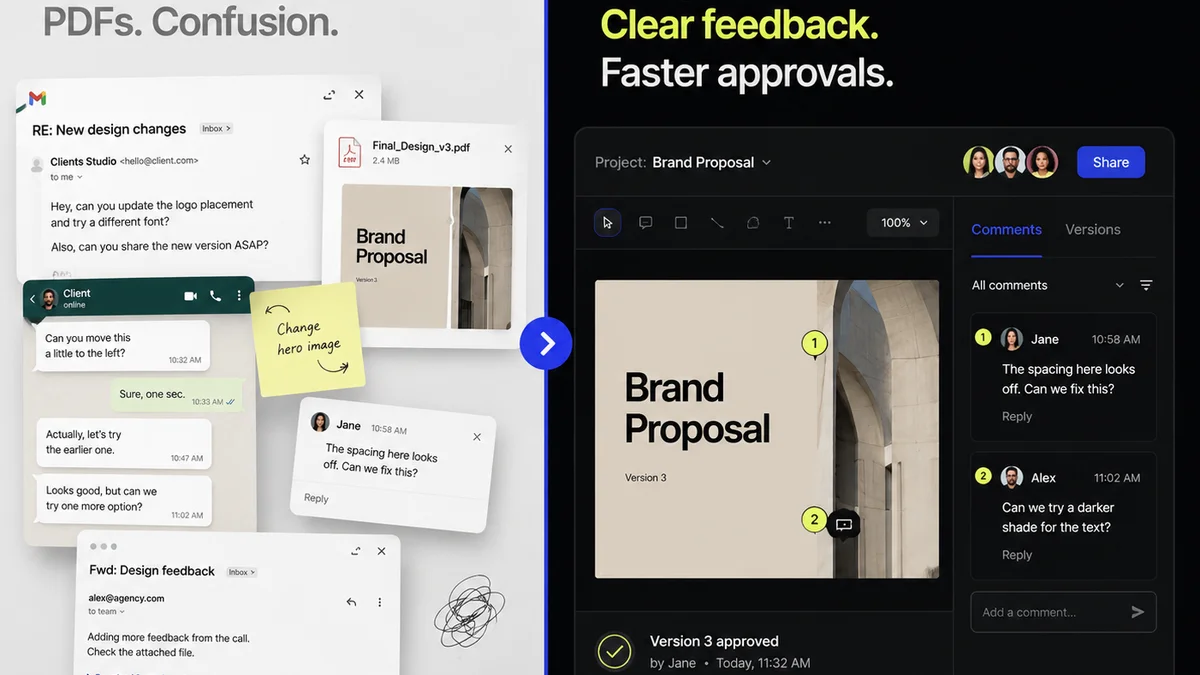
Imagine feedback arriving via a scattershot of emails, Slack messages, annotated PDFs, and verbal notes. How does anyone keep track?
How do you ensure the *right* feedback is acted upon? How do you track that it *has* been acted upon?
This ambiguity leads to:
- Missed revisions
- Incorrect revisions
- Scope creep disguised as feedback
- Wasted time trying to decipher notes
- Internal arguments about what the client *really* meant
- Delayed approvals
When feedback is centralized, contextual, and actionable, you cut down on misunderstandings. You speed up the revision cycle. You get to approvals faster.
This directly reduces the hours spent on a project, meaning higher profit margins. It also improves client relationships because the process feels smoother and more transparent for them.
5. Where Revue Fits In
Managing quality effectively, especially across multiple projects and clients, requires robust systems. Trying to wrangle feedback, revisions, and approvals through spreadsheets, email chains, and generic cloud storage is a recipe for inefficiency and errors.
Revue is built to tackle these exact challenges.
It provides a centralized hub for all creative assets and client feedback. Instead of chasing down comments across disparate platforms, you have a single source of truth.
Streamlining the Quality Control Process
- Centralized Feedback: All comments, annotations, and approvals live in one place, directly on the creative asset. No more deciphering scattered notes.
- Revision Management: Track every version of an asset, see what changed, and understand the context of each revision. This builds accountability and transparency.
- Clear Approval Workflows: Define who needs to approve what, and when. Get clear, documented sign-offs that prevent disputes later.
- Quality Checkpoints: Integrate your internal quality checks directly into the workflow. Ensure that briefs are validated, concepts are on track, and final assets meet defined criteria *before* they go to the client.
By bringing structure and clarity to the feedback and approval process, Revue helps agencies reduce the time lost to miscommunication and rework. This isn't about adding bureaucracy; it's about removing friction, which directly translates to lower operational costs and higher profitability.
6. Final Thought
Are you managing the *quality* of your creative output, or just the *output* itself?
The difference is where the real cost savings lie. It's in the operational discipline that ensures every hour spent is a productive hour, moving the project forward efficiently and effectively.
When you optimize your process for quality, you don't just deliver better work; you build a more profitable, less stressful business.
Frequently asked questions
What's the difference between QA and quality management?
QA (Quality Assurance) is typically a final check to catch errors before delivery. Quality management is a proactive, ongoing process integrated throughout the project lifecycle, from brief to final approval, aiming to prevent errors and ensure strategic alignment.
How does better quality management reduce costs?
It reduces costs by catching issues early when they are cheapest to fix, minimizing rework, cutting down on wasted billable hours due to miscommunication or scope creep, and preventing client complaints that consume time and resources.
Is focusing on quality management just about preventing mistakes?
No, it's also about ensuring the work strategically aligns with client goals and business objectives. A flawless-looking piece that doesn't perform or solve the client's problem isn't high quality. Proactive management ensures both aesthetic and functional quality.
How can I make client feedback more effective?
Centralize feedback in a single platform, ensure it's contextual (tied directly to the asset), and establish clear criteria for what constitutes actionable feedback. This reduces ambiguity and speeds up the revision process.