You've heard it a thousand times: scope creep kills projects. It eats budgets, tanks timelines, and leaves teams exhausted. Everyone agrees you need to stop it. You implement stricter change order processes. You demand more detailed SOWs. You try to nail down every single requirement upfront.
None of that is wrong. But it’s incomplete. It’s like putting a bigger fence around a problem you haven't actually solved.
The real hard truth? Scope creep isn’t a process problem. It’s a communication and visibility problem, dressed up in a process suit.
1. The Illusion of Control: Why Process Alone Fails
Agencies and in-house teams often believe that adding more layers of process will magically prevent scope creep. They create complex sign-off flows, lengthy documentation requirements, and rigid change request forms.
This approach treats scope creep like a rogue actor rather than a symptom.
Here’s the deeper reality:
- Misaligned Expectations: Processes don’t fix the fact that the client (or even internal stakeholders) might not fully grasp the implications of their requests, or the agency might not fully understand the client’s underlying needs.
- Fear of Saying No: A complex process can sometimes feel like an excuse *not* to have a difficult conversation. It’s easier to fill out a form than to push back on a client’s evolving vision.
- Lack of Transparency: If stakeholders can't easily see the current status, the original brief, or the impact of requested changes, they're more likely to make requests that *seem* minor but add up.
- Information Silos: Different team members have different pieces of the puzzle. Without a central hub, crucial context gets lost, leading to misinterpretations and scope drift.
You end up with a beautiful, intricate process that everyone follows, but the project still spirals. The paperwork is done, but the project is off the rails.
2. The Root Cause: Fuzzy Briefs and Vague Feedback
Scope creep often starts long before the first line of code is written or the first pixel is designed. It begins with the brief itself.
The Ambiguous Brief
Many briefs are more aspirational than actionable. They describe a desired outcome without clearly defining the scope, deliverables, or success metrics. This leaves too much room for interpretation.
- A client says, “We want to be the next Amazon.” What does that *actually* mean in terms of features, user base, and technical architecture for *this* project?
- “Improve user engagement.” How? By adding a social feed? Gamification? Personalized content?
- “Make it look modern and clean.” What specific design elements convey “modern and clean” to this particular client?
When the starting line is blurry, every step taken afterward can feel like a deviation.
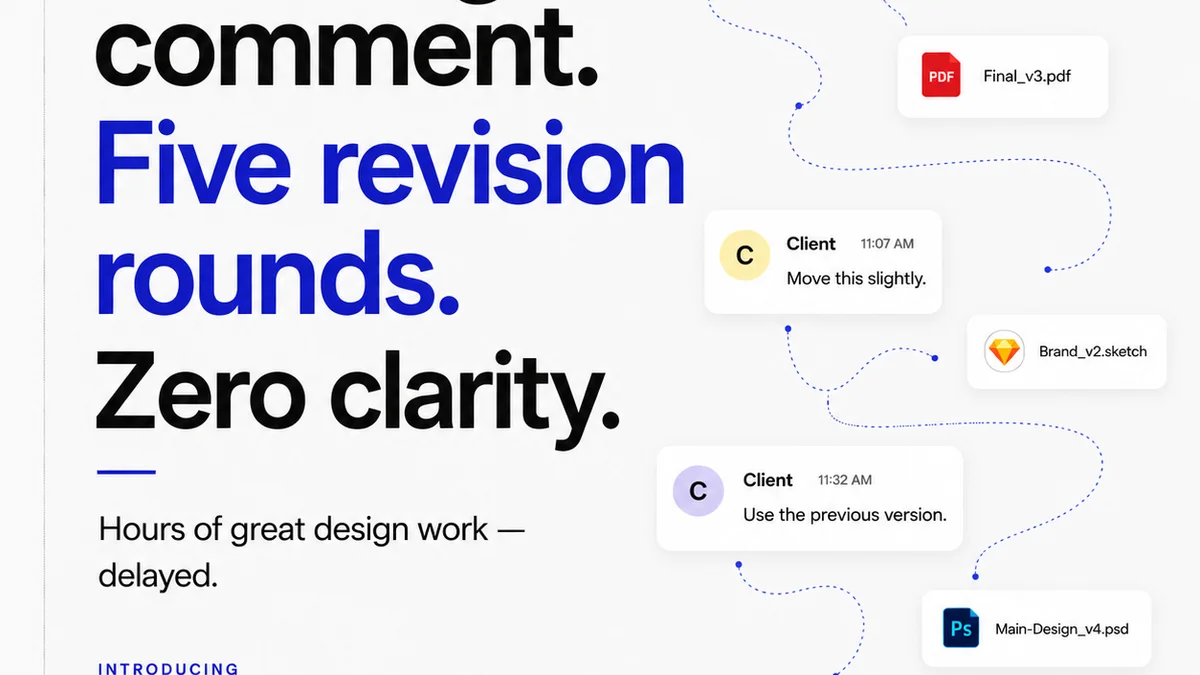
The Subjective Feedback Loop
Then comes the feedback phase. This is where scope creep truly takes hold if not managed correctly.
Feedback is often subjective, emotional, and contradictory.
Consider these classic examples:
- “I don’t like it.” (Without explaining why.)
- “Can you make it pop more?” (What does “pop” mean visually or functionally?)
- “Let’s try adding X.” (Without considering how X impacts Y and Z.)
- “My boss saw it and wants…” (A new request from an unbriefed stakeholder.)
- “Just a small tweak.” (That requires significant rework.)
Without a structured way to capture, interpret, and act on feedback, these small requests snowball. Each “small tweak” adds to the overall project scope, often without a corresponding adjustment to budget or timeline.
3. The Real Solution: Radical Clarity and Continuous Alignment
If process isn’t the answer, what is? It’s about fostering an environment of radical clarity and ensuring continuous alignment between your team and the client.
Nail the Brief, Then Reference It Constantly
The brief isn't just a document to get signed. It's the North Star.
- Define SPECIFIC deliverables. What exactly are you building or designing?
- Establish CLEAR success metrics. How will you know the project is successful?
- Document KEY assumptions. What are you assuming about the client’s input, existing systems, or market conditions?
- Identify OUT-OF-SCOPE items. Be explicit about what the project *is not* intended to cover.
This brief must be a living document, accessible to everyone involved. It should be the first point of reference whenever a new request or question arises.
Structure Feedback for Actionability
Transform subjective feedback into actionable tasks.
- Ask clarifying questions. “When you say ‘pop,’ what specific visual element are you imagining?”
- Connect feedback to objectives. “How does adding this feature help us achieve the goal of increasing conversion rates?”
- Quantify requests. If a change involves significant effort, frame it in terms of time and cost.
- Centralize all feedback. Don't let feedback live in scattered emails, Slack DMs, or meeting notes.
This requires a shift from simply *receiving* feedback to actively *managing* it.
Visibility is Key
Stakeholders need to see the impact of their decisions in real-time. When a requested change means more time or money, that should be immediately apparent, not buried in a change order form that’s only reviewed weeks later.
This transparency builds trust and encourages more thoughtful decision-making. It shifts the conversation from “Can we do this?” to “Should we do this, given the impact?”
4. Where Revue Fits In
This is where a tool like Revue becomes indispensable for agencies and in-house teams aiming to reduce scope creep.
Revue acts as that central hub for communication and visibility.
- Centralized Feedback: All client comments, annotations, and approvals live in one place, tied directly to the asset being reviewed. No more hunting through emails or Slack threads.
- Clear Revision History: Track every version, every comment, and every approval. This provides an irrefutable audit trail, making it easy to see how the project evolved and why.
- Streamlined Approvals: Formalize the sign-off process. Stakeholders know exactly what they are approving, and your team has clear confirmation. This reduces the chance of “I never approved that” later on.
- Visibility into Scope: By having all communication and revisions in one system, you gain a clear, real-time view of the project's scope as it stands. Any deviation from the original brief is immediately apparent.
Revue doesn't add more process for process's sake. It streamlines the essential communication and documentation steps, making it easier to maintain clarity and alignment.
5. The Human Element: Building Trust and Collaboration
Beyond tools and processes, managing scope creep is about managing relationships.
It requires building trust with your clients and stakeholders.
- Be a Partner, Not Just a Vendor: Offer strategic insights, not just execution. Help clients understand the *why* behind your recommendations.
- Communicate Proactively: Don't wait for problems to arise. Share updates, flag potential issues early, and manage expectations constantly.
- Educate Your Clients: Help them understand the implications of their requests on timeline, budget, and overall project goals.
- Foster Internal Alignment: Ensure your own team is on the same page, understanding the project scope and client needs.
When clients trust your expertise and feel like you're working collaboratively towards a shared goal, they are less likely to make arbitrary requests. They become partners in managing the scope.
Final Thought
Is scope creep an inevitable cost of doing business, or a sign of a breakdown in communication and transparency? The answer lies not in more rigid processes, but in cultivating radical clarity, fostering genuine collaboration, and leveraging tools that provide real-time visibility.
How are you ensuring clarity and alignment on your projects today?
Frequently asked questions
What is the biggest misconception about scope creep?
The biggest misconception is that scope creep is primarily a process problem. While processes are important, scope creep is often a symptom of deeper issues like unclear briefs, subjective feedback, and a lack of transparency. Focusing solely on adding more process without addressing these root causes is ineffective.
How can I get clearer briefs from clients?
To get clearer briefs, be explicit about what you need. Ask for specific deliverables, measurable success metrics, key assumptions, and clearly defined out-of-scope items. Don't be afraid to push back gently on vague requests and ask clarifying questions until you have a solid, actionable brief.
How do I handle subjective client feedback effectively?
Transform subjective feedback into actionable items by asking clarifying questions (e.g., 'What do you mean by 'pop'?'), connecting feedback to project objectives, and quantifying the impact of requested changes. Centralizing all feedback helps prevent misinterpretations and ensures everyone is working from the same information.
Can a tool really help reduce scope creep?
Yes, a tool like Revue can significantly help by providing a centralized platform for all project communication, feedback, and approvals. This increases transparency, creates an irrefutable audit trail, and makes it easier to manage expectations and see the real-time impact of any requested changes, thereby reducing scope creep.