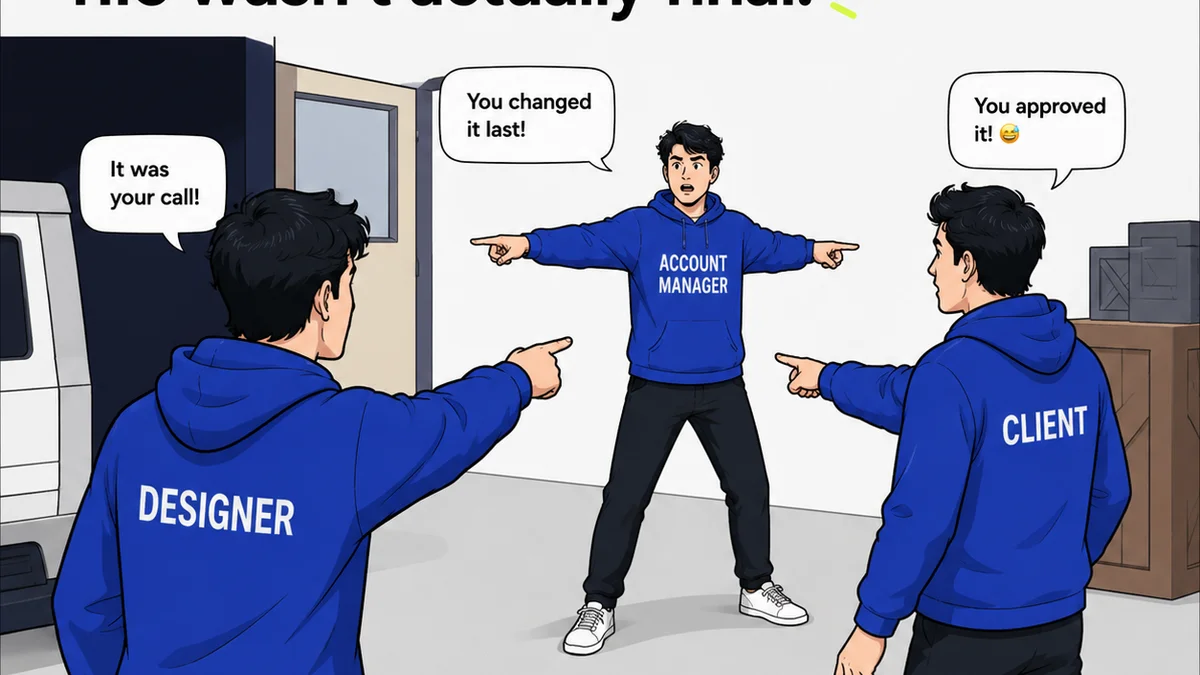
Everyone thinks scope creep is about saying 'yes' too often. That clients are just… unreasonable. That the solution is a more ironclad contract and a stern tone.
None of that is wrong. But it’s incomplete. It misses the real operational rot that lets scope creep fester.
The hard truth? Scope creep isn't just a client problem. It's an internal process problem. It’s a communication breakdown. It's a lack of clarity built into your project management from the start.
And it’s costing you.
1. The Illusion of 'Just a Small Change'
It starts innocently. A quick email: “Can you just move this button a little to the left?” Or, “Could we try a different shade of blue here?”
These seem like minor tweaks. Easy fixes. They don't feel like a deviation from the agreed-upon scope. But each one is a tiny crack.
The Time Sink
What feels like five minutes to the client can take an hour for your team. It’s not just the actual design work. It’s:
- Pulling the file.
- Making the change.
- Re-exporting.
- Uploading or sending the updated version.
- Getting new feedback on the change.
Multiply that by a dozen 'just a small change' requests across a project, and you’ve eaten hours. Hours that weren’t accounted for. Hours that erode your profit margin.
The Context Switch
Every time a designer or developer is pulled off their planned task to handle a 'small change,' their focus is broken. They lose momentum.
Getting back into the flow of the original task can take significant time. This context switching is a hidden productivity killer. It’s not just about the minutes spent on the new task; it’s about the lost time on the *old* task.
The Feature Creep Slippery Slope
A small change often leads to another. “While you’re there, could you also…”
Before you know it, a simple website redesign has morphed into a full-blown feature development project. The original brief is a distant memory.
2. Unclear Project Briefs and Goals
This is ground zero for scope creep. If the initial brief is vague, subjective, or incomplete, you’ve already lost.
Your team and the client are operating on different assumptions. What one person considers ‘done’ or ‘successful’ might be entirely different for another.
What Does 'Good Enough' Look Like?
A brief that says “make it look modern” is a disaster waiting to happen. Modern to whom? Modern how?
You need concrete deliverables and success metrics. What are the key performance indicators (KPIs) for this project? What specific outcomes are we aiming for?
The 'Discovery Phase' Misconception
Many agencies treat discovery as a formality. A quick meeting to jot down notes.
True discovery is about deep dives. It's about understanding the client's business, their audience, their competitors, and their *real* objectives. It’s about asking the hard questions *before* the creative work begins.
If your discovery process doesn't result in a crystal-clear, signed-off brief that defines success, you’re setting yourself up for trouble. This brief is your north star.
3. Poorly Defined Deliverables
What exactly are you delivering? A wireframe? A high-fidelity mockup? A fully coded website? A series of social media posts?
Be explicit. List every single asset, file type, and output. Use a clear, unambiguous language.
The 'And...' Trap
Clients often think in terms of 'and.' “We need the website, *and* we need the social media templates, *and* we need an email campaign.”
If these aren't explicitly called out and priced in the initial proposal and brief, they become scope creep.
File Formats and Revisions
Specify file formats (e.g., .AI, .EPS, .JPG, .PNG, .HTML, .CSS). Specify the number of revision rounds included for each deliverable. This manages expectations.
A deliverable that includes “source files” can be interpreted differently. Does that mean layered Photoshop files? Or just the final exported assets?
4. Ineffective Feedback and Approval Processes
This is where many agencies bleed time and money. Feedback is often:
- Vague: “I don’t like it.”
- Conflicting: Different stakeholders saying opposite things.
- Delayed: Holding up the project for days or weeks.
- Unstructured: A jumble of comments without clear ownership.
And approvals? They can be non-existent, informal (a Slack message), or buried in long email chains.
The 'Everyone Has an Opinion' Syndrome
Who is the final decision-maker? If multiple stakeholders are involved, their feedback can pull the project in different directions. This is a classic path to scope creep.
You need to identify the primary approver early on. All feedback should ideally funnel through them, or at least be validated by them.
Lack of Centralized Communication
Feedback scattered across emails, Slack, Google Docs, and phone calls is a recipe for disaster. It’s impossible to track changes, understand the full history, or ensure nothing gets missed.
This chaos makes it easy for small requests to slip through the cracks, disguised as 'minor adjustments' that everyone forgot were outside the original scope.
5. Weak Change Management
Even with the best intentions, some changes are inevitable. The key is how you manage them.
A formal change order process is crucial. It’s not about being difficult; it’s about professional project management.
The Change Order Process
When a request arises that is outside the original scope:
- Document the request clearly.
- Assess the impact on time and budget.
- Create a formal Change Order document outlining the new scope, cost, and timeline.
- Obtain written approval from the client *before* starting the work.
This process protects both you and the client. It ensures transparency and mutual agreement.
Skipping this step is where most agencies get burned.
Where Revue Fits In
Managing complex projects with multiple stakeholders and feedback loops is where operational clarity becomes paramount. Scope creep thrives in ambiguity.
Revue is built to bring that clarity.
By centralizing all client feedback, comments, and approvals in one place, you create a single source of truth. No more hunting through email threads or Slack channels.
When feedback is logged directly on the asset, it's contextual and specific. This drastically reduces the chances of misinterpretation or the 'just a small change' creep.
Revision history is automatically tracked. You can see exactly what changed, when, and by whom. This makes it easy to identify when a request is pushing beyond the agreed scope.
Formalizing approvals within Revue means you have a clear, auditable trail. This isn’t just good for preventing scope creep; it’s essential for protecting your agency when disputes arise.
Think of it as building guardrails for your projects. They keep things on track and prevent costly deviations.
6. The Hidden Costs of 'Good Enough'
Sometimes, to keep a project moving or a client happy, an agency might absorb the cost of scope creep. “It’s only a few hours,” they tell themselves.
But these 'few hours' add up. They impact your bottom line, your team's morale, and your ability to take on profitable new work.
Eroding Profitability
Every hour spent on unbilled work is a direct hit to your profit margin. If your margins are thin, absorbing even a small amount of scope creep can turn a profitable project into a loss-leader.
Team Burnout
Constantly working beyond the planned scope leads to burnout. Your team feels overworked, undervalued, and frustrated. They’re not being compensated for the extra effort, and their work-life balance suffers.
Strained Client Relationships
While the intention might be to keep the client happy, unchecked scope creep can lead to resentment on both sides. The client might feel nickel-and-dimed if you eventually try to bill for the extra work, or they might take your willingness to absorb costs for granted, expecting it on future projects.
7. Setting Boundaries from Day One
Prevention is far better than cure. It starts the moment you engage with a potential client.
Clear Proposals
Your proposals must be detailed. They should clearly outline:
- The project objectives.
- The specific scope of work.
- The deliverables.
- The number of revision rounds included.
- The pricing structure.
- The process for handling out-of-scope requests.
Don't be afraid to say 'no' to vague requirements or unrealistic expectations upfront.
Educate Your Clients
Many clients aren't fully aware of the complexities of creative production. They might not understand the time and resources involved in making 'small' changes.
Use your expertise to educate them. Explain the process, the impact of changes, and why sticking to the agreed scope is beneficial for everyone.
Internal Alignment
Ensure your entire team understands the scope, the processes, and the importance of managing scope creep. Regular internal check-ins and clear project documentation are key.
Final Thought
Scope creep isn't an act of malice by clients. It's a symptom of unclear communication, undefined processes, and a failure to establish boundaries.
Are you managing your projects, or are your projects managing you?
Frequently asked questions
What is scope creep in project management?
Scope creep refers to uncontrolled changes or continuous growth in a project's scope, often occurring after the project begins without proper adjustments to time, cost, or resources. In creative agencies, it typically involves clients requesting additional features, changes, or deliverables beyond what was originally agreed upon in the contract or brief.
How can I prevent scope creep from my clients?
Prevention starts with a detailed project brief and proposal, clearly defining objectives, deliverables, and what's included. Establish a formal change order process for any requests outside the original scope. Educate your clients on the impact of changes and maintain clear, centralized communication throughout the project.
What are the signs of scope creep?
Common signs include frequent 'small' requests that add up, changing requirements mid-project, new stakeholders demanding features, vague initial briefs, and a lack of a formal approval process. These often lead to project delays and budget overruns.
How does feedback management relate to scope creep?
Ineffective feedback management is a major contributor to scope creep. When feedback is unclear, conflicting, or unmanaged, it's easy for requests to expand beyond the original scope. Centralizing feedback and approvals helps maintain clarity and control.