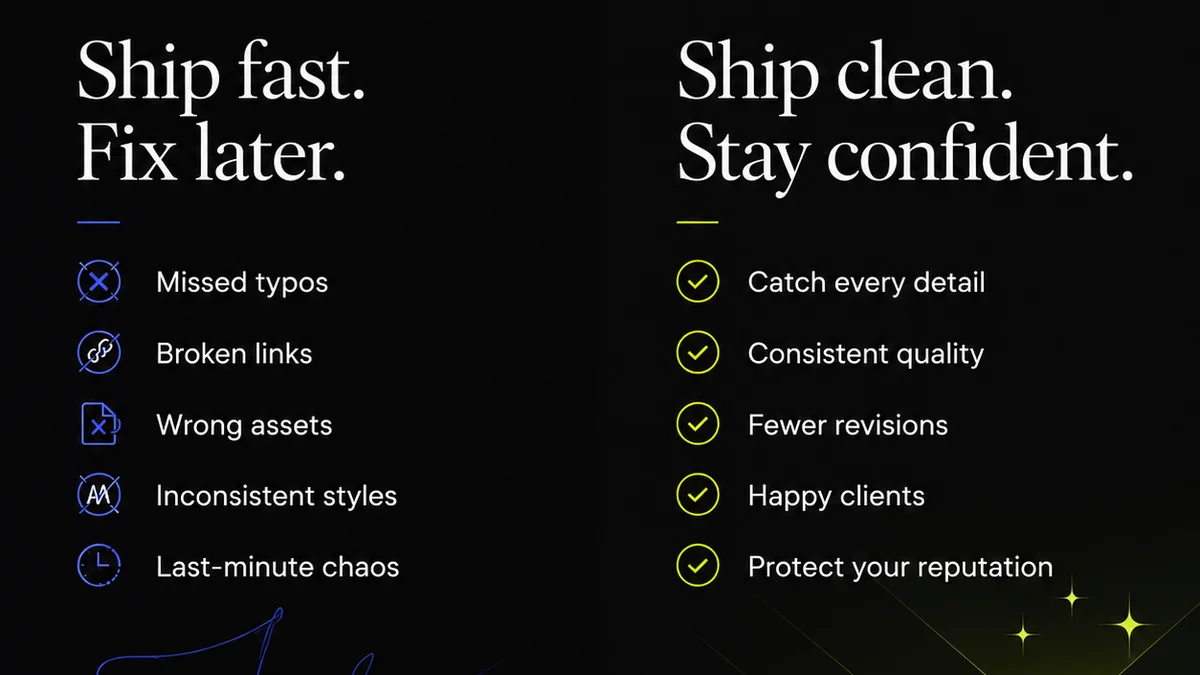
You think reviewing creative for brand accuracy is just about making sure the logo is the right color and the tagline is spelled correctly. It’s about checking the tiny details. The stuff nobody else notices.
None of that is wrong. But it’s incomplete. Way incomplete.
The hard truth is that brand accuracy in creative review isn’t a checklist. It’s a system. It’s about building a process that catches deviations before they ever reach the client, or worse, the public.
1. Defining "Brand Accuracy" Beyond the Surface
Most teams stop at the visual. Is the blue the right hex code? Is the font the one specified in the style guide? These are table stakes.
Brand accuracy is deeper. It’s about ensuring the creative feels right. It reflects the brand’s voice, its values, its strategic positioning. It’s not just about looking right; it’s about *being* right.
The Visual Layer
This is the obvious one. Every element must align:
- Logo usage (clear space, minimum size, correct variations)
- Color palettes (primary, secondary, accent, accessibility contrast)
- Typography (correct fonts, weights, leading, tracking, hierarchy)
- Imagery style (tone, subject matter, quality)
- Layout and composition (alignment, balance, grid adherence)
The Messaging Layer
This is where many reviews falter. Does the copy:
- Align with the brand voice (formal, casual, witty, serious)?
- Use approved terminology and avoid banned words?
- Reflect the brand’s core values and mission?
- Maintain a consistent tone across all touchpoints?
- Accurately represent product features and benefits?
The Strategic Layer
This is the highest level. Does the creative:
- Support the current marketing campaign objectives?
- Target the correct audience segment?
- Reinforce the brand’s unique selling proposition?
- Differentiate from competitors?
- Align with the overall brand strategy and positioning?
When you only focus on the visual, you miss the forest for the trees. You might approve a visually perfect ad that completely undermines the brand’s strategic goals.
2. The Cost of Inconsistent Review Processes
What happens when brand accuracy reviews are ad-hoc? Or worse, nonexistent?
Chaos. And it’s expensive.
Brand Dilution: Every off-brand asset is a small chip at your brand’s identity. Over time, these chips erode trust and recognition.
Client Dissatisfaction: Clients hire you for your expertise. Sending them work that doesn’t meet their brand standards is a failure to deliver. It damages the relationship.
Rework Hell: Discovering brand inaccuracies late in the game means costly revisions. This eats into your profit margins and delays project timelines.
Internal Confusion: When there’s no clear process, different team members will have different standards. This leads to subjective feedback and internal conflict.
Think about it: If your junior designer has a different understanding of brand voice than your senior art director, and neither is consistently checked against a defined standard, you’re setting yourself up for failure.
3. Building a Robust Brand Accuracy Review Framework
This isn’t about creating more bureaucracy. It’s about creating clarity and efficiency. It’s about making sure everyone is on the same page, every time.
Standardize Your Brand Guidelines
This sounds obvious, but how many agencies have outdated or incomplete brand guides? Ensure yours are:
- Comprehensive: Cover all the bases—visual, messaging, tone, strategy.
- Accessible: Easy for everyone on the team to find and reference.
- Up-to-date: Regularly reviewed and updated as the brand evolves.
- Actionable: Provide clear examples and do's/don'ts.
Develop a Brand Accuracy Checklist
This isn't meant to replace critical thinking, but to ensure fundamental checks are always performed. Tailor it to your client’s brand.
A good checklist should cover:
- Visual elements (logo, color, typography)
- Messaging consistency (voice, tone, key messages)
- Strategic alignment (audience, objective, USP)
- Legal and compliance requirements (disclaimers, PII)
- Technical specifications (file formats, resolution, bleed)
This checklist becomes the baseline. Anything that deviates requires a deeper discussion.
Assign Clear Reviewer Roles
Who is responsible for what? Don’t leave it to chance.
Different roles should have different focuses:
- Creative Lead: Overall brand feel, strategic alignment, creative quality.
- Copy Lead: Messaging, voice, tone, grammar, spelling.
- Design Lead: Visual elements, layout, technical specs.
- Account Manager: Client expectations, project scope, strategic objectives.
This tiered approach ensures multiple perspectives are applied, catching more potential issues.
Integrate Feedback Loops
How is feedback given and received? Is it clear, constructive, and actionable?
Ad-hoc email chains and scribbled notes on PDFs are a recipe for disaster. You need a system:
- Centralized Feedback: All comments in one place.
- Contextual Comments: Feedback tied directly to the asset.
- Version Control: Track changes and revisions easily.
- Clear Action Items: Who needs to do what by when.
4. Where Revue Fits In
This is where the operational truth bites. You can have the best guidelines and the most motivated team, but if your feedback and revision process is broken, your brand accuracy will suffer.
Revue is built to solve this. It provides a single source of truth for feedback on creative assets.
Centralized Client Feedback: No more hunting through email threads or Slack messages. All comments, approvals, and revisions live on the asset itself, within the context of the project.
Visible Revision History: Track every iteration. See exactly what changed, who requested it, and who approved it. This transparency is crucial for maintaining brand integrity and accountability.
Streamlined Approval Workflows: Define clear steps for review and approval. Ensure that brand accuracy checks are a mandatory part of the process, not an afterthought.
Quality Assurance at Scale: With all feedback and revisions in one place, conducting a final quality check for brand accuracy becomes significantly easier and more reliable.
It transforms a chaotic, subjective process into a structured, objective one. It ensures that the brand guidelines you spent so much time crafting are actually adhered to.
5. The Human Element: Training and Culture
Technology can only do so much. You need the right people, trained properly, and working within a culture that values brand integrity.
Continuous Training
Onboard new team members effectively. Regularly refresh existing team members on brand updates and best practices.
Make brand guideline reviews a regular part of team meetings.
Foster a Culture of Ownership
Every team member, from intern to CEO, should feel responsible for upholding brand standards. Encourage proactive identification of potential issues.
Celebrate when the team catches a significant brand deviation before it goes live.
Empower Junior Staff
Don’t assume junior team members aren’t capable of spotting brand issues. Provide them with the tools and training, and trust their eyes. Often, a fresh perspective is exactly what’s needed.
Leadership Buy-In
Brand accuracy starts at the top. If leadership treats it as a secondary concern, the rest of the team will too. Make it a strategic priority.
Final Thought
Is your brand review process a safety net or a sieve? If you’re still relying on gut feelings and last-minute checks, you’re letting critical brand elements slip through the cracks. True brand accuracy isn't about catching mistakes; it's about building a system so robust that mistakes rarely happen in the first place. What's one small change you can make to your review process today to tighten that net?
Frequently asked questions
What is the difference between visual accuracy and brand accuracy?
Visual accuracy focuses on whether specific design elements (like logo color or font) match the guidelines. Brand accuracy is broader, ensuring the creative also aligns with the brand's voice, tone, values, and strategic objectives.
How often should brand guidelines be updated?
Brand guidelines should be updated whenever there's a significant shift in the brand's strategy, messaging, or visual identity. At a minimum, they should be reviewed and confirmed as current at least annually.
Can junior team members effectively review for brand accuracy?
Yes, with proper training and clear guidelines, junior team members can be very effective. They often bring a fresh perspective that can catch deviations senior team members might overlook due to familiarity.
What are the biggest risks of poor brand accuracy in creative assets?
The biggest risks include brand dilution, loss of client trust, damage to brand reputation, costly rework, and internal confusion about brand standards.