Everyone says Frame.io is the gold standard for creative review. It’s the tool agencies and production houses swear by for getting video feedback. And that’s not wrong. Frame.io is excellent at what it does: streamlining video collaboration.
But if you’re thinking Frame.io is the only tool you need for client feedback, think again. It’s like using a sledgehammer to hang a picture frame. You might get it done, but you’re missing the nuance. And you’re likely creating more work for yourself down the line.
The hard truth? Most creative agencies need more than just a video review tool. They need a centralized system for ALL creative feedback, revisions, and approvals across every asset type. Video is just one piece of the puzzle.
1. The Video-Centric Bubble
Frame.io’s strength is its laser focus on video. It offers precise time-based commenting, version control specifically for video files, and integrations with video editing software like Adobe Premiere Pro and Final Cut Pro. This is invaluable for video production teams.
But what about the static assets? The website mockups, the banner ads, the social media graphics, the brand guidelines, the PDFs? Where do those live for client review?
Agencies often end up juggling multiple tools:
- Frame.io for video.
- Email for static image feedback.
- Slack for quick chats.
- Google Drive or Dropbox for file sharing.
- Project management tools for task tracking.
This fragmentation is a workflow killer. It leads to:
- Lost feedback in email chains.
- Version confusion with multiple file uploads.
- Lack of clarity on what’s been approved.
- Wasted time hunting for the latest version.
- Inconsistent client experiences.
Frame.io doesn’t solve this. It deepens the divide by focusing solely on one medium.
2. The Illusion of Centralization
Frame.io’s proponents might argue it centralizes *video* feedback. And they’re right. But creative agencies don’t work in a video-only vacuum. They produce a diverse range of assets for every client campaign.
Consider a typical campaign:
- Phase 1: Strategy & Branding (Mood boards, brand guides, logos)
- Phase 2: Creative Development (Website mockups, ad concepts, social graphics)
- Phase 3: Production (Video storyboards, animations, final video edits)
- Phase 4: Deployment & Iteration (Campaign banners, landing pages, social posts)
Trying to manage feedback for all these different stages and asset types across disparate tools is chaotic. It’s not centralization; it’s siloed efficiency.
The real need is a single source of truth for ALL creative work and feedback, regardless of file type.
3. Revision Management: Beyond Comments
Frame.io excels at annotation. You can pinpoint a moment in a video and leave a comment. This is precise and efficient for video edits.
But what about broader revision management? Tracking the lifecycle of an asset? Ensuring all stakeholders have signed off? Communicating changes clearly across the team and to the client?
This involves more than just comments. It requires:
- Clear status tracking (e.g., Pending Review, Approved, Needs Revision).
- Defined approval workflows.
- Audit trails of who approved what, and when.
- A centralized history of all feedback and changes for each asset.
Frame.io’s feature set doesn’t extend to this level of holistic project oversight for non-video assets. It’s a review tool, not a complete workflow management system.
4. The Cost of Specialization
Let’s talk about budget. Frame.io is a powerful, specialized tool. Its pricing reflects that specialization. For agencies working with multiple clients and diverse projects, layering Frame.io on top of existing tools can become expensive quickly.
You’re paying for deep video functionality you might not need for every project, while still needing other tools for everything else.
This leads to inflated software costs and complex vendor management. It’s inefficient from both a financial and operational standpoint.
Where Revue Fits In
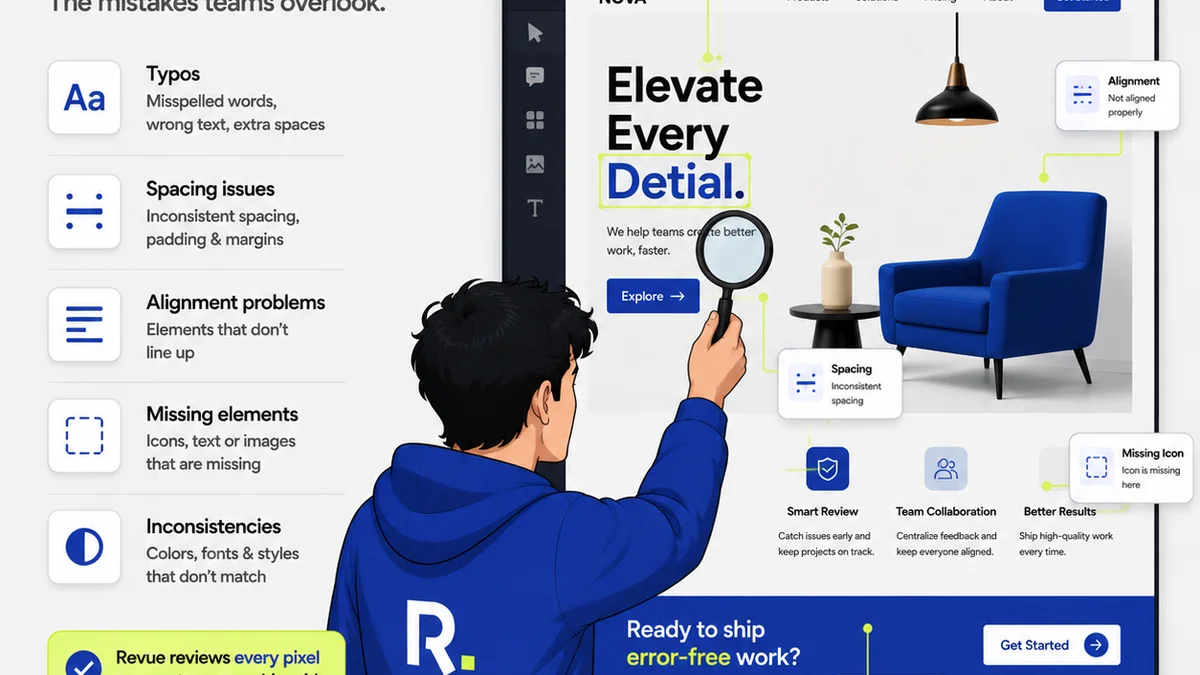
This is where Revue offers a different approach. It’s built from the ground up to be the central hub for ALL creative feedback and approvals, not just video.
Imagine this:
- Upload your video, your website mockup, your PDF report, your social graphic — all into one project.
- Clients can leave time-based comments on videos, just like Frame.io.
- They can also annotate static images, PDFs, and other documents directly within Revue.
- All feedback, no matter the asset type, is centralized and organized.
- Clear approval statuses and audit trails are visible for every single item.
- Your team has one place to manage revisions, track progress, and ensure quality.
Revue bridges the gap between specialized tools and the holistic needs of a modern creative agency. It eliminates the need to juggle multiple platforms for feedback, providing a unified experience for both your team and your clients.
It ensures that whether it's a 30-second spot or a 30-page deck, the feedback process is consistent, transparent, and efficient.
5. Quality Assurance: The Missing Link
A critical part of any creative workflow is quality assurance (QA). This goes beyond just client approval. It’s about ensuring the final output meets project requirements, brand standards, and technical specifications.
For video, this might mean checking resolution, audio levels, or color grading. For web, it’s cross-browser compatibility or accessibility. For print, it’s bleed, CMYK, or resolution.
Frame.io is not designed for this type of comprehensive QA. Its focus remains on client review and approval of the creative content itself.
A truly integrated workflow requires a space where QA checks can be documented, assigned, and resolved alongside client feedback. This ensures that the final deliverable is not just client-approved, but also agency-approved and technically sound.
6. Scalability and Client Experience
As agencies grow, managing feedback across numerous clients and projects becomes exponentially more complex. Relying on a patchwork of tools creates friction at every touchpoint.
Clients expect a seamless, professional experience. When they have to log into different platforms, navigate different interfaces, and remember different processes for different asset types, it degrades their perception of your agency’s efficiency.
A unified platform like Revue provides a consistent, branded experience. It simplifies the client’s role, making it easier for them to provide clear, actionable feedback. This leads to faster approvals and happier clients.
Frame.io, while excellent for video, adds another login, another interface, another process to the client’s already busy schedule. It doesn’t simplify the overall client experience; it adds another layer.
Final Thought
Frame.io is a powerful tool for video professionals. If your agency’s primary output is video and you need deep, video-specific collaboration features, it’s a strong contender. But is it the answer to your agency’s overall client feedback and revision management challenges?
For most creative agencies, the answer is likely no. The real challenge isn’t managing video feedback in isolation. It’s managing feedback across *all* creative assets, streamlining revisions, and ensuring clarity and accountability throughout the entire project lifecycle.
Are you optimizing your workflow for one specific asset type, or are you building a system that supports the full spectrum of your creative output?
Frequently asked questions
What is Frame.io best used for?
Frame.io is primarily designed for video collaboration and review. It excels at time-based commenting, version control for video files, and integrations with video editing software, making it ideal for video production teams.
Can Frame.io handle feedback for static assets like images or PDFs?
Frame.io's core functionality is centered around video. While it might offer some basic file upload capabilities, it is not optimized for detailed feedback, annotation, or version management of static assets like images, mockups, or documents.
What are the main drawbacks of using only a video review tool for an agency?
The main drawback is fragmentation. Agencies often end up using multiple tools for different asset types (video, static images, documents), leading to lost feedback, version confusion, inconsistent client experiences, and a lack of a single source of truth for all creative work.
How does Revue differ from Frame.io in terms of functionality?
Revue is a comprehensive creative workflow platform designed to centralize feedback and approvals for ALL asset types, including video, static images, PDFs, and more. Frame.io is specialized for video review, offering deep video-specific features but lacking broader asset management capabilities.
Is Revue a good alternative to Frame.io for agencies?
Revue can be a more holistic solution for agencies that handle a variety of creative assets beyond just video. If you need a single platform to manage feedback, revisions, and approvals across all your projects, Revue offers that comprehensive approach, whereas Frame.io is best for dedicated video workflows.