Everyone says you need a dedicated tool for creative feedback. That it’s the only way to streamline client reviews and get projects approved faster. None of that is wrong. But it’s incomplete.
The hard truth? Most creative feedback tools are glorified annotation apps. They let clients scribble on JPEGs. They let you chase down stray emails. They don’t actually solve the core problems of project management, revision tracking, and quality control.
Let’s look at GoVisually, a tool many agencies consider. It’s good at what it does: visual annotation. But what your agency *really* needs is a system that goes deeper.
1. The Assumption: Visual Annotation = Feedback Solved
GoVisually, like many others, excels at the visual layer. You upload a JPG, a PDF, a GIF. Clients can drop pins, add comments, and draw arrows. It feels immediate. It feels like progress.
But this is where the illusion breaks.
The Problem with Pin-Drop Feedback
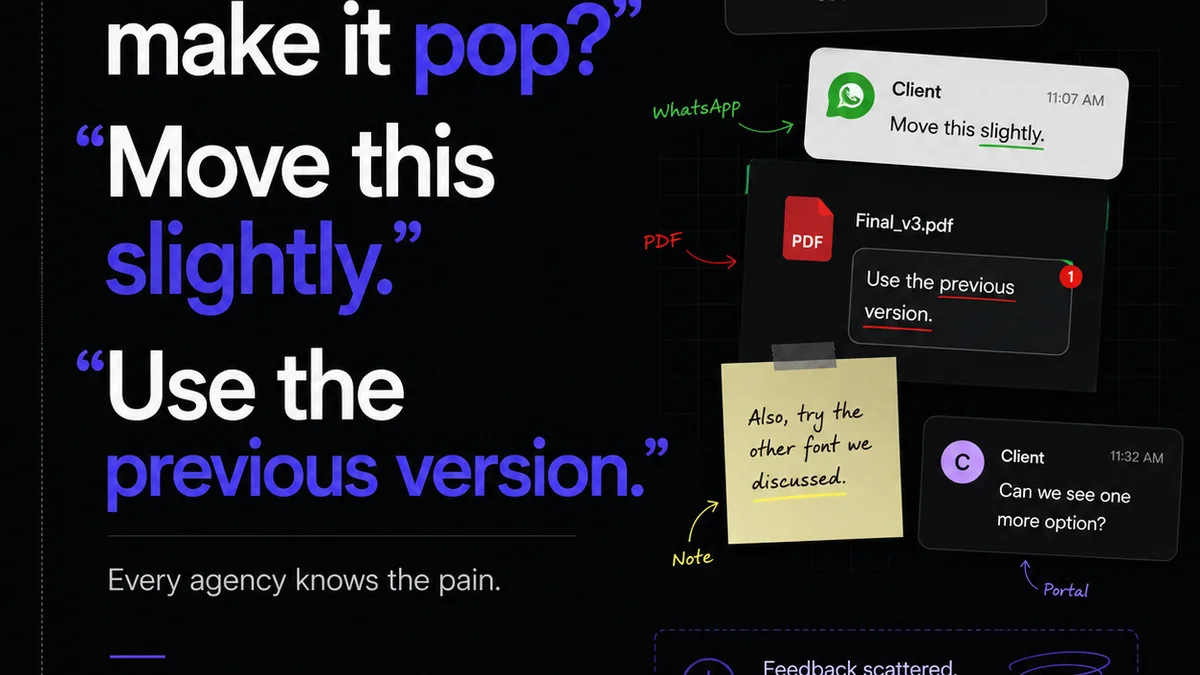
Visual annotation, by its nature, is fragmented. A client drops a pin on a logo. Another client emails a change request for the copy. A third leaves a voice note about the overall mood.
- Where do these disparate pieces of feedback live?
- How do you ensure every single comment is addressed?
- How do you track which version of the design responded to which specific comment?
This isn't a workflow; it's a digital scavenger hunt.
The Illusion of Control
GoVisually offers version control. You can upload new versions. This is essential. But it doesn’t inherently link the *new* feedback to the *previous* feedback.
You’re still manually comparing versions, trying to remember what changed and why. This is where revisions get missed. This is where scope creep disguised as 'minor tweaks' happens.
2. The Hard Truth: Feedback is a Process, Not a Pin
Creative feedback isn’t just about marking up pixels. It’s about context, communication, and clear decision-making. A tool that only handles the visual markup is like a hammer without a workbench.
Context Collapse
When feedback is scattered across annotation tools, emails, Slack messages, and Zoom calls, context is lost. Why was that specific change requested? What was the client’s original goal? Without this, revisions become arbitrary.
Your team spends more time deciphering feedback than executing it.
Revision Chaos
Agencies often juggle multiple rounds of revisions. Without a clear, centralized record of *all* feedback, *all* decisions, and *all* versions, chaos ensues.
- Did we address that layout change from Version 2?
- Was that copy tweak approved by the legal team?
- Is this the final, final, *final* version?
This uncertainty kills efficiency and strains client relationships.
The Bottleneck of Approval
Even with annotation tools, the final approval step can be murky. Was the client happy with the last set of changes? Is there a silent
Frequently asked questions
What are the main differences between Revue and GoVisually?
GoVisually primarily focuses on visual annotation, allowing clients to comment directly on images and PDFs. Revue, while offering annotation, is built as a broader project management platform designed for centralized feedback, revision tracking, and quality control across all creative assets and communication.
Is GoVisually good for agencies?
GoVisually is effective for visual markup and getting specific comments on design assets. However, agencies often find it insufficient on its own for managing the entire feedback and revision lifecycle, which requires more robust tracking and communication features.
Can Revue replace GoVisually?
Revue can replace the core functionality of GoVisually and much more. It centralizes visual feedback alongside other project communications, provides clear revision history, and integrates approval workflows, offering a more comprehensive solution for agency project management.
What makes a creative feedback tool effective for agencies?
An effective tool centralizes all feedback, provides clear version control linked to specific comments, streamlines the approval process, and offers visibility into the revision history. It should reduce ambiguity and save time, not create more communication silos.