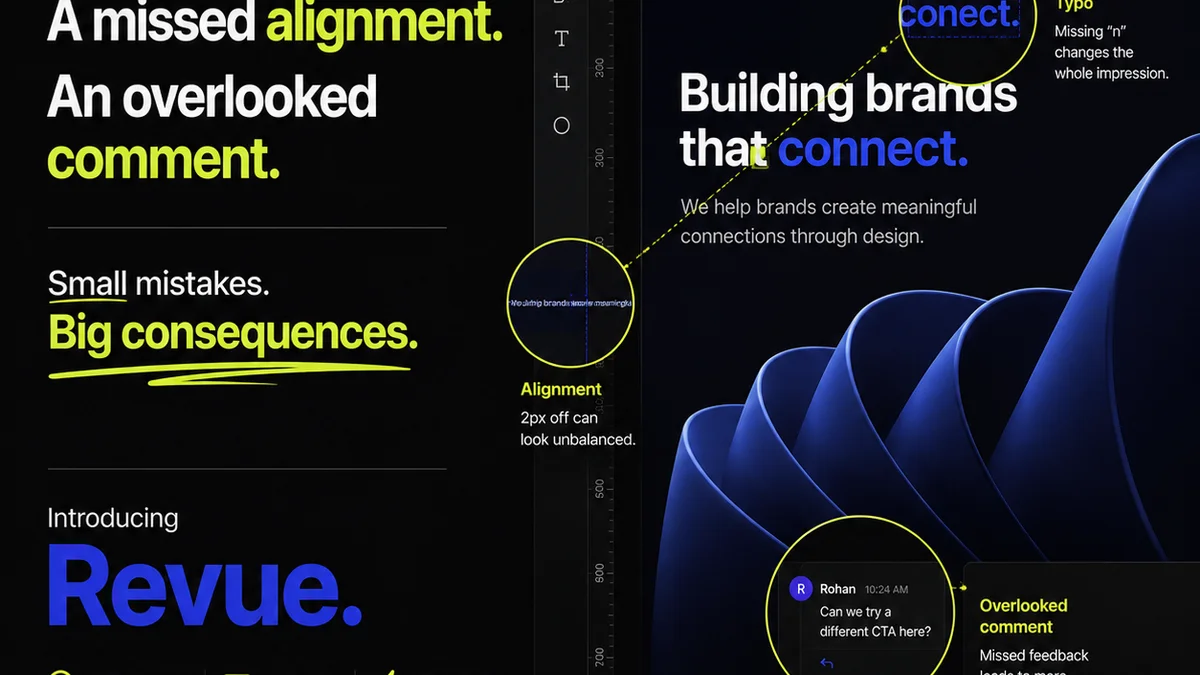
You're looking at creative review software. Maybe you've landed on Revue and Ziflow. Everyone tells you to compare features: annotation tools, version control, user roles. None of that is wrong. But it’s incomplete.
The real difference isn't the checkboxes. It's how the tool actually fits into your agency's messy, beautiful reality of client feedback, revisions, and approvals.
1. The Assumption: Features Define Value
It's easy to fall into the feature comparison trap. You see a list of features for Revue and Ziflow, and you start ticking boxes. Does it have real-time commenting? Can it handle video? What about different user permissions?
This approach is logical. It’s how you'd buy a car or a laptop. But agencies aren't like that.
Your agency’s workflow is unique. It’s a living, breathing thing shaped by client demands, team dynamics, and project types. A feature is only valuable if it solves a real problem in *your* workflow, not just a theoretical one.
2. The Hard Truth: Workflow Integration is King
The best creative review tool isn't the one with the most features. It's the one that disappears into your process. It speeds things up, reduces friction, and makes your team's life easier.
This means looking beyond the UI and asking harder questions:
- Does this tool force us to change how we work, or does it adapt to us?
- How much setup time is involved? Can a new project manager pick it up in an hour?
- Does it create more bottlenecks or eliminate them?
- Will clients actually use it without extensive training?
- How does it integrate with our existing tech stack (e.g., project management, file storage)?
This is where the real value of a tool like Revue or Ziflow is unlocked. Or where it’s lost.
3. Feature Deep Dive: Annotation & Feedback
This is the core of any review tool. How does your team and your client provide feedback?
Revue's Approach
Revue focuses on clear, actionable feedback. It allows for contextual comments directly on the creative asset. Think of it as a digital whiteboard, but smarter.
Key aspects include:
- Point-based annotations: Pin comments directly to specific areas of an image or PDF.
- Version comparison: Easily see what’s changed between revisions.
- Consolidated feedback: All comments are in one place, reducing the need to hunt through emails.
Ziflow's Approach
Ziflow also offers robust annotation features, aiming for comprehensive review capabilities.
Their strengths lie in:
- Advanced annotation options: Tools for drawing, shapes, and more, beyond simple text comments.
- Team-specific workflows: Tailoring the review process for different internal teams.
- Guest reviewer access: Allowing external stakeholders to comment without full account access.
The Workflow Question: Does the tool's annotation style match how your clients prefer to give feedback? Do they need a simple text box, or do they want to draw on the screen? How much training will they need?
4. Feature Deep Dive: Revision Management & Approvals
Getting to 'final' is the goal. How does each tool help you manage that journey?
Revue's Workflow
Revue streamlines the path to approval by making the feedback loop visible and manageable.
- Clear revision history: Every version is tracked, so you know exactly what was reviewed when.
- Approval status tracking: See at a glance which assets are approved, pending, or rejected.
- Automated notifications: Keep everyone in the loop when new feedback or versions are ready.
Ziflow's Workflow
Ziflow provides tools to manage the entire lifecycle from initial review to final sign-off.
- Customizable approval workflows: Set up multi-stage approval processes.
- Audit trails: Detailed logs of who did what and when, crucial for accountability.
- Integration with DAMs: Connecting to Digital Asset Management systems for seamless file handling.
The Workflow Question: How complex are your approval processes? Do you need a simple 'yes/no' or a multi-step sign-off from legal, marketing, and the client? How does the tool's approval mechanism integrate with your project management system?
5. Feature Deep Dive: User Experience & Client Adoption
A tool is only as good as its users. If your clients hate using it, it’s a failure.
Revue's User Focus
Revue is designed with simplicity in mind, aiming for quick adoption by both internal teams and external clients.
- Intuitive interface: Minimal learning curve for new users.
- Familiar interaction patterns: Feels like other modern web applications.
Ziflow's User Experience
Ziflow offers a feature-rich experience that can be powerful but may require more onboarding.
- Comprehensive feature set: Can be overwhelming initially but offers deep control.
- Role-based permissions: Granular control over what different users can see and do.
The Workflow Question: How tech-savvy are your clients? Are they likely to embrace a new tool, or will they resist? How much time can you afford to spend training clients on a new platform?
6. Feature Deep Dive: Integrations & Scalability
No tool exists in a vacuum. How does it play with the rest of your tech stack?
Revue's Connectivity
Revue focuses on core review functionality, integrating where it matters most for creative workflows.
- API access: For custom integrations if needed.
- Standard file support: Works with common creative file types.
Ziflow's Ecosystem
Ziflow often emphasizes broader integration capabilities, connecting to a wider range of business tools.
- Project management integrations: Connecting with tools like Asana, Jira, etc.
- Cloud storage integrations: Linking with Google Drive, Dropbox, etc.
- Enterprise-level features: Designed to scale for larger organizations with complex needs.
The Workflow Question: What tools do you rely on daily? Does the review platform need to talk to your PM tool, your DAM, your Slack channels? Or is standalone functionality sufficient?
7. Where Revue Fits In
Revue is built for creative agencies and in-house teams who need a centralized hub for feedback and approvals. It cuts through the noise of endless email threads and scattered Slack messages.
Think of it as your agency’s dedicated quality control station. It’s where client feedback is collected, organized, and acted upon, ensuring revisions are tracked and approvals are clear.
The goal is to reduce the friction in the creative process, giving you back time to focus on what you do best: creating great work.
8. Final Thought
Comparing Revue and Ziflow feature-for-feature is a starting point, not an end goal. The real decision hinges on how each tool understands and supports the intricate dance of your agency's daily operations.
Does the tool empower your team and delight your clients, or does it become another hurdle to overcome?
Frequently asked questions
What is the main difference between Revue and Ziflow?
While both offer creative review and approval features, the key difference lies in their approach to workflow integration. Revue prioritizes a streamlined, intuitive experience for quick adoption and feedback, while Ziflow offers a more extensive feature set aimed at complex, multi-stage approval processes and broader system integrations.
Which tool is better for client feedback?
Revue is often favored for client feedback due to its user-friendly interface, which requires minimal onboarding for clients. Ziflow can also handle client feedback effectively but may involve a steeper learning curve depending on the client's technical proficiency and the complexity of the setup.
How do these tools handle version control?
Both Revue and Ziflow provide version control, allowing you to upload new iterations of a creative asset. They enable clear comparison between versions and track feedback specific to each revision, ensuring you can always refer back to previous stages.
Can these tools integrate with other project management software?
Ziflow generally offers more extensive integration capabilities with popular project management tools like Asana and Jira. Revue focuses on core review functionalities, but may offer API access for custom integrations depending on your specific needs.
What if my agency has a very specific approval process?
For highly complex, multi-stage approval processes, Ziflow's customizable workflow features might be a better fit. Revue is designed for clarity and efficiency, suitable for agencies with more straightforward or iterative approval cycles.