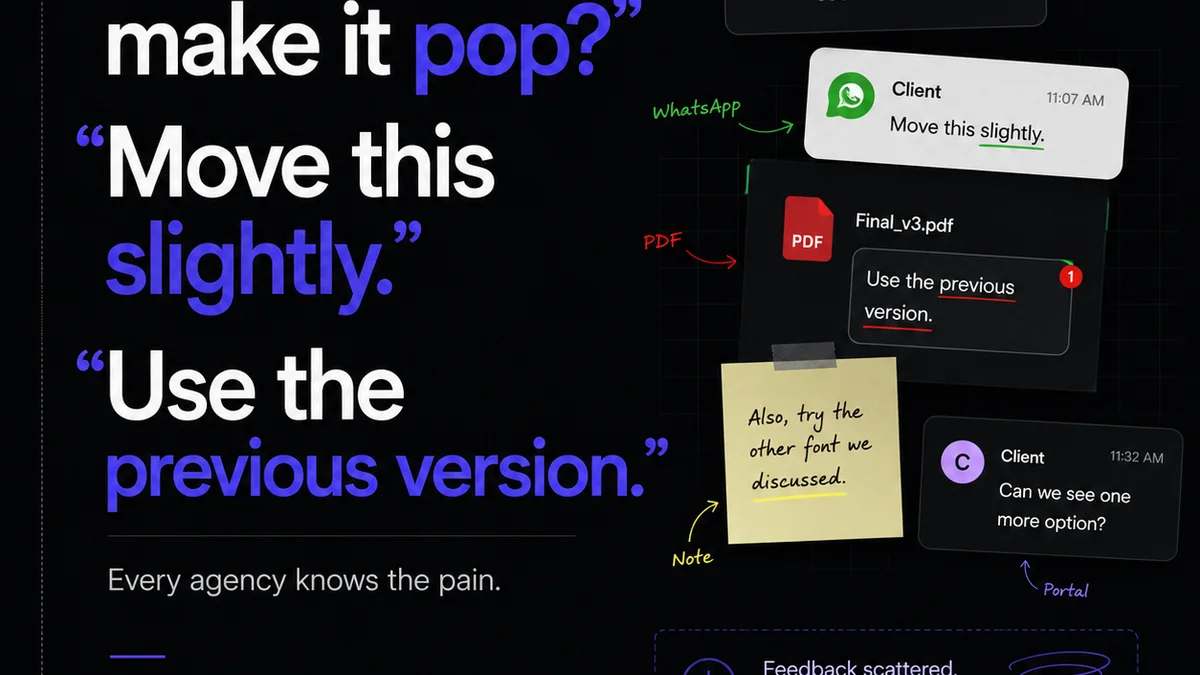
Everyone talks about quality. Good work. Happy clients. Repeat business. None of that is wrong. But it’s incomplete. Simply aiming for “high quality” is a fuzzy target. It’s a feeling, not a metric. And if you can’t measure it, you can’t truly manage it. Or prove its value.
The hard truth? Quality management isn’t just a nice-to-have for creative agencies; it’s a direct driver of profit and sustainability. But you need to move beyond subjective assessments and track tangible outcomes.
1. The Hidden Costs of Poor Quality
What does “bad quality” actually cost your agency? It’s more than just a grumpy client email. Think about the ripple effect.
Poor quality manifests in obvious ways:
- Scope creep driven by endless revisions.
- Client churn due to dissatisfaction.
- Damaged agency reputation.
- Missed deadlines impacting cash flow.
But the hidden costs are often worse. They eat away at your team’s time and morale.
Consider these internal drains:
- Wasted designer hours on rework.
- Project manager burnout from managing chaos.
- Internal friction between teams (e.g., creative vs. account management).
- Lost opportunities because your team is bogged down fixing mistakes.
- The sheer mental overhead of dealing with preventable issues.
These aren't just line items; they are profit leaks. Every hour spent fixing a quality failure is an hour not spent on billable work, new business, or team development.
2. Defining and Measuring Quality in Creative Work
If quality is the goal, what does it look like in practice? It’s not just about aesthetics. It's about meeting objectives, on time, on budget, and with clear communication.
You need to define what quality means for your agency and your clients. This involves setting clear expectations upfront.
Key Quality Indicators (KQIs)
Think about what you can actually track. These aren't always complex. They just need to be consistent.
- Client Satisfaction Scores: Post-project surveys are standard, but dig deeper. Ask specific questions about the process, not just the final output.
- Revision Cycles: Track the number of rounds of feedback and revisions required per project phase or deliverable. An increase might signal quality issues early on.
- Error Rate: How often do deliverables go live with errors (typos, broken links, design inconsistencies)? Track these post-launch.
- Scope Creep vs. Necessary Changes: Differentiate between client requests that expand the project scope and those that are necessary to correct quality oversights.
- Team Time Allocation: Monitor how much time is spent on initial creation versus rework or fixing errors.
- On-Time Delivery Rate: While influenced by many factors, consistent delays can point to underlying quality control breakdowns.
These KQIs provide objective data points. They turn subjective feelings about quality into measurable performance indicators.
3. The Direct Link: Quality Management to Profitability
How does actively managing quality translate directly into more profit? It’s about efficiency and value.
Efficient processes fueled by quality control reduce wasted time and resources. This means higher profit margins on existing projects.
When clients experience consistent quality and a smooth process, they are more likely to:
- Provide positive testimonials and case studies.
- Refer new business.
- Increase their spend with your agency.
This reduces your client acquisition cost (CAC) and increases customer lifetime value (CLTV). These are fundamental drivers of agency profitability.
Furthermore, a reputation for reliable quality allows you to command premium pricing. Clients pay for certainty and results, not just creative output.
4. Implementing a Quality Management Framework
A formal quality management system (QMS) isn't just for manufacturing. It’s essential for service-based businesses like agencies.
Key components include:
- Standard Operating Procedures (SOPs): Document clear processes for everything from briefing and concepting to final delivery and archiving.
- Checklists: Use detailed checklists for critical project stages (e.g., creative brief review, pre-launch QA).
- Feedback Loops: Establish structured ways to gather and act on both client and internal feedback.
- Training: Ensure your team understands quality standards and their role in maintaining them.
- Post-Mortems: Conduct regular project reviews to identify what went well and what could be improved regarding quality.
This structured approach reduces reliance on individual heroics and builds a consistent, reliable delivery engine.
The Role of Technology
Manual tracking is a recipe for missed data and inconsistency. Leveraging the right tools is crucial for effective quality management.
Software can automate tracking, streamline communication, and provide centralized visibility into project health. This allows teams to identify potential quality issues before they escalate.
Where Revue Fits In
Revue is built to support a robust quality management process. It addresses the core challenges of centralized feedback, clear approvals, and visibility into the revision process.
Centralized Feedback: Instead of chasing scattered emails and Slack messages, all client feedback lives in one place. This reduces misinterpretations and ensures all comments are captured. Clear, contextual feedback is the first step in ensuring quality.
Revision Management: Track every version of a creative asset. See exactly what changed between iterations and who approved what. This creates an undeniable audit trail, crucial for accountability and identifying where quality might have slipped.
Visibility and Approvals: Streamline the approval workflow. When everyone knows the status of a deliverable and can approve it efficiently, you reduce bottlenecks that can compromise quality under pressure.
By providing a single source of truth for creative assets and client feedback, Revue helps agencies maintain a higher standard of quality, reducing rework and improving client satisfaction.
5. Calculating the ROI
Now, let’s tie it all together. How do you calculate the ROI of your quality management efforts?
The formula is straightforward:
ROI = (Gain from Investment - Cost of Investment) / Cost of Investment
Gain from Investment: This is where your KQIs come in. Quantify the improvements:
- Reduced hours spent on rework (calculate saved billable hours).
- Increased project profitability due to less scope creep.
- Value of new business generated from improved reputation and referrals.
- Reduced client churn (calculate the value of retained clients).
- Potential for premium pricing.
Cost of Investment: This includes:
- Software costs (like Revue).
- Time spent developing SOPs and training.
- Time spent on quality reviews and post-mortems.
Start by tracking the costs of *poor* quality. Then, measure the reduction in those costs after implementing your QMS. The difference is your ROI.
For example, if you reduce rework hours by 10 hours per week, and those hours are worth $150 each, that’s a $1500 weekly saving. If your QMS tools and process development cost $1000 per month, your ROI is clearly positive and significant.
Final Thought
Quality management isn't about adding bureaucracy. It’s about building a more resilient, profitable, and predictable agency. It’s about transforming a subjective aspiration into a measurable, strategic advantage. Are you actively measuring the impact of quality on your agency’s bottom line, or are you leaving profit on the table?
Frequently asked questions
What are the key benefits of measuring quality management ROI?
Measuring quality management ROI helps agencies justify investments in process improvements, identify areas of waste, demonstrate the financial impact of quality initiatives, and make data-driven decisions to enhance profitability and client satisfaction.
How can I calculate the cost of poor quality in my agency?
You can calculate the cost of poor quality by tracking expenses related to rework, scope creep, client complaints, project delays, missed deadlines, and lost client business due to dissatisfaction. Quantify the time and financial resources spent addressing these issues.
What are some Key Quality Indicators (KQIs) for creative agencies?
Key Quality Indicators can include client satisfaction scores, number of revision cycles, error rates in deliverables, on-time delivery rates, scope creep vs. necessary changes, and team time allocation between creation and rework.
How does technology like Revue help with quality management?
Tools like Revue centralize feedback, manage revisions with clear audit trails, and streamline approvals. This reduces miscommunication, ensures all feedback is captured, minimizes errors, and provides visibility into project status, all contributing to better quality control.