Everyone wants to scale their creative agency. More clients, more revenue, more impact. It’s the natural progression. You might assume scaling means hiring a bigger team, taking on more projects, and maybe even opening a swanky new office.
None of that is wrong. But it’s incomplete.
The hard truth about scaling a creative agency is that it's less about *more* and more about *better systems*. Without robust operational frameworks, growth becomes chaos. Client expectations go unmet. Margins shrink. Your team burns out.
1. The Myth of the 'Hustle' Scalability
Many agencies believe their success is tied to individual talent and relentless effort – the 'hustle' culture. This works when you're small. One or two key people can juggle everything.
But try scaling that.
Suddenly, your star designers are bogged down in project management. Your account managers are chasing down feedback. Your founder is still approving every single pixel.
This isn't scalable. It's a bottleneck.
The Bottleneck Effect
When your agency relies on the constant, heroic efforts of a few, you hit a ceiling.
- Projects get delayed because key people are overloaded.
- Quality suffers because people are rushed or spread too thin.
- New business is hampered because existing projects aren't running smoothly.
- Your best people start looking for less stressful environments.
Scaling requires shifting from individual output to systemic efficiency.
2. Standardize Your Workflow, Not Your Creativity
Creativity is inherently messy. But the *process* that supports creativity doesn't have to be.
Think about your core services: client onboarding, brief interpretation, design iteration, client review, final delivery.
Where are the friction points? Where does information get lost? Where are approvals held up?
Standardizing these processes creates predictability. It allows you to onboard new clients and new team members faster. It ensures a consistent level of quality.
Onboarding and Briefing
A clear, repeatable onboarding process is crucial. This includes standardized intake forms, kickoff meeting agendas, and client questionnaires.
A well-defined brief template ensures you capture all necessary information upfront, reducing ambiguity and the need for endless clarification.
Design and Revision Cycles
Establish clear guidelines for design rounds. How many revisions are included? What constitutes a 'major' vs. 'minor' change?
Use tools that allow for clear, contextual feedback. This prevents endless email chains and misinterpretations.
Project Handoff and Delivery
Define your file naming conventions, folder structures, and delivery checklists.
This ensures that when a project is 'done,' it's truly done and ready for the client or the next phase.
3. The Power of Centralized Communication
Email chains are the enemy of efficient scaling. Every client, every stakeholder, every internal team member sending messages to a dozen different places.
Information gets lost. Misunderstandings arise. Time is wasted searching for that *one* crucial piece of feedback buried in an inbox.
Centralized communication means one source of truth for all project-related discussions and assets.
Client Feedback Loops
Client feedback is often the biggest choke point. It can be vague, contradictory, or delayed.
A system that allows clients to provide feedback directly on the creative assets, with clear annotations and version history, is invaluable. This streamlines the feedback process and reduces back-and-forth.
Internal Collaboration
Your internal team needs a shared space to discuss projects, share updates, and resolve issues.
Moving discussions out of scattered Slack channels or personal inboxes and into a project-specific hub keeps everyone aligned.
4. Visibility is Key: Tracking Progress and Performance
You can't manage what you can't see. Scaling requires clear visibility into project status, team capacity, and overall agency performance.
Are projects on track? Are certain team members overloaded? Are we hitting our profitability targets?
Project Management Tools
Invest in robust project management software. This isn't just about task lists; it's about understanding dependencies, timelines, and resource allocation.
Tools like Asana, Monday.com, or specialized creative agency software can provide the oversight needed.
Financial Tracking
Keep a close eye on project profitability. Are your estimates accurate? Are scope creep issues being managed?
Regularly review project budgets against actual time spent. This informs future quoting and resource planning.
Team Capacity and Utilization
Understand your team's bandwidth. Over-utilization leads to burnout and decreased quality. Under-utilization impacts profitability.
Use capacity planning tools or simple spreadsheets to forecast workload and allocate resources effectively.
5. Where Revue Fits In
Scaling a creative agency is fundamentally about managing complexity and ensuring quality at volume. This is where a platform like Revue becomes essential.
Revue acts as the central nervous system for your creative workflow. It tackles the chaos of client feedback and revision management head-on.
Imagine a world where every client comment is logged, tracked, and responded to within a single interface. Where version control is automatic, and approvals are crystal clear. Where your team isn't wasting hours deciphering emails or hunting for the latest file.
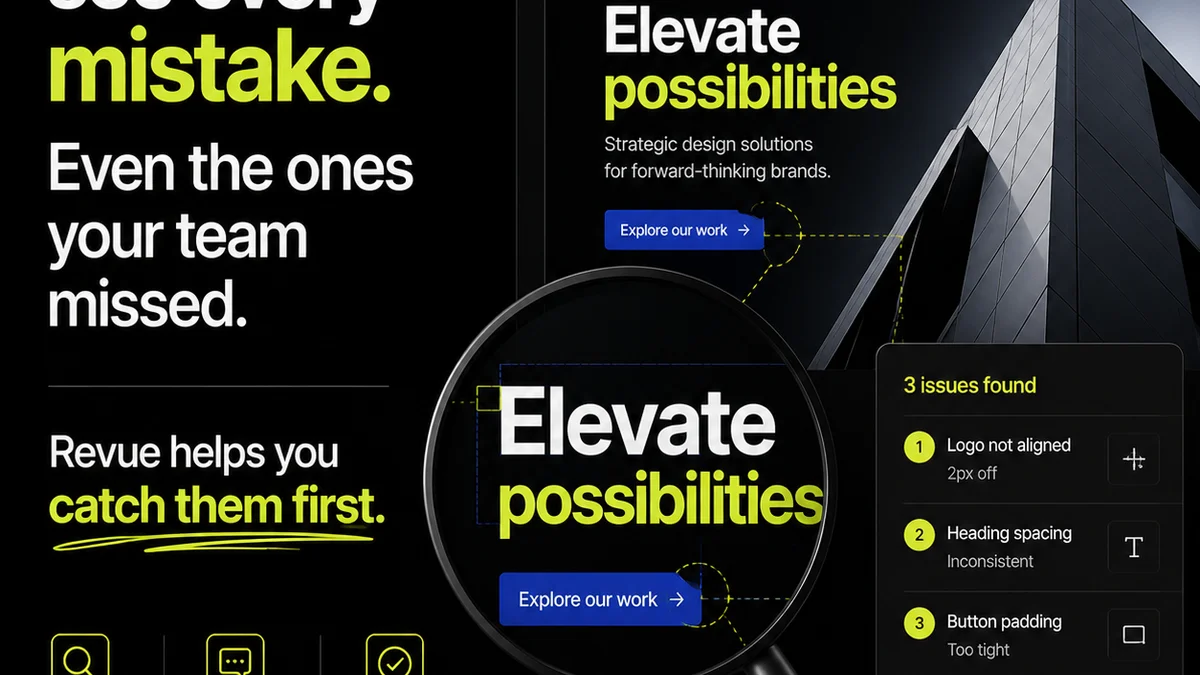
Revue provides that clarity. It streamlines the feedback loop, ensuring clients can easily provide precise annotations directly on your work. It gives you a clear audit trail of revisions and approvals, removing ambiguity and disputes. This allows your team to focus on creative execution, not administrative overhead.
By centralizing feedback, managing revisions efficiently, and providing clear visibility into the approval process, Revue helps you maintain quality and client satisfaction as you grow. It turns the messy parts of agency work into predictable, manageable processes.
6. Building a Scalable Culture
Systems are only as good as the people operating them. Scaling requires a culture that supports process, collaboration, and continuous improvement.
Empowerment, Not Just Delegation
Delegate tasks, yes. But empower your team members to own processes and make decisions within defined parameters. This builds confidence and frees up leadership.
Invest in Training
As you standardize processes, invest in training your team on them. Ensure everyone understands the 'why' behind the systems and how to use them effectively.
Encourage Feedback (On Your Systems)
Your operational processes aren't static. Encourage your team to provide feedback on what's working and what isn't.
Regularly review and refine your workflows. This iterative approach ensures your systems evolve with your agency.
Final Thought
Scaling a creative agency isn't about finding a magic bullet. It's about the disciplined, often unglamorous, work of building robust systems. It’s about transforming potential chaos into predictable excellence.
Are you building systems that support growth, or systems that will eventually break under its weight?
Frequently asked questions
What's the biggest mistake agencies make when trying to scale?
The biggest mistake is relying on individual effort and 'hustle' rather than building standardized, efficient systems. This approach hits a bottleneck quickly, leading to burnout and decreased quality as the agency grows.
How important is standardizing processes for scaling?
It's critical. Standardizing core workflows like client onboarding, feedback loops, and project delivery creates predictability, reduces errors, and allows for faster onboarding of new clients and team members. It ensures consistent quality.
Why is centralized communication vital for scaling?
Scattered communication leads to lost information, misunderstandings, and wasted time. Centralizing all project discussions and assets in one place ensures everyone is aligned, feedback is clear, and approvals are tracked effectively.
How can an agency maintain creativity while standardizing workflows?
Standardize the *process*, not the *creativity*. Focus on creating efficient systems for managing feedback, revisions, and approvals. This frees up your creative team to focus on innovative problem-solving and execution, rather than administrative tasks.
What role does technology play in scaling a creative agency?
Technology is essential for implementing scalable systems. Project management tools, centralized feedback platforms like Revue, and financial tracking software provide the visibility and efficiency needed to manage growth without sacrificing quality or profitability.