You think scaling design productivity means hiring more people. That’s a start. But it’s not the whole story.
The real challenge is orchestrating disparate teams, time zones, and workflows into a cohesive, high-output unit. It’s about systems, not just headcount.
The Hard Truth: Scale Isn’t About More Hands, It’s About Smarter Processes
Many agencies and in-house teams assume that to handle more work, they just need more designers. So they hire. And then they hire some more.
Suddenly, they have a larger team. But the output hasn’t increased proportionally. In fact, it might have decreased. Communication breaks down. Revisions get lost. Quality dips. The complexity of managing more people and more projects becomes a bottleneck.
The hard truth is this: scaling design productivity is fundamentally a problem of operational efficiency, not just resource allocation.
You can’t just throw more bodies at a broken process and expect better results. You need to fix the process first. Especially when your team is spread across different cities, countries, or continents.
1. Centralize Your Feedback Loop: The End of “Did You Get My Email?”
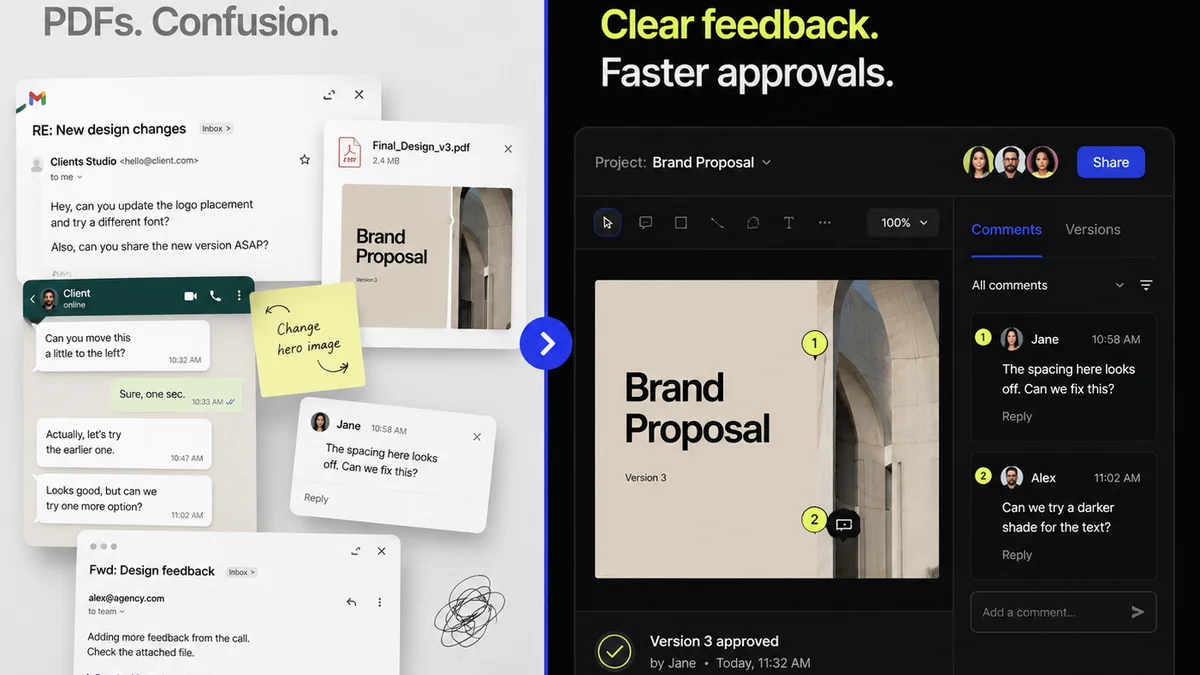
Global teams mean global communication challenges. Emails get buried. Slack messages get missed. Documents are scattered across cloud storage, each with its own version history.
This isn’t just annoying. It’s a productivity killer. Designers spend hours chasing down feedback, clarifying requests, and trying to piece together the client’s true intent from a dozen different sources.
The Cost of Scattered Feedback
- Endless email chains that are impossible to track.
- Missed comments leading to rework and client frustration.
- Version control nightmares where the wrong design is approved.
- Internal arguments about who said what and when.
- Wasted time spent searching for information instead of designing.
This chaos is amplified when teams are in different time zones. A crucial piece of feedback sent at the end of one day might not be seen until the start of the next, delaying progress by 24 hours.
The solution? A single source of truth for all client feedback and approvals.
This means a dedicated platform where clients can comment directly on the creative work, and where designers can respond, track revisions, and get clear sign-off. No more email attachments, no more confusing annotations on screenshots. Just clear, contextual feedback, all in one place.
2. Standardize Your Revision and Approval Workflow
Every project has a lifecycle. But when teams are distributed, that lifecycle can become unpredictable. What’s the process for submitting work for review? How are revisions requested? What constitutes a final approval?
Without clear, standardized steps, these questions become points of friction.
The Pitfalls of Ad Hoc Workflows
- Inconsistent review processes leading to missed steps.
- Vague revision requests that require back-and-forth clarification.
- Unclear approval gates, resulting in work moving forward without full client buy-in.
- Designers working on outdated versions because the approval wasn’t properly logged.
- Project managers spending time manually tracking status instead of enabling the team.
Global teams need even more rigor. Time zone differences mean that a handoff between team members can easily introduce delays if the status and next steps aren’t crystal clear.
The fix is to define and enforce a consistent workflow for every project.
This involves mapping out each stage: initial concept, first review, revision rounds, final approval, and delivery. Then, using a tool that guides the team and the client through these stages systematically.
This ensures that everyone knows what’s expected, what the current status is, and what needs to happen next, regardless of where they are in the world.
3. Implement Rigorous Quality Assurance (QA) Gates
It’s easy to let quality slip when you’re rushing to meet deadlines, especially when managing multiple projects across different teams.
For global teams, the risk is compounded. A designer in one location might miss a detail that a reviewer in another location would catch, but only if they have the time and the right checklist.
The Dangers of Neglecting QA
- Inconsistent branding or visual style across different assets.
- Technical errors like incorrect image resolutions, broken links, or typos.
- Designs that don’t meet accessibility standards.
- Deliverables that miss the mark on the client’s original brief.
- Reputational damage from consistently subpar work.
A robust QA process isn’t just about catching mistakes. It’s about ensuring that every piece of work leaving your agency or team meets a high standard, consistently.
This requires structured checklists and clear ownership for quality control.
Think beyond just a final glance. Implement checks at multiple stages. Ensure that your QA process is documented and that team members are trained on it. For global teams, this might mean creating shared QA templates or leveraging technology to automate parts of the process.
4. Foster Asynchronous Collaboration and Documentation
The dream of real-time collaboration is often a myth, especially across significant time differences. Trying to schedule meetings for everyone is a logistical nightmare and often leads to people dialing in groggily or missing crucial information.
The real key to scaling with global teams is mastering asynchronous work.
Why Asynchronous is Key
- Respects different working hours and personal lives.
- Allows for thoughtful, well-considered responses rather than rushed reactions.
- Creates a searchable record of decisions and discussions.
- Empowers individuals to contribute when they are most productive.
- Reduces reliance on synchronous meetings, freeing up valuable time.
This means shifting from a culture of instant messaging and meetings to one of clear, concise documentation and well-structured communication.
Every decision, every brief, every piece of feedback should be documented in a way that someone joining the project days or weeks later can easily understand.
The goal is to make information accessible and understandable without requiring real-time interaction.
This requires clear project briefs, detailed meeting notes (even if they are just summaries of asynchronous discussions), and a centralized knowledge base.
5. Invest in Tools That Bridge Gaps, Not Widen Them
You’ve probably tried a dozen tools already. Project management software, chat apps, file-sharing services, design collaboration platforms. The problem isn’t a lack of tools; it’s often the fragmentation and the lack of integration between them.
Each tool creates its own silo of information, requiring manual data transfer or constant context switching.
For global teams, this friction is magnified. A designer might be working in Figma, getting feedback via email, tracking tasks in Asana, and sharing final files via Dropbox. Each step is a potential point of failure.
The most effective tools for scaling global teams are those that centralize core functions and integrate seamlessly.
Look for platforms that can handle:
- Centralized client feedback and version control.
- Streamlined revision and approval tracking.
- Project status visibility across different teams and locations.
- Integration with your existing design software.
The goal is to reduce the number of tools your team has to juggle and to ensure that information flows smoothly between them.
Where Revue Fits In
Scaling design productivity across global teams isn’t about reinventing the wheel. It’s about building a more robust, reliable vehicle.
That’s where a platform like Revue comes in. It’s built to address the core operational challenges that plague distributed creative teams.
With Revue, you can:
- Centralize client feedback: All comments, annotations, and discussions happen directly on the creative assets. No more lost emails or confusing Slack threads. This provides a single, clear source of truth for feedback, accessible to everyone on the team, no matter their location or time zone.
- Manage revisions and approvals with clarity: Track every version, every change, and every sign-off. This ensures that everyone is working on the latest iteration and that approvals are formally logged, preventing costly misunderstandings and rework. The audit trail is invaluable for accountability.
- Run quality checks efficiently: Integrate your QA checklists and processes directly into the workflow. This ensures that critical checks are not missed, even when teams are operating asynchronously or across different regions. You can build confidence in your deliverables.
By bringing these critical functions into one integrated system, Revue helps you reduce friction, improve communication, and ultimately, boost the productivity and quality of your global design operations.
Final Thought
Scaling design productivity isn’t a destination; it’s an ongoing refinement of your operational engine. It requires moving beyond the idea that more people automatically means more output.
It demands a critical look at your processes, your communication channels, and your technology stack.
Are your systems designed to amplify your team’s talent, or are they inadvertently holding them back?
Frequently asked questions
How can global teams improve design feedback loops?
Global teams can improve feedback loops by centralizing all client comments and stakeholder input onto a single platform, like Revue. This eliminates scattered emails and messages, creating a clear, accessible record of feedback that everyone can reference, regardless of their time zone.
What's the best way to manage revisions for distributed design teams?
The best way is to standardize your revision and approval workflow. Use a system that clearly tracks versions, logs feedback, and formalizes approvals. This ensures that designers are always working on the latest iteration and that client sign-offs are unambiguous, even when team members are geographically dispersed.
How do you ensure quality control with remote or global design teams?
Implement rigorous, documented quality assurance (QA) gates at multiple stages of the design process. Use checklists and leverage technology to automate or streamline these checks. Centralizing these processes makes them consistent and trackable, ensuring high standards are maintained across all teams.
Is asynchronous collaboration really effective for design teams?
Yes, asynchronous collaboration is highly effective for global design teams. It respects different working hours, allows for more thoughtful responses, and creates a searchable record of discussions and decisions. Mastering asynchronous communication reduces reliance on disruptive real-time meetings and boosts overall efficiency.
What kind of tools are essential for scaling design productivity globally?
Essential tools should centralize core functions like feedback, revisions, and approvals, and integrate with your existing design software. Look for platforms that reduce tool fragmentation, provide clear visibility into project status, and facilitate seamless communication across different locations and time zones.