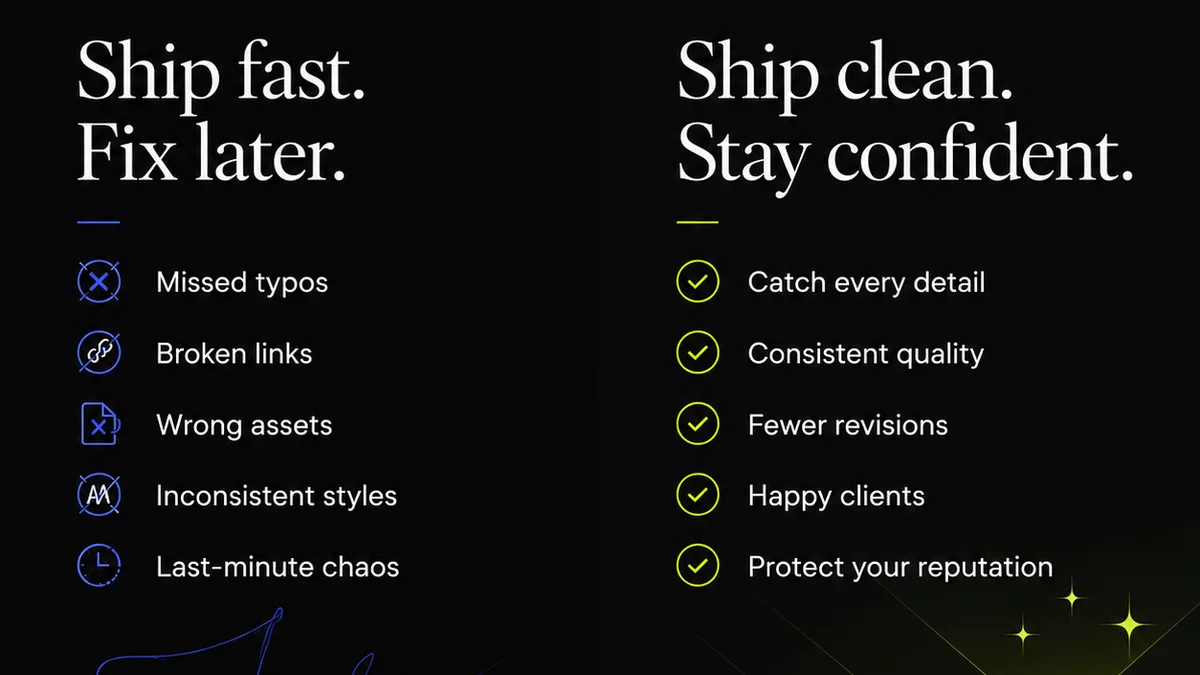
You think scaling design QA means hiring more reviewers. Or maybe implementing a stricter checklist. None of that is wrong. But it’s incomplete.
The hard truth is that scaling design QA isn't about adding more eyes. It’s about building a system where quality is baked in from the start, and every team member owns a piece of the process. Without that, you’re just adding more cooks to a kitchen that’s already on fire.
1. The Myth of the Dedicated QA Team
Many agencies assume that as they grow, they need to build a dedicated Quality Assurance department for design. This sounds logical. More projects, more complexity, more need for specialized oversight.
But this often creates a bottleneck. The QA team becomes the gatekeeper, slowing down delivery. Worse, it can foster a culture where designers feel less responsible for the quality of their own work, assuming QA will catch everything.
The Real Problem: Ownership, Not Oversight
The issue isn't a lack of reviewers; it's a lack of integrated quality ownership. When QA is seen as a separate phase, it's reactive. It’s about finding flaws after the fact.
A scalable approach makes quality everyone’s job, from the initial brief to the final handover. This means:
- Designers understanding and adhering to brand guidelines and technical specs *before* submitting work.
- Project managers ensuring briefs are crystal clear and requirements are documented.
- Creative directors providing constructive, actionable feedback early and often.
- Clients understanding the review process and providing consolidated, clear feedback.
2. Establishing a Universal Quality Bar
What does “good” even mean at your agency? If every team member has a different definition, you’re doomed.
You need a clearly defined, universally understood quality bar. This isn't just about aesthetics; it's about:
- Brand Consistency: Are we adhering to the client’s established visual identity?
- Technical Accuracy: Are files correctly formatted, specs met, and assets production-ready?
- Usability/Functionality: Does the design work as intended, especially for digital products?
- Alignment with Brief: Does the final output directly address the client’s stated goals?
- Accessibility: Are designs inclusive and usable by people with disabilities?
This quality bar should be documented. It’s not a suggestion; it’s the standard.
Codifying Your Standards
Think of it like a design system, but for process and output standards. This includes:
- Style Guides & Brand Books: Essential for every client.
- Technical Checklists: Specific requirements for different file types or platforms (e.g., web assets, print specs, social media dimensions).
- Accessibility Guidelines: A clear set of rules for color contrast, typography, and interactive elements.
- Feedback Protocols: How feedback should be given and received.
These aren't optional extras. They are the bedrock of consistent, high-quality output across all teams.
3. Integrating QA into the Workflow, Not Bolting It On
The biggest mistake is treating QA as a final hurdle. It’s a continuous process.
This means building checkpoints into every stage of the project lifecycle. Not just one big review at the end.
Micro-Checks for Macro Results
Implement smaller, more frequent reviews:
- Brief Review: Does the brief clearly define the objectives and success metrics? Is anything missing?
- Concept Review: Do the initial concepts align with the brief and brand?
- Mid-Stage Review: Is the design developing according to spec? Are there any potential issues emerging?
- Pre-Client Review: An internal check against the quality bar before it goes out the door.
- Client Review: A structured process for gathering and consolidating client feedback.
Each of these stages has a specific purpose and a defined output. This prevents major issues from snowballing.
Empower Designers for Self-QA
Before any work leaves a designer’s desk, they should be performing their own initial QA. This involves:
- Cross-referencing the brief and requirements.
- Running through the relevant technical checklists.
- Checking against the established quality bar.
- Performing basic usability checks.
This isn't about making designers do more work; it's about making them more efficient by catching errors early. It’s a fundamental shift from “Can someone else check this?” to “Is this right?”
4. Standardizing Feedback and Revisions
Scattered feedback is the enemy of scalable QA. When feedback comes from everywhere, in every format, it’s impossible to manage and easy to miss critical points.
This is where many agencies falter. They accept feedback via email, Slack messages, verbal notes, and even carrier pigeons.
The Chaos of Unstructured Feedback
What happens then?
- Important comments get lost.
- Conflicting feedback creates confusion.
- Revisions take longer because context is missing.
- The final output doesn’t match the original intent.
- Client relationships suffer from perceived disorganization.
You need a single source of truth for all feedback and revisions.
Consolidated Feedback is Scalable Feedback
This means implementing a system where:
- All feedback is logged in one place.
- Comments are tied directly to the specific design element.
- Reviewers can see all previous feedback and revisions.
- Stakeholders can easily track the status of revisions.
- Approvals are clearly documented.
This structured approach ensures that nothing falls through the cracks and that the revision process is efficient, transparent, and manageable, even with multiple teams and stakeholders involved.
5. Where Revue Fits In
This is precisely why Revue was built.
Trying to manage design feedback, revisions, and approvals across multiple teams, projects, and clients using email and spreadsheets is a recipe for disaster. It’s inefficient, error-prone, and fundamentally unscalable.
Revue provides a centralized platform designed to streamline this exact process. It allows you to:
- Centralize Client Feedback: All comments, annotations, and discussions happen in one place, directly on the creative asset. No more hunting through email chains or Slack threads.
- Manage Revisions and Approvals Visibly: Track every version, see who approved what and when, and easily compare changes. This transparency is key to accountability and efficiency.
- Run Quality Checks Effectively: Use the structured feedback and clear audit trail to ensure work meets defined standards before final sign-off. It transforms QA from a subjective opinion to an objective process.
By bringing clarity and structure to the feedback loop, Revue empowers your teams to deliver higher quality work, faster, and with less friction. It’s not just about managing feedback; it’s about building a more robust, scalable creative operation.
Final Thought
Scaling design QA isn’t about adding more layers of review. It’s about fundamentally rethinking how quality is integrated into your agency’s DNA. It’s about process, clarity, and shared ownership.
Are you building a system that catches mistakes, or one that prevents them from happening in the first place?
Frequently asked questions
What is the biggest mistake agencies make when scaling design QA?
The biggest mistake is treating QA as a separate, final step or believing that hiring more reviewers is the solution. The real issue is a lack of integrated quality ownership throughout the entire workflow and a failure to establish clear, universally understood quality standards.
How can I ensure quality is consistent across multiple design teams?
Establish a clear, documented quality bar that defines what 'good' means for your agency, covering brand consistency, technical accuracy, usability, and alignment with the brief. Implement standardized checklists and feedback protocols that all teams must follow.
What role should designers play in the QA process?
Designers should be empowered to perform initial self-QA before submitting work. This involves checking against the brief, technical checklists, and the quality bar. This proactive approach catches errors early, making the overall process more efficient and scalable.
How does a centralized platform help scale design QA?
A centralized platform like Revue consolidates all feedback, revisions, and approvals in one place. This eliminates confusion, prevents comments from getting lost, provides a clear audit trail, and makes the entire quality control process transparent and manageable, even with many stakeholders.