Everyone talks about the big design failures: the rebrand that tanks, the campaign that offends, the website that crashes. We get it. Those are the headline-grabbers, the war stories you swap over beers. But what about the tiny missteps? The slightly off-brand color choice? The button that’s just a hair too small? The copy that’s *almost* right? Most assume these are minor annoyances, easily fixed, and ultimately insignificant.
None of that is wrong. But it’s incomplete.
The hard truth is that these seemingly small design flaws, left unchecked, don't just impact the final visual. They compound. They eat away at your agency’s efficiency, your client’s trust, and your profitability. They become expensive business problems disguised as minor creative hiccups.
1. The Erosion of Trust Starts Small
The Client’s Perspective
Your client hired you for expertise. They expect you to catch the details they’ll miss. When a small error slips through – a typo in a PDF, a logo that’s slightly distorted, a CTA that doesn't lead anywhere – it plants a seed of doubt.
It’s not about the single mistake. It's about what it implies:
- Are they paying for a team that’s truly detail-oriented?
- Is this a sign of carelessness that could affect bigger strategic decisions?
- Will they have to be the quality control for their own agency?
The Cost of Doubt
This erosion of trust leads to more oversight. Clients who don't trust the process start micromanaging. They ask for more revisions than necessary, questioning every tiny decision. This isn't productive; it's a symptom of lost confidence. And more oversight means more time spent by your team in endless back-and-forth, not on creative execution.
2. The Hidden Cost of Revisions
The Myth of the Quick Fix
A small mistake seems easy to fix, right? A quick tweak here, a minor adjustment there. But that’s where the real cost hides. The ‘quick fix’ rarely lives in isolation.
Consider a small copy error on a landing page. You fix the text. Great. But did that text change the character count? Does it now break the layout on mobile? Did it require a new image to be sourced or mocked up? Was it reviewed again by the client? Each of these follow-up actions, however small, adds time. And time is money.
The Revision Spiral
When small errors become common, they don't just generate single extra revisions; they create revision spirals. One fix leads to another, which leads to a client second-guessing the original intent, which leads to more feedback, and so on. What started as a single pixel out of place can balloon into multiple rounds of costly rework, pushing project timelines and eating into your profit margins.
The true cost isn't the designer's time to fix it; it's the project manager's time to track it, the client services rep's time to manage the fallout, and the potential delay to the *next* project waiting in the wings.
3. Inefficiency in the Workflow
The Bottleneck Effect
Small errors create friction. They jam up your workflow. A designer finishes a piece, but it has a minor flaw. It goes to the art director, who catches it. It goes back to the designer. Then maybe it goes to QA, who finds another small issue. Then it goes to the client, who flags something else.
Each handoff, each review cycle, is an opportunity for delay. When these small errors are frequent, your production pipeline becomes a series of mini-crises instead of a smooth, predictable process. This slows down delivery for everyone.
The Opportunity Cost
Every hour your team spends chasing down and fixing minor design flaws is an hour they are *not* spending on strategic thinking, client onboarding, or developing new business. It’s the ultimate opportunity cost. That time could be spent innovating, improving client relationships, or simply delivering value on the *next* project. Instead, it’s being sunk into correcting avoidable mistakes.
4. Brand Dilution and Inconsistency
The Death by a Thousand Cuts
A brand is more than just a logo. It’s a consistent experience delivered across every touchpoint. Small design inconsistencies chip away at that experience.
Think about it:
- A social media graphic that uses a slightly different shade of blue than the website.
- An email footer that doesn't match the corporate letterhead.
- A presentation deck with inconsistent typography.
Individually, these might seem trivial. Collectively, they create a perception of sloppiness. They dilute the brand's power and make it harder for clients to build recognition and trust.
The Strategic Disconnect
When design elements are inconsistent, it signals a lack of strategic alignment. It suggests that the brand guidelines aren't being followed, or perhaps that they aren't clear enough. This can undermine the client’s confidence in your agency’s ability to deliver cohesive, strategically sound creative work.
5. The Unseen Impact on Team Morale
The Frustration Factor
Nobody likes doing rework. Especially not when it feels preventable. Designers get frustrated when their work is sent back for minor issues they feel should have been caught earlier. Project managers get stressed managing the chaos. Account teams have to deliver difficult news to clients about delays.
This constant churn and the pressure of fixing small mistakes can lead to burnout. It drains energy that could be channeled into more rewarding, impactful work.
The Culture of Carelessness
If small errors are tolerated, it can foster a culture where details don't matter. This is a dangerous path. It lowers the bar for quality across the board. It makes it harder to attract and retain top talent who pride themselves on craftsmanship and precision.
Where Revue Fits In
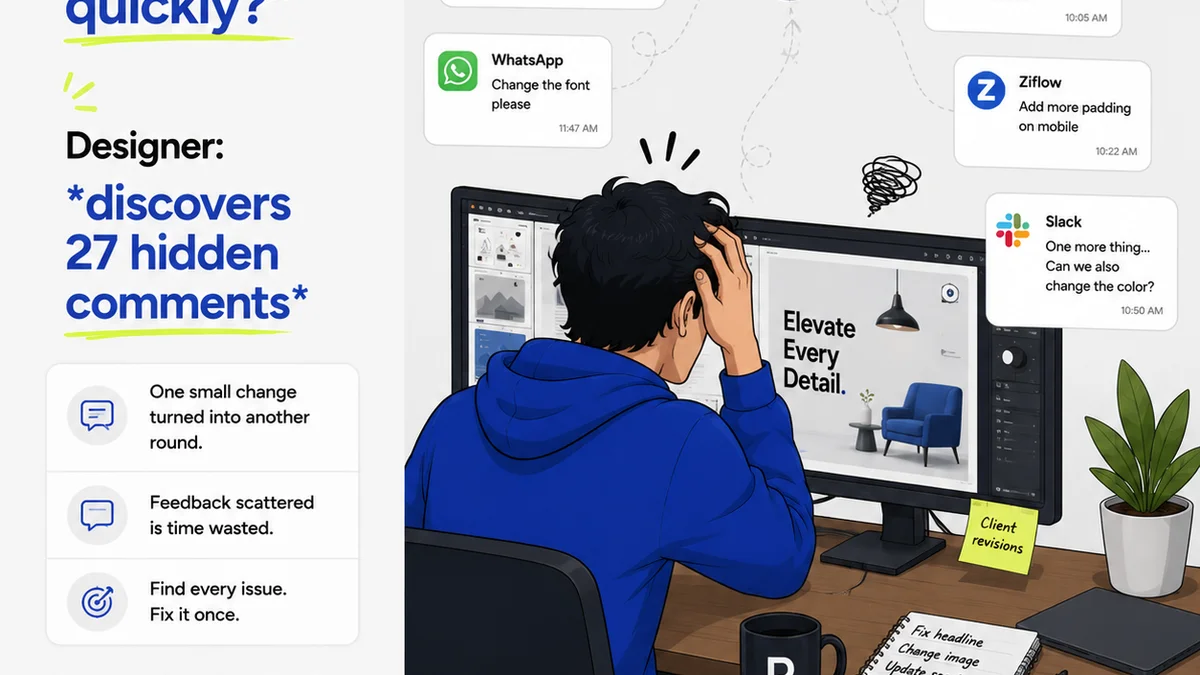
The problem isn't a lack of talent. It's a lack of streamlined process. Small design mistakes thrive in chaotic, fragmented communication channels. They multiply when feedback is buried in emails, revisions are tracked manually, and quality checks are an afterthought.
Revue was built to tackle this head-on. By centralizing client feedback, you create a single source of truth for every comment, every revision, every approval. No more digging through endless email threads to find that one crucial piece of feedback about button color.
Visibility into the revision and approval process means everyone knows where a project stands and what needs to be done. This dramatically reduces the chances of small errors slipping through the cracks. Automated quality checks and clear audit trails ensure that what goes out the door has been vetted, reducing the likelihood of those costly, subtle mistakes that erode trust and efficiency.
Final Thought
We often focus on the grand gestures in design, the big strategic wins. But the true measure of an agency’s operational health, and its long-term profitability, lies in its ability to manage the small things. Are you building a system that catches the tiny errors before they snowball, or are you just hoping for the best?
Frequently asked questions
What are the most common small design mistakes that cause big problems?
Common culprits include inconsistent branding (colors, fonts), minor layout issues, typos, broken links, and copy that's 'almost' right. These seem minor but erode trust and require more revisions than expected.
How do small design errors specifically increase costs for an agency?
They increase costs through extended revision cycles, increased project management time, potential delays to other projects, and the 'opportunity cost' of team members fixing errors instead of doing higher-value work. They also lead to client oversight, which means more of your team's time spent managing that oversight.
Can a single small design mistake really damage client trust?
Yes. While one typo might be forgivable, a pattern of small errors suggests a lack of attention to detail or quality control. This makes clients question the agency's overall competence and can lead to micromanagement.
How can an agency prevent these small but costly design mistakes?
Implement robust internal review processes, use centralized feedback tools like Revue to ensure clarity and trackability, enforce brand guidelines rigorously, and conduct thorough quality assurance checks before final delivery. Clear communication and accountability are key.