Everyone agrees that measuring creative performance is important. You’ve probably heard that data-driven creative is the future. That better metrics lead to better outcomes. And that you should be tracking things like engagement, conversion rates, or client satisfaction.
None of that is wrong. But it’s incomplete.
The hard truth is that simply *wanting* to measure creative metrics is useless without a system. Without Standard Operating Procedures (SOPs), your tracking efforts will be chaotic, inconsistent, and ultimately, meaningless. You’ll collect data, sure, but you won’t know what to do with it. Or worse, you’ll draw the wrong conclusions.
1. The Myth of the "Intuitive" Creative Metric
Many agencies and in-house teams operate under the assumption that creative metrics should be intuitive. That a good Creative Director or an experienced Account Manager can just *feel* what’s working. They might look at a campaign and say, “This one’s a winner,” or “This design just isn’t landing.”
This is a dangerous assumption.
While experience and intuition are valuable, they are not a substitute for objective measurement. Relying solely on gut feeling leads to:
- Inconsistent decision-making across projects and teams.
- Difficulty in scaling creative operations.
- A lack of clear justification for creative choices to clients or stakeholders.
- Missed opportunities for optimization.
- Increased risk of subjective bias influencing outcomes.
The real problem isn’t that intuition is bad. It’s that intuition without data is just a guess. And in business, we don’t run on guesses.
2. Defining Your "Why": What Are You Actually Trying to Improve?
Before you can build SOPs for creative metrics, you need to know *why* you’re measuring them. What business problem are you trying to solve? What outcome are you trying to drive?
Are you trying to:
- Increase client retention?
- Improve project profitability?
- Boost campaign performance for clients?
- Streamline your internal creative review process?
- Reduce the number of revision rounds?
- Enhance team efficiency and output?
Your “why” dictates which metrics matter. Measuring client satisfaction is pointless if your primary goal is to reduce project turnaround time. Focusing solely on engagement metrics won't help if your client's core objective is lead generation.
2.1. Connecting Metrics to Business Goals
Every metric you track must have a direct line back to a tangible business objective. If you can’t articulate how tracking “click-through rate” helps achieve “increase Q3 revenue by 10%,” then reconsider tracking it. Or, at least, figure out the intermediary steps.
For example:
- Business Goal: Increase client retention by 15% YoY.
- Supporting Metric: Client satisfaction scores (e.g., NPS, survey results).
- How it Connects: Higher satisfaction leads to more repeat business and fewer client departures.
- Business Goal: Improve project profitability by 5%.
- Supporting Metric: Average revision rounds per project, time spent on revisions.
- How it Connects: Fewer, more efficient revisions directly reduce billable hours spent on rework, increasing profit margins.
3. Identifying Key Creative Metrics (and How to Measure Them)
Once your “why” is clear, you can select the right metrics. Don’t fall into the trap of vanity metrics – those that look good but don’t impact the bottom line. Focus on actionable insights.
Here are some common areas and the metrics that support them:
3.1. Client Satisfaction & Retention
- Metrics: Net Promoter Score (NPS), Client Lifetime Value (CLV), Churn Rate, Repeat Business Rate, Testimonial/Referral Volume.
- How to Measure: Regular surveys (post-project, quarterly), CRM data, financial records.
3.2. Project Profitability & Efficiency
- Metrics: Project Profit Margin, Billable Hours vs. Non-Billable Hours, Average Revision Rounds, Time Spent Per Revision, On-Time Delivery Rate.
- How to Measure: Time tracking software, project management software, financial reporting.
3.3. Creative Output Quality & Performance
- Metrics: Campaign Conversion Rates, Engagement Rates (likes, shares, comments), Click-Through Rates (CTR), Bounce Rates, Lead Generation Volume, Brand Sentiment (social listening).
- How to Measure: Web analytics (Google Analytics), social media platform analytics, ad platform dashboards, dedicated social listening tools.
3.4. Internal Workflow & Team Performance
- Metrics: Internal Review Turnaround Time, Task Completion Rate, Team Utilization Rate, Error Rate (e.g., typos, incorrect specs).
- How to Measure: Project management tools, time tracking, internal QA checklists.
Remember, the specific metrics will vary wildly based on your agency’s specialization and your clients’ goals.
4. Building Your SOPs: The "How-To" of Measurement
This is where the rubber meets the road. SOPs turn your chosen metrics from abstract concepts into concrete, repeatable actions.
4.1. Documentation is King
Your SOPs need to be written down. Clearly. Concisely. Accessible to everyone who needs them.
For each key metric, your SOP should detail:
- What is being measured? (e.g., “Client Satisfaction via NPS Survey”)
- Why is it being measured? (Connect back to the business goal)
- Who is responsible for measurement? (Assign ownership)
- When will it be measured? (Frequency: weekly, monthly, per-project)
- How will it be measured? (Specific tools, platforms, survey methods)
- What are the data sources? (Where to pull the numbers)
- How will the data be recorded? (Spreadsheet, dashboard, PM tool)
- What constitutes “good” or “bad” performance? (Define benchmarks or targets)
- What is the action plan if targets are not met? (Escalation, review process)
4.2. Standardize Data Collection
Consistency is crucial. If one person tracks time in one way and another in a different way, your efficiency metrics will be skewed.
Your SOPs must mandate:
- Uniform use of time-tracking categories.
- Consistent naming conventions for files and projects.
- Standardized survey questions and distribution methods.
- Defined processes for pulling reports from various platforms.
This might seem tedious. It is. But it’s the only way to ensure your data is reliable.
4.3. Define Roles and Responsibilities
Who owns the data? Who pulls the reports? Who analyzes them? Who acts on the insights?
Clear roles prevent data from falling through the cracks. An Account Manager might be responsible for sending client surveys. A Project Manager might track revision rounds. A Creative Director might analyze campaign performance. A Head of Operations might oversee the overall system.
Ensure everyone understands their part in the measurement process.
4.4. Establish Reporting Cadence and Format
How often will data be reviewed? Who will see the reports? What will the reports look like?
Regular reporting meetings (weekly, bi-weekly, monthly) ensure that metrics aren’t just collected, but acted upon. Standardized report templates make data easier to digest and compare over time.
Consider:
- Weekly check-ins on project efficiency metrics.
- Monthly reviews of client satisfaction scores.
- Quarterly deep-dives into campaign performance against KPIs.
4.5. Create Actionable Workflows
Measurement is pointless if it doesn’t lead to action. Your SOPs must include clear steps for what happens when metrics indicate a problem or an opportunity.
For instance:
- If Revision Rounds Exceed Target: SOP might trigger an automatic alert to the PM, prompting a discussion with the client about scope or feedback clarity.
- If NPS Score Drops Below Benchmark: SOP might require the Account Director to schedule a client check-in call within 48 hours.
- If Campaign CTR is Underperforming: SOP might mandate A/B testing of ad creatives or landing pages within a specific timeframe.
This creates a feedback loop, turning data into improvement.
5. Where Revue Fits In
Building robust SOPs for creative metrics requires a central hub for managing creative workflows. This is where tools like Revue become indispensable.
Revue streamlines the entire process of client feedback, revision, and approval. By centralizing communication and documentation, it provides the necessary foundation for reliable data collection:
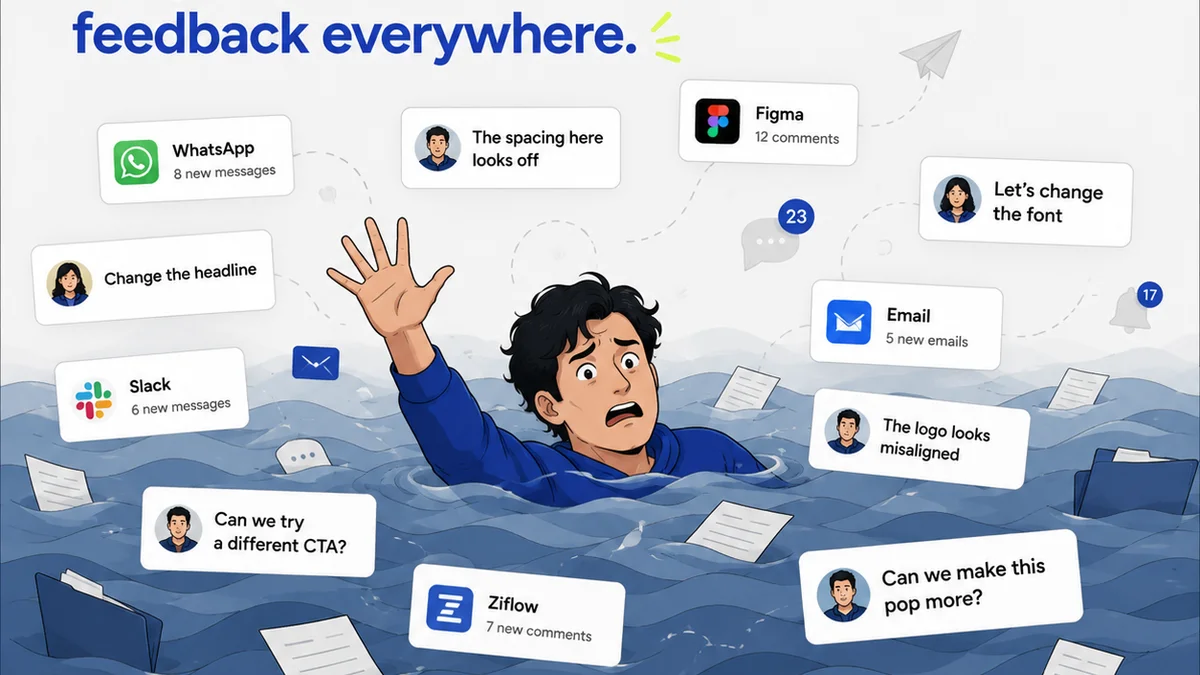
- Centralized Feedback: All client comments are in one place, linked to specific assets. This eliminates scattered feedback across emails and chats, ensuring you capture all client input accurately for satisfaction metrics.
- Revision & Approval Visibility: Track the number of revision rounds requested and approved directly within the platform. This provides clear, objective data for your efficiency and profitability metrics.
- Quality Checks: Standardized approval workflows help ensure that creative meets defined quality standards before final sign-off, contributing to both client satisfaction and reduced rework.
- Audit Trail: Revue creates a clear history of feedback and approvals, providing an undeniable source of truth for performance analysis and client discussions.
Without a system to manage the creative process itself, collecting and acting on metrics becomes exponentially harder. Revue helps enforce the discipline needed to make your SOPs effective.
6. Iteration and Evolution
Your SOPs are not set in stone. The creative industry evolves. Client needs change. Your business goals will shift.
Schedule regular reviews of your SOPs. Are the metrics still relevant? Is the process still efficient? Are you actually seeing improvements based on the data?
Treat your SOPs like any other creative project: subject to critique, refinement, and iteration.
Final Thought
Are you measuring what matters, or just measuring what’s easy? The difference between collecting numbers and driving business results lies in the discipline of your process. Building and adhering to SOPs for creative metrics isn't just good practice – it's the bedrock of a high-performing, scalable creative operation. What’s one metric you’re tracking today that you could improve with a clear SOP?
Frequently asked questions
What is the main benefit of having SOPs for creative metrics?
SOPs ensure that creative metrics are collected consistently, reliably, and are actionable. This moves beyond guesswork and intuition to data-driven decision-making, leading to improved client satisfaction, project profitability, and overall creative quality.
How do I choose the right creative metrics to track?
Start by defining your core business objectives (e.g., increase retention, improve profit). Then, select metrics that directly support those goals. Avoid vanity metrics and focus on those that provide actionable insights into client satisfaction, project efficiency, creative performance, or internal workflows.
Who should be responsible for creating and maintaining these SOPs?
Ideally, this is a collaborative effort involving leadership (e.g., Head of Operations, Creative Director, Account Director) to ensure buy-in and alignment. However, specific responsibilities for data collection, reporting, and analysis should be clearly assigned to relevant team members as defined within the SOPs themselves.
How can a tool like Revue help with creative metrics SOPs?
Revue centralizes client feedback, revisions, and approvals, providing a clear audit trail and visibility into project workflows. This structured data collection is essential for accurately tracking metrics like revision rounds, client satisfaction, and approval times, making your SOPs more effective.