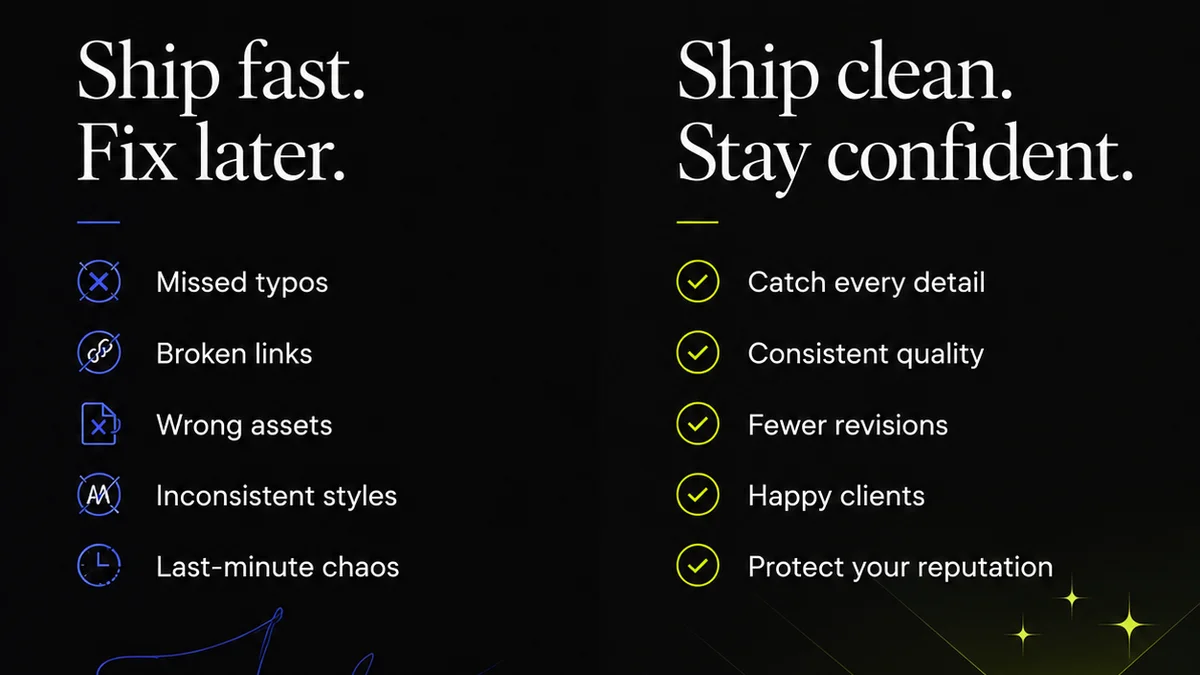
Everyone wants high-quality creative work. It’s the bedrock of a successful agency. So, you probably think building SOPs for quality management is about checklists, approval forms, and maybe a few rigid rules.
None of that is wrong. But it’s incomplete.
The hard truth is that true quality management isn't an add-on. It’s a system baked into your process, from kickoff to final delivery. And it’s built on robust Standard Operating Procedures (SOPs) that everyone actually follows.
1. Why Your Current Quality Control Isn't Enough
Most agencies operate on a reactive quality model. Something slips through the cracks, you scramble to fix it, and then you *think* about how to prevent it next time.
This leads to:
- Endless, frustrating revision cycles.
- Client complaints that could have been avoided.
- Team members working late to fix preventable errors.
- A general feeling of chaos around project delivery.
Your team is talented. Your clients are discerning. But without a clear, documented process, talent alone can’t guarantee consistent quality.
2. The Foundation: What Makes a Good SOP?
A Standard Operating Procedure isn't just a document to collect dust. It's a living guide that tells your team exactly how to perform a task to achieve a specific, consistent outcome.
For quality management, your SOPs need to be:
Clear and Concise
No jargon. No ambiguity. Every step should be easy to understand, even for a new hire.
Actionable
They must tell people *what* to do, *how* to do it, and *why* it’s important for quality.
Accessible
Easily found when needed. Not buried in a forgotten shared drive.
Up-to-Date
Processes change. SOPs must reflect current workflows and tools.
Enforceable
There needs to be accountability. What happens when an SOP isn't followed?
3. Mapping Your Quality Touchpoints
Before you write a single SOP, you need to understand your entire creative workflow. Where can quality falter? Where can it be strengthened?
Walk through a typical project lifecycle:
Project Kickoff & Briefing
This is where quality starts. A poorly understood brief guarantees downstream problems.
- SOP Idea: Briefing Intake & Clarification. Ensure all mandatory fields are completed. Define a process for client Q&A before concepting begins.
- SOP Idea: Client Brief Review. A designated person (e.g., Account Manager, Project Manager) must sign off that the brief is clear, actionable, and aligned with client goals.
Concepting & Creative Development
Here, the brief comes to life. Quality here means alignment with strategy and client needs.
- SOP Idea: Internal Creative Review. Establish criteria for internal reviews (e.g., strategic alignment, brand consistency, technical feasibility) before client presentation.
- SOP Idea: Creative Brief Adherence Check. A pre-presentation checklist to ensure concepts directly address the brief's core requirements.
Client Feedback & Revisions
This is often the most chaotic phase. SOPs bring order.
- SOP Idea: Feedback Aggregation. Define how client feedback (from multiple stakeholders) is collected, organized, and synthesized into actionable revision notes.
- SOP Idea: Revision Scope Management. Establish a process for evaluating if requested revisions fall within the original scope. If not, trigger a change order process.
- SOP Idea: Proofreading & Copyediting. Mandate a multi-stage proofreading process for all client-facing copy, including a final check by someone not involved in the initial writing.
Asset Delivery & Finalization
The last mile. Small errors here can undo all previous good work.
- SOP Idea: File Naming Convention. Standardize how final assets are named to avoid confusion.
- SOP Idea: Final Asset QA Checklist. A mandatory checklist for delivery: correct formats, correct resolutions, all requested variations included, no typos, no broken links.
- SOP Idea: Archiving Procedure. How final assets and project files are organized and stored for future reference.
4. Documenting Your SOPs: The How-To
Writing SOPs doesn't have to be a bureaucratic nightmare. Keep it practical.
Start Small
Don’t try to document everything at once. Pick one high-impact area where quality is often compromised. Master that, then move on.
Involve Your Team
The people doing the work know the process best. Ask them to document their steps. This also builds buy-in.
Use a Template
Consistency in SOP format makes them easier to read and use.
A basic SOP template might include:
| Section | Description |
|---|---|
| SOP Title | Clear, descriptive name of the procedure. |
| SOP Number/ID | Unique identifier for tracking. |
| Purpose | Why this SOP exists and its goal. |
| Scope | Which projects, teams, or processes this SOP applies to. |
| Responsibility | Who is responsible for performing this procedure. |
| Procedure Steps | Detailed, step-by-step instructions. Use numbered lists. |
| Quality Criteria/Checks | What defines success at each step. What to look for. |
| Tools/Resources | Any software, templates, or links needed. |
| Definitions | Explain any specialized terms. |
| Revision History | Track changes and updates. |
Choose Your Medium
Where will these live? A shared drive? A wiki? A project management tool?
The key is that they are easily searchable and accessible. Think about how your team naturally looks for information.
5. Implementing and Enforcing SOPs
This is where most agencies stumble. You have great-looking documents, but nobody uses them.
Train Your Team
Don't just hand out SOPs. Walk through them. Explain the 'why'. Conduct training sessions, especially for new hires.
Integrate into Workflow
Make following the SOP part of the actual work. If an SOP says to use a specific checklist before client delivery, build that checklist into your project management tool.
Regular Audits
Periodically review projects to see if SOPs are being followed. This isn't about punishment; it's about identifying gaps in understanding or process.
Feedback Loop
SOPs aren't static. Encourage your team to provide feedback on how SOPs can be improved. This fosters ownership and ensures they remain relevant.
Accountability
There must be consequences for consistently ignoring SOPs. This could range from re-training to more formal performance management. Quality is a team responsibility.
Where Revue Fits In
Building SOPs for quality management is about establishing predictable, repeatable processes. Revue is built to support exactly that.
Think about your client feedback process. Instead of scattered emails and endless Slack threads, Revue centralizes all stakeholder comments in one place, linked to the specific version of the creative asset. This directly supports your SOP for feedback aggregation and clarification.
When it comes to revisions, Revue provides clear visibility into what feedback was given, what was actioned, and who approved the final output. This traceability is crucial for your SOPs on revision scope management and final approval.
Furthermore, Revue’s structured review and approval workflows can be configured to ensure that mandatory steps – like proofreading checks or adherence to client briefs – are completed before a project can move to the next stage or be marked as final. This embeds quality checks directly into your workflow, making SOP adherence less about remembering and more about simply doing the work.
Final Thought
Quality isn't a happy accident. It’s the result of intentional design and disciplined execution.
By building clear, accessible, and enforceable SOPs, you move from chasing quality to actively building it into the DNA of your agency. What's the first SOP you'll document?
Frequently asked questions
What is the primary benefit of having SOPs for quality management?
The primary benefit is consistency. SOPs ensure that tasks are performed the same way every time, reducing errors, improving efficiency, and leading to predictable, high-quality output for your clients.
How do I get my team to actually use the SOPs?
Involve your team in creating them, ensure they are easily accessible and clearly written, provide thorough training, and integrate them into your daily workflow. Regular audits and feedback loops also help reinforce their importance.
What if a client's request doesn't fit our established SOPs?
Your SOPs should include a process for handling scope creep or exceptions. This typically involves documenting the deviation, assessing its impact, and initiating a change order process to get client approval for any additional work or changes to the original agreement.
How often should SOPs be reviewed and updated?
SOPs should be reviewed at least annually, or whenever there's a significant change in process, tools, or team structure. Encouraging ongoing feedback from the team ensures they remain relevant and practical.