Everyone assumes that delivering stellar UI/UX requires a glacial pace. That more user research, more wireframes, more stakeholder reviews automatically means better design and a smoother client experience. None of that is wrong. But it’s incomplete.
The hard truth is that UI/UX excellence doesn't come from adding more steps. It comes from making the essential steps faster, clearer, and more collaborative. The real enemy of speed isn't the design process itself – it's the friction within it. Specifically, the friction caused by messy communication and fragmented feedback.
1. The Myth of the Perfect Brief
You’ve probably heard it a million times: “Get the brief right, and everything else falls into place.” A perfect brief is the holy grail, right?
Wrong. Or at least, not the whole story.
A brilliant brief is a fantastic starting point. But user needs evolve. Market conditions shift. Stakeholders have epiphanies (or just change their minds) mid-project. Relying on a static, initial brief to guide complex UI/UX decisions throughout an entire project is a recipe for misunderstanding and wasted effort.
The real challenge isn't just getting the brief right *once*. It's building a system that allows the brief to breathe and adapt as the project progresses. It’s about continuous alignment, not a one-time handshake.
The Feedback Loop Is Where the Magic Happens (or Dies)
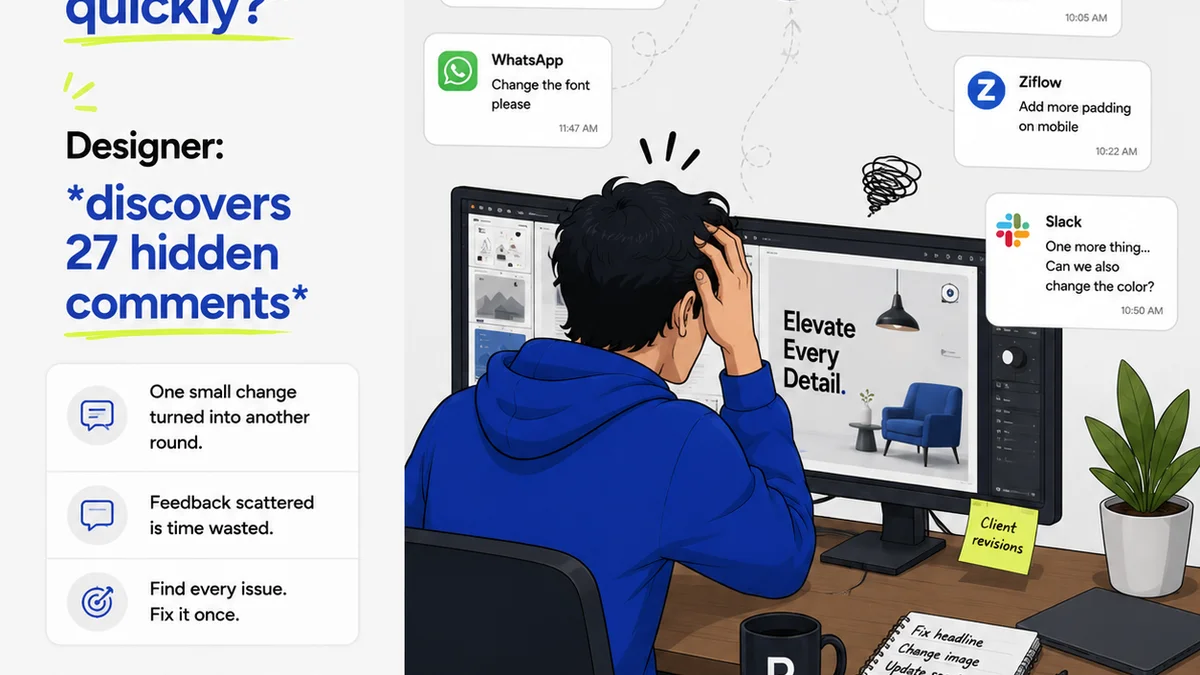
Most teams treat feedback as a bottleneck. A necessary evil to be endured before the *real* work can resume. Clients send rambling emails, designers try to decipher cryptic annotations, and revisions spiral into endless cycles.
This isn't a feedback problem. It's a communication problem.
When feedback is:
- Disorganized
- Unstructured
- Lacking context
- Siloed in email chains or Slack DMs
…it becomes a productivity killer. It forces designers into a guessing game, leading to rework and frustration. It makes clients feel unheard and leads to scope creep disguised as
Frequently asked questions
How can we get client feedback faster?
Centralize feedback in one platform. Use tools that allow for contextual comments directly on designs. Set clear expectations for feedback turnaround times and provide structured ways for clients to give input.
What's the biggest mistake teams make with UI/UX?
Treating UI/UX as a purely linear, front-loaded process. The biggest mistake is not building in continuous collaboration and iterative refinement, especially around feedback and revisions.
How do we avoid endless revision cycles?
Ensure feedback is clear, specific, and actionable. Use a system that tracks revisions and approvals so everyone knows the current state and what's been signed off on. Define clear project scope and revision limits upfront.
Can UI/UX actually be fast?
Yes, but not by cutting corners. Speed comes from efficiency. Streamlining communication, centralizing assets, and having clear approval workflows dramatically reduce wasted time and allow teams to move faster.