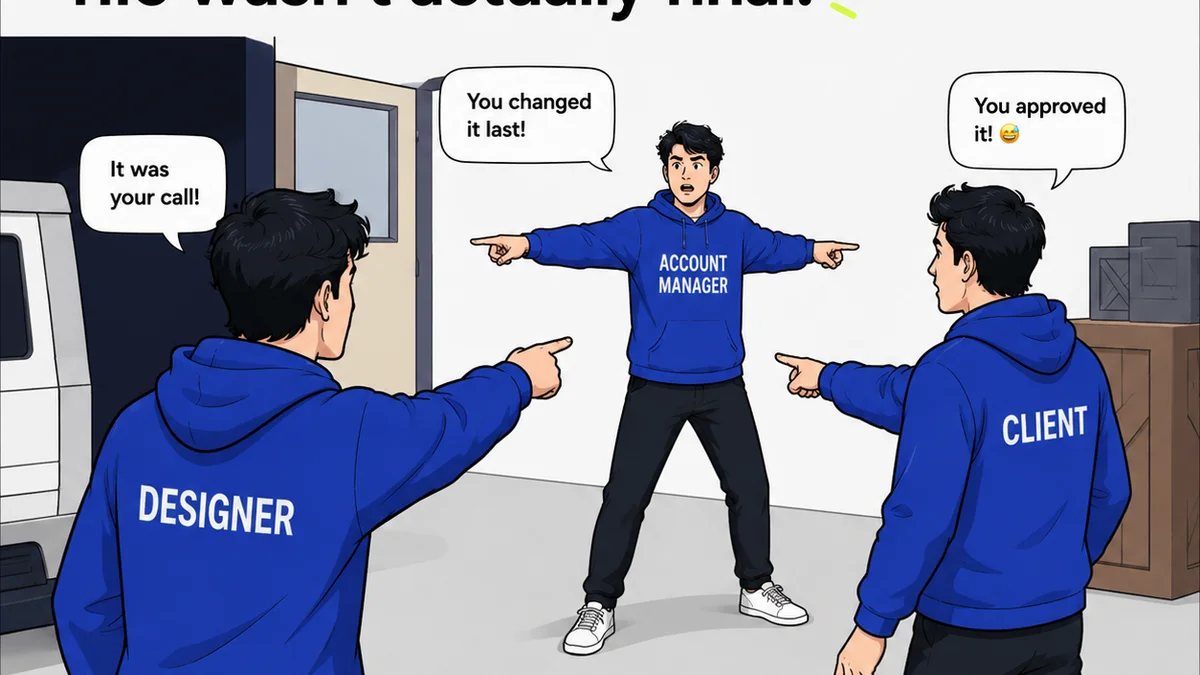
Everyone thinks they know what good UI/UX looks like. You see it on Dribbble, you read about it in countless articles. It’s about clean lines, intuitive navigation, and a delightful user journey. And that’s all true, in theory.
But it’s incomplete. Focusing only on the final output, the polished pixels, misses the operational engine that drives it. And that’s where most teams fall short.
The hard truth? Getting UI/UX right isn't a design problem. It's a workflow problem. It's about how you manage feedback, how you track revisions, and how you ensure quality at every step.
1. The Illusion of 'Good Enough' Design
We often assume that if a design *looks* good and the client *says* it’s good, we’re done. This is a dangerous assumption. It prioritizes subjective aesthetic approval over objective usability and strategic alignment.
This leads to:
- Surface-level feedback: Clients focus on colors, fonts, or minor layout tweaks because they lack the context or tools to provide deeper input.
- Endless revisions: Small, disconnected changes accumulate, creating a Frankenstein’s monster of a UI that loses its original intent.
- Missed opportunities: The core user needs and business goals get sidelined by endless, often contradictory, aesthetic debates.
Designers burn out. Clients get frustrated. The product suffers.
The Real Goal: Usability and Business Value
Good UI/UX doesn't just look pretty. It solves a problem for the user and achieves a business objective for the client.
This means:
- Clarity over complexity.
- Efficiency over novelty.
- Strategic alignment over subjective preference.
Achieving this requires more than just a talented designer. It requires a robust process.
2. The Feedback Black Hole
Client feedback is the lifeblood of any project. But it’s also the most common bottleneck and source of chaos.
How many times have you:
- Received feedback via a chain of forwarded emails?
- Scoured Slack messages for that one crucial comment?
- Had a client verbally approve something, only to backtrack later?
- Struggled to tell which version of a design is the *actual* latest?
This isn't just inefficient; it’s actively detrimental. It breeds miscommunication, delays, and resentment.
The Feedback Cycle: A System, Not a Suggestion
Effective feedback management isn't about hoping for the best. It's about building a system:
- Centralized comments: All feedback, from all stakeholders, in one place, tied directly to the design element it refers to.
- Clear annotation: Pinning comments directly on the UI itself, removing ambiguity.
- Version control: A clear history of what changed, when, and why.
- Status tracking: Knowing at a glance whether feedback is pending, in progress, or approved.
Without this, feedback becomes a guessing game. And guessing is a terrible strategy for delivering great UI/UX.
3. The Revision Rollercoaster
Revisions are inevitable. But the way they’re managed can turn a smooth ride into a stomach-churning ordeal.
Teams often fall into these traps:
- Scope creep disguised as
Frequently asked questions
What's the biggest mistake teams make with UI/UX?
The biggest mistake is treating UI/UX as purely a design problem, focusing only on aesthetics. The real issue is often a broken workflow for managing feedback, revisions, and quality assurance, leading to miscommunication and subpar results.
How can I improve client feedback on UI/UX designs?
Implement a centralized system for feedback. Use tools that allow comments to be pinned directly to design elements, track versions clearly, and provide a clear approval process. This reduces ambiguity and ensures all stakeholders are on the same page.
What is the role of version control in UI/UX?
Version control is crucial for tracking changes, understanding the evolution of a design, and preventing confusion. It ensures everyone is working from the latest approved version and provides an audit trail for revisions.
How does quality assurance fit into UI/UX?
QA in UI/UX goes beyond bug testing. It involves checking for usability issues, ensuring consistency across the interface, verifying that the design meets strategic goals, and confirming that all client feedback has been addressed accurately.