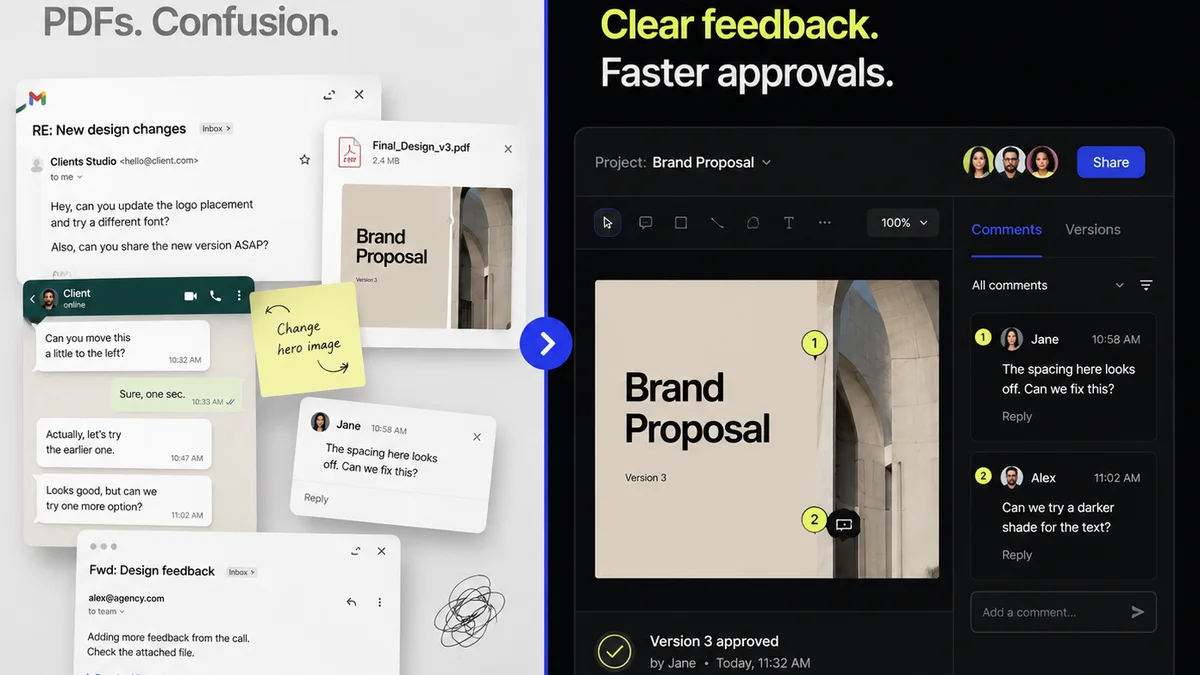
Everyone knows client feedback is crucial for creative agencies. You nod along, you hear it all the time. But most agencies treat visual feedback like a necessary evil – a tacked-on step after the real work is done. Like a final coat of paint before shipping the car.
None of that is wrong. But it’s incomplete.
The hard truth? The *way* you handle visual feedback is a direct indicator of your agency’s operational maturity and your ability to deliver consistently excellent work. It’s not a bottleneck; it’s the engine.
1. The Illusion of 'Direct Feedback'
The most common assumption is that if a client can just 'mark up the design,' that’s good enough. The idea is that direct annotation saves time and avoids misinterpretation.
This often leads to chaotic comment threads, conflicting markups, and a frantic scramble to decipher intentions.
The Reality: Context is King
A stray arrow pointing at a logo isn't feedback. A highlighted paragraph isn't a revision instruction.
Real feedback requires context. It needs to explain why something isn't working, not just what is wrong. This is often lost when feedback is purely visual and decontextualized.
Why Pure Visual Feedback Fails
- Ambiguity: Does that red line mean 'move this element' or 'delete this element'?
- Conflicting Inputs: Multiple stakeholders marking up the same asset without a unified view.
- Lack of Rationale: Comments that are subjective preferences rather than strategic critiques.
- Version Control Nightmares: Trying to reconcile multiple versions of annotated PDFs or screenshots.
This is where many agencies stumble, creating more work than they save.
2. The Strategic Value of Structured Feedback
Agencies that thrive don't just collect feedback; they actively manage it. They understand that feedback is a strategic tool, not just a reaction.
This means moving beyond simple annotation to a system that encourages clarity, alignment, and actionable insights.
Moving Beyond Gut Feel
Structured feedback asks specific questions and guides the client towards providing constructive input. It’s about facilitating a conversation, not just receiving instructions.
Consider the difference between a client saying 'I don't like this' and 'This headline doesn't clearly communicate the value proposition for our target audience because of X, Y, and Z. Could we explore options that emphasize benefit A?'
Key Elements of Structured Feedback
- Clear Objectives: What is this specific piece of creative meant to achieve?
- Target Audience: Who are we trying to reach with this message?
- Call to Action: What do we want the viewer to do?
- Brand Alignment: Does this adhere to our brand guidelines and voice?
When clients are prompted with these considerations, their feedback naturally becomes more strategic and actionable.
3. The Operational Cost of Poor Feedback Loops
Every hour spent deciphering vague comments, chasing down clarifications, or redoing work due to misinterpretation is an hour lost. And it’s not just about time.
Poor feedback loops erode client trust and damage team morale.
The Hidden Costs
- Scope Creep: Vague feedback can easily morph into requests that go beyond the original project scope.
- Missed Deadlines: Unforeseen revision cycles blow out project timelines.
- Budget Overruns: Extra hours translate directly to increased project costs.
- Team Burnout: Constant back-and-forth and unclear direction is exhausting for creatives.
- Client Frustration: Clients get annoyed when their feedback isn't understood or implemented correctly, or when projects drag on.
This isn't just about managing a single project; it's about the sustainable profitability of your agency.
4. Centralizing Visual Feedback: The Workflow Advantage
The real challenge for agencies isn't getting feedback; it's managing the *flow* of feedback across multiple projects, clients, and team members.
This is where operational systems become critical. A centralized platform for all creative assets and their associated feedback is non-negotiable for efficiency.
Why Centralization Matters
- Single Source of Truth: All versions, comments, and approvals live in one place. No more hunting through emails or disparate cloud storage.
- Clear Revision History: Track every change, every comment, and every approval. Understand the evolution of a design.
- Streamlined Communication: Reduce the need for endless meetings and email chains. Feedback is contextual and directly attached to the asset.
- Visibility for All: Project managers, creatives, and even clients can see the status and history of feedback at a glance.
This operational discipline is what separates agencies that are constantly firefighting from those that are predictably delivering.
Where Revue Fits In
Revue is built to tackle the operational realities of creative feedback. We understand that 'good enough' feedback management isn't good enough.
Our platform provides a dedicated space to centralize all your client feedback, manage revisions, and track approvals directly on your creative assets.
- Centralized Feedback: Upload any file type. Add comments, annotations, and markups directly on the visual. No more scattered emails or confusing screenshots.
- Revision and Approval Tracking: See who said what, when. Manage versions effortlessly and get clear sign-offs to move projects forward.
- Quality Assurance: Ensure every stakeholder has seen and approved the final output before it goes live, reducing costly errors.
Revue transforms feedback from a chaotic byproduct into a structured, manageable workflow that drives efficiency and client satisfaction.
5. The Future: Proactive, Predictive Feedback
The most advanced agencies aren't just reacting to feedback; they're anticipating it. They build feedback mechanisms into the creative process from the outset.
This involves setting clear expectations early and establishing a shared understanding of project goals and success metrics.
Building Feedback into the Process
- Early and Frequent Check-ins: Share wireframes, concepts, and drafts at key milestones.
- Defined Feedback Windows: Set clear timelines for when feedback is due.
- Clear Roles and Responsibilities: Identify who is responsible for providing feedback and who needs to approve.
- Client Education: Help clients understand the creative process and how to provide effective feedback.
This proactive approach minimizes surprises and ensures alignment throughout the project lifecycle.
Final Thought
Is your agency truly managing visual feedback, or is it letting feedback manage you? The distinction is operational, and it’s everything.
Frequently asked questions
What's the biggest mistake agencies make with visual feedback?
Treating it as a simple annotation step rather than a strategic operational process. This leads to ambiguity, conflicting inputs, and wasted time deciphering unclear comments.
How can I make client feedback more actionable?
Structure the feedback process. Prompt clients with specific questions about objectives, target audience, and brand alignment. This encourages more strategic input beyond subjective preferences.
What are the hidden costs of poor feedback loops?
Hidden costs include scope creep, missed deadlines, budget overruns, team burnout, and client frustration. These operational inefficiencies directly impact profitability and agency reputation.
How does a centralized feedback system help?
A centralized system provides a single source of truth for all assets and comments, streamlines communication, offers clear revision history, and improves visibility for the entire team, reducing confusion and errors.