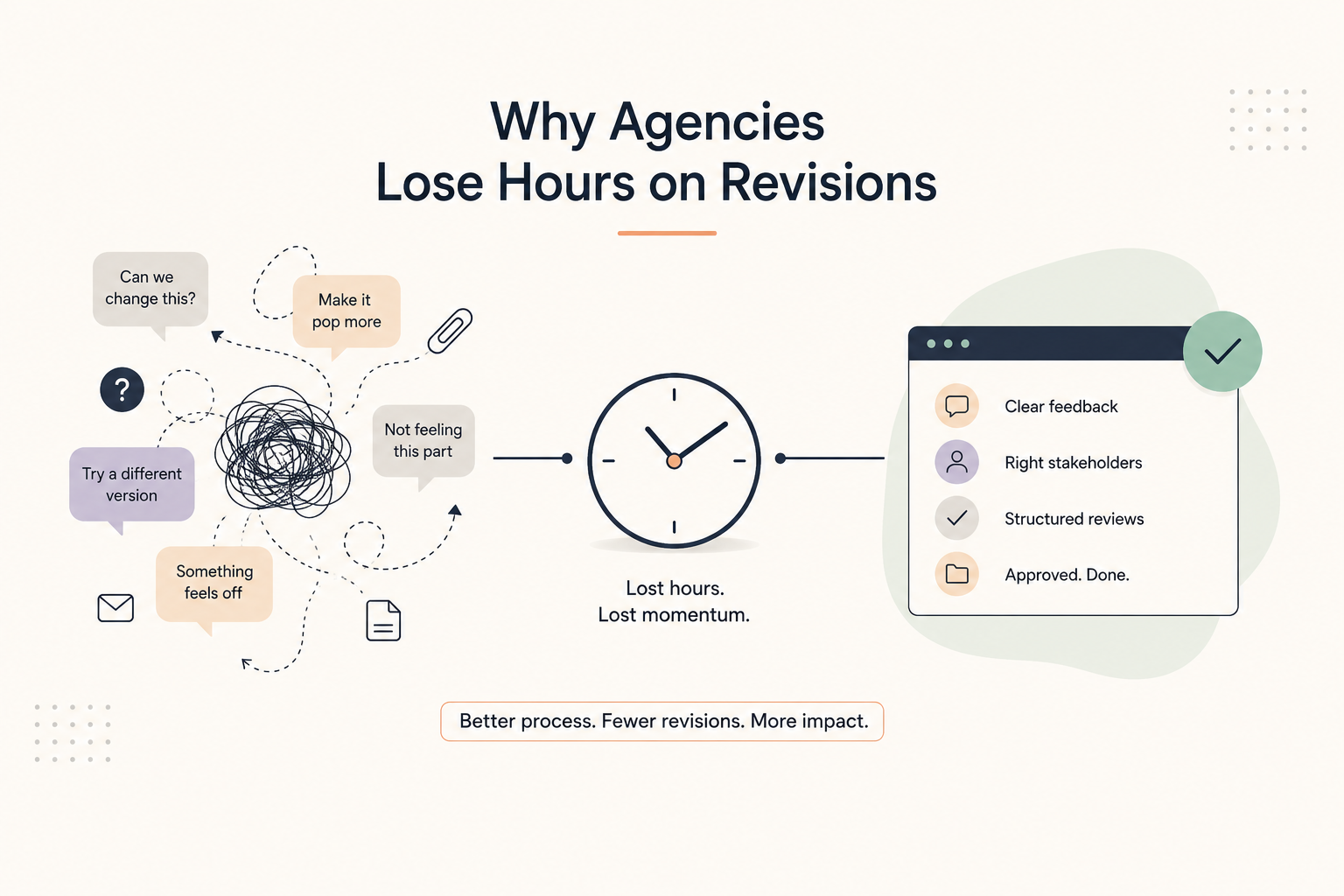
Revisions Are Not the Problem
Ask any agency owner where their team's time disappears, and you'll hear a familiar answer:
"Revisions."
Projects that should take five days stretch into three weeks.
Designers revisit the same files repeatedly.
Clients request "small changes" that somehow consume entire afternoons.
Account managers spend hours coordinating feedback.
And deadlines keep moving further away.
Most agencies assume revisions are simply part of creative work.
They're wrong.
The real problem isn't revisions.
The real problem is revision inefficiency.
Because the most profitable agencies don't necessarily do fewer revisions.
They do better revisions.
The Hidden Cost of "Just One More Change"
Every agency has heard:
"Just one quick tweak."
"Can we see another version?"
"Let's explore a few more options."
"This should only take five minutes."
Individually, these requests seem harmless.
Collectively, they're devastating.
A revision rarely involves only the designer.
It often triggers:
Project management time
Internal reviews
Client communication
Version updates
File exports
Approval rounds
A five-minute request often becomes a thirty-minute process.
Multiply that across dozens of projects, and agencies lose hundreds of billable hours every month.
Why Revisions Consume So Much Time
1. Feedback Arrives Too Late
One of the biggest causes of revision waste is delayed feedback.
Many agencies present nearly finished work before validating:
Strategy
Messaging
Direction
Stakeholder expectations
When major concerns emerge late in the process, teams must revisit work that should have been approved earlier.
A small strategic misalignment can trigger massive redesign efforts.
2. Stakeholders Join Too Late
A common agency nightmare looks like this:
Week 1: Marketing manager approves.
Week 2: Brand manager approves.
Week 3: Creative director approves.
Week 4: CEO sees it for the first time.
Everything changes.
The project starts over.
The issue isn't design quality.
The issue is stakeholder sequencing.
When decision-makers enter the process too late, revision volume explodes.
3. Vague Feedback Creates More Work
Comments like:
"Make it pop."
"It feels off."
"Can we make it more premium?"
"Let's try something different."
Sound harmless.
But vague feedback forces designers to guess.
When designers guess, revision cycles increase.
Every unclear comment creates multiple possible interpretations.
And every interpretation creates additional work.
The Revision Multiplier Effect
Most agencies underestimate how quickly revision complexity grows.
One stakeholder leaves five comments.
Three stakeholders leave fifteen comments.
Five stakeholders leave fifty comments.
The challenge isn't addition.
It's interaction.
Comments often conflict.
For example:
Marketing wants more information.
Design wants simplicity.
Sales wants more features.
Leadership wants stronger branding.
Each revision influences every other revision.
Complexity compounds.
The Psychology Behind Endless Revisions
Many revisions aren't driven by actual problems.
They're driven by human behavior.
Fear of Commitment
Approving creative work feels risky.
Clients worry about:
Customer reactions
Internal criticism
Revenue impact
When uncertainty rises, revision requests rise.
Sometimes revisions become a substitute for decision-making.
Desire for Control
People feel ownership when they contribute.
As a result, some stakeholders leave comments simply to participate.
The feedback isn't always necessary.
It's psychological.
Confirmation Bias
Once someone dislikes a concept, they start searching for reasons to justify their opinion.
This creates revision requests that focus on symptoms rather than root causes.
Why Email Is a Revision Nightmare
Many agencies still manage feedback through:
Email threads
PDF markups
Messaging apps
Meeting notes
This creates predictable problems.
Lost Context
Nobody remembers why a decision was made.
Duplicate Feedback
The same issue appears multiple times.
Contradictory Requests
Stakeholders disagree.
Version Confusion
Teams work from outdated files.
The result is revision chaos.
The Real Cost of Revision Waste
Most agencies measure project profitability incorrectly.
They calculate:
Design hours
Development hours
Meeting hours
But they often ignore revision costs.
Revision waste impacts:
Profitability
More revisions mean lower margins.
Team Morale
Repeated changes frustrate creative teams.
Delivery Speed
Projects take longer to launch.
Client Experience
Excessive revisions create fatigue on both sides.
Growth Capacity
Hours spent revising cannot be spent acquiring new business.
The opportunity cost is enormous.
The Agency Profitability Equation
A simple truth exists:
Every unnecessary revision reduces profit.
Imagine an agency handling:
20 active projects
3 unnecessary revision rounds per project
45 minutes per revision round
That's:
45 hours of lost productivity.
Every month.
For many agencies, that's the equivalent of an additional employee's workload being consumed by avoidable revision activity.
Why High-Performing Agencies Handle Revisions Differently
The best agencies don't eliminate revisions.
They structure them.
They understand that revisions are communication events, not design events.
Their goal is to improve decision-making quality.
Not simply move pixels faster.
How Agencies Reduce Revision Hours
1. Align Before Designing
Before creating visuals, align on:
Goals
Audience
Messaging
Success criteria
The earlier alignment happens, the fewer revisions occur later.
2. Define Decision-Makers Early
Identify:
Who can approve
Who can comment
Who must be informed
This prevents surprise stakeholders from entering late.
3. Ask Better Questions
Replace:
"What do you think?"
With:
Does this meet the objective?
Is anything factually incorrect?
Does this align with the brand?
Specific questions produce specific feedback.
4. Centralize Feedback
The most efficient agencies maintain a single source of truth.
Modern creative review platforms such as Revue help agencies collect annotations, approvals, comments, and version history in one place, reducing confusion and unnecessary revision cycles.
When everyone reviews the same asset within the same workflow, communication improves dramatically.
5. Separate Preferences from Problems
Not every comment deserves implementation.
Great agencies learn to ask:
"What problem are we solving?"
Before making changes.
This prevents teams from revising based solely on personal preference.
6. Create Review Milestones
Instead of gathering all feedback at the end, establish checkpoints:
Stage 1: Strategy Approval
Confirm direction.
Stage 2: Concept Approval
Confirm creative approach.
Stage 3: Design Approval
Confirm execution.
Stage 4: Quality Review
Confirm accuracy.
Breaking reviews into stages prevents large-scale revisions later.
The Role of Quality Control in Reducing Revisions
A surprising number of revisions originate from preventable mistakes:
Typos
Incorrect dates
Misaligned elements
Wrong pricing
Missing assets
Brand inconsistencies
These aren't creative disagreements.
They're quality issues.
The more quality checks happen before client review, the fewer revision cycles occur afterward.
This is one reason agencies are increasingly investing in structured creative operations and quality-control workflows.
What Elite Agencies Understand
Top-performing agencies know something most agencies miss:
Revisions are rarely caused by poor design.
They're usually caused by:
Poor communication
Poor alignment
Poor review processes
Poor decision-making structures
The solution isn't faster designers.
The solution is better systems.
Because every hour saved on revisions becomes an hour available for:
More projects
Better creative work
Stronger client relationships
Higher profitability
Conclusion
Agencies don't lose time because revisions exist.
They lose time because revisions are often unmanaged.
When feedback is vague, stakeholders are misaligned, approvals are scattered, and communication lacks structure, revision hours multiply quickly.
The agencies that scale successfully aren't the ones avoiding revisions.
They're the ones creating systems that make revisions efficient.
Because the real goal isn't fewer comments.
It's fewer unnecessary comments.
And that's where profitability begins.
Frequently asked questions
Why do agencies spend so much time on revisions?
Most revision delays are caused by poor feedback quality, stakeholder misalignment, unclear approval processes, and fragmented communication.
How can agencies reduce revision cycles?
By aligning objectives early, involving decision-makers sooner, centralizing feedback, and implementing structured review workflows.
What causes endless design revisions?
Common causes include vague feedback, late stakeholder involvement, fear of decision-making, and lack of clear approval stages.
How do revisions affect agency profitability?
Each additional revision consumes billable hours, delays delivery, reduces margins, and limits team capacity for new projects.
What tools help agencies manage revisions better?
Creative review and feedback management platforms can centralize communication, approvals, annotations, and version history to reduce revision inefficiencies.