Most client-agency conflicts don't start because someone is incompetent.
They don't happen because agencies don't care.
And they don't happen because clients are unreasonable.
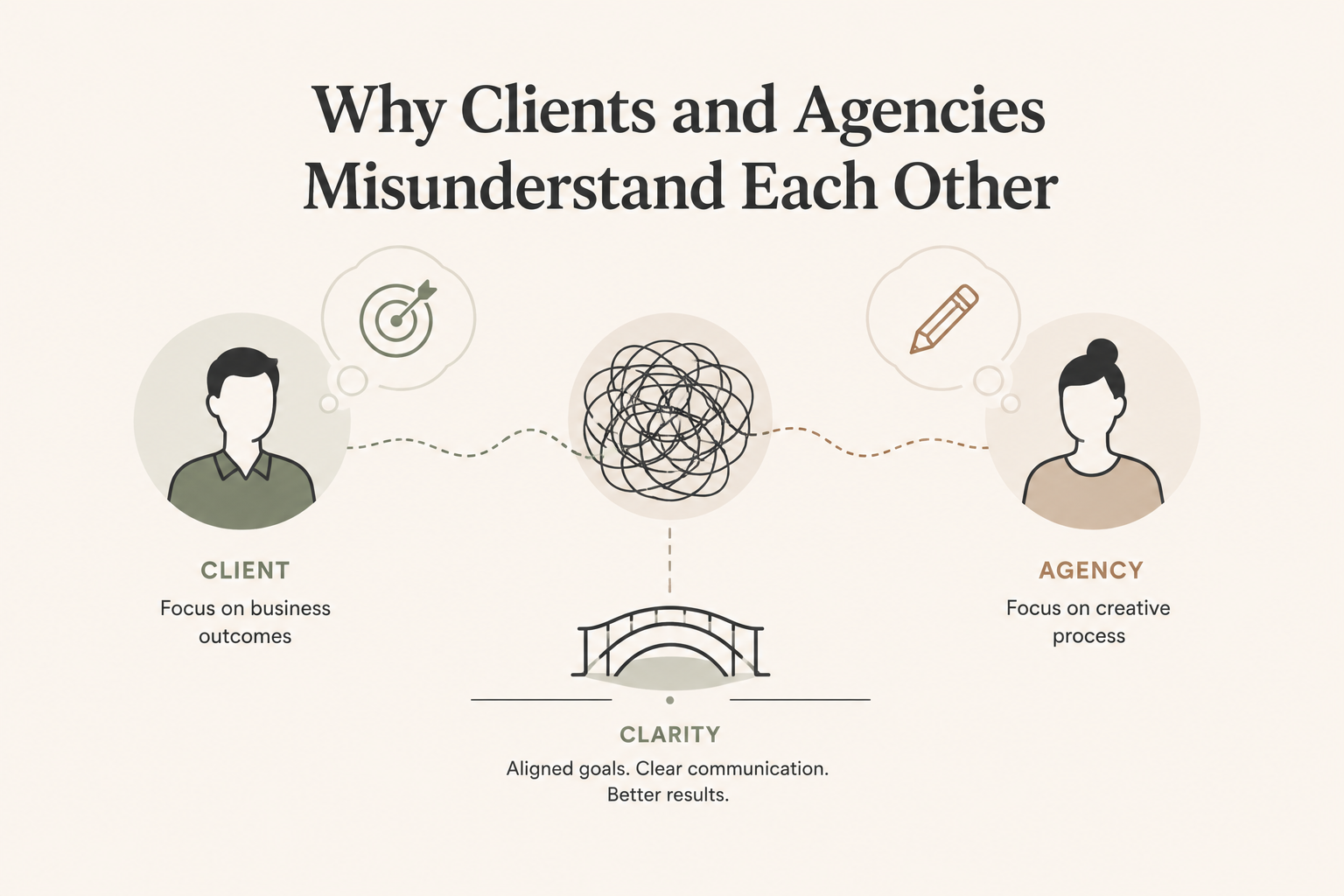
Most misunderstandings occur because clients and agencies are solving the same problem from completely different perspectives.
The client sees business outcomes.
The agency sees creative execution.
The client wants certainty.
The agency needs exploration.
The client focuses on results.
The agency focuses on process.
Neither side is wrong.
But when these perspectives aren't aligned, misunderstandings become inevitable.
The Client-Agency Relationship Is Built on Different Expectations
Every project begins with expectations.
The challenge is that clients and agencies often have different definitions of success.
Clients may expect:
Faster delivery
Immediate responsiveness
Predictable outcomes
Minimal revisions
Clear ROI
Agencies may expect:
Timely feedback
Clear decision-making
Strategic collaboration
Creative trust
Structured review processes
When these expectations remain unspoken, friction appears later.
Clients Buy Outcomes. Agencies Deliver Processes.
One of the biggest disconnects in creative work is how each side views progress.
Clients care about:
Increased sales
Better brand perception
More leads
Higher engagement
Business growth
Agencies focus on:
Research
Concepts
Reviews
Revisions
Production workflows
Clients often see the final result.
Agencies see everything required to get there.
This difference creates frustration when timelines, budgets, or review cycles become longer than expected.
Why Creative Work Feels Uncertain to Clients
Most business functions are measurable.
A finance report is either correct or incorrect.
An inventory count is either accurate or inaccurate.
Creative work is different.
Questions such as:
Is this design modern enough?
Does this campaign feel premium?
Is this message compelling?
are subjective.
Clients often expect certainty.
Creative development requires experimentation.
This tension creates misunderstandings during reviews and approvals.
The Communication Gap
Many agency-client problems are actually communication problems.
Information becomes fragmented across:
Emails
Calls
Meetings
Messaging apps
Presentation decks
As communication spreads across multiple channels:
Feedback gets lost
Decisions become unclear
Expectations shift
Accountability weakens
Both sides believe they are communicating effectively.
Yet both sides leave conversations with different interpretations.
Why Feedback Creates Friction
Feedback is essential.
But feedback is also where many relationships begin to break down.
Agencies Think:
"The client keeps changing their mind."
Clients Think:
"The agency doesn't understand what we need."
In reality, both sides are often reacting to unclear communication.
Without structured feedback systems:
Comments become inconsistent
Decisions get revisited
Revision cycles increase
The project slows down.
The Approval Problem
Clients often feel agencies push for approvals too quickly.
Agencies often feel clients take too long to decide.
Both perspectives are understandable.
Clients may need:
Internal stakeholder alignment
Legal reviews
Leadership approvals
Budget confirmation
Agencies need:
Project momentum
Resource planning
Delivery schedules
Capacity management
Neither side fully sees the pressures facing the other.
Why Agencies Overestimate Client Knowledge
Creative professionals work with:
Brand systems
Design principles
Typography
User experience
Production requirements
every day.
Clients usually don't.
Agencies sometimes assume clients understand:
Creative terminology
Workflow stages
Revision implications
Production constraints
This assumption creates confusion.
What feels obvious to an agency may be completely unfamiliar to a client.
Why Clients Underestimate Agency Complexity
From the client's perspective:
"Can we make one small change?"
From the agency's perspective:
That change may require:
New layouts
Additional reviews
Updated assets
Quality checks
Stakeholder approvals
Clients often see the request.
Agencies see the process behind the request.
This difference affects timelines and expectations.
The Cost of Misunderstanding
Misalignment affects more than relationships.
It affects business performance.
More Revision Cycles
Unclear expectations create additional rounds of changes.
Slower Approvals
Stakeholders hesitate when objectives aren't aligned.
Reduced Profitability
Agencies spend more time clarifying than creating.
Lower Client Satisfaction
Clients lose confidence when projects feel unpredictable.
Team Frustration
Both sides become exhausted by repeated conversations.
How High-Performing Agencies Reduce Misunderstandings
The best agencies don't simply communicate more.
They communicate more clearly.
Start With Better Discovery
Projects begin with clear objectives.
Everyone agrees on:
Goals
Success criteria
Deliverables
Constraints
Document Decisions
Important decisions should never live only in meetings.
Documentation creates alignment.
Centralize Feedback
When feedback exists in one location:
Comments remain visible
Decisions stay traceable
Revisions become easier to manage
Separate Creative and Productive Reviews
Strategic feedback and execution feedback require different conversations.
Combining them often creates confusion.
Improve Quality Control
Clients lose trust when they repeatedly find avoidable mistakes.
Strong quality assurance improves confidence and reduces friction.
The Role of Creative Workflow Systems
Modern agencies increasingly rely on workflow tools to improve transparency.
These systems help teams:
Manage feedback
Track approvals
Document revisions
Compare versions
Improve project visibility
When both clients and agencies share the same source of truth, misunderstandings decrease significantly.
The Best Client Relationships Are Built on Clarity
Many agencies believe stronger relationships come from better creativity.
Creativity matters.
But clarity matters just as much.
Clients don't simply want great work.
They want confidence.
They want visibility.
They want predictability.
The agencies that consistently earn trust are often the ones that make collaboration easier.
Conclusion
Clients and agencies rarely misunderstand each other because of bad intentions.
They misunderstand each other because they operate with different priorities, perspectives, and assumptions.
Clients focus on outcomes.
Agencies focus on execution.
Clients seek certainty.
Agencies navigate ambiguity.
The solution isn't more communication.
It's better communication systems.
Because when expectations, feedback, approvals, and decisions become clearer, collaboration improves naturally.
And when collaboration improves, better creative work follows.
Frequently asked questions
1. Why do clients and agencies often misunderstand each other?
Clients and agencies approach projects from different perspectives. Clients focus on business outcomes, while agencies focus on creative processes and execution. Without alignment, misunderstandings are common.
2. What are the biggest causes of client-agency communication problems?
Common causes include unclear expectations, fragmented feedback, undocumented decisions, delayed approvals, and differing assumptions about project timelines and deliverables.
3. How can agencies improve client communication?
Agencies can improve communication by setting expectations early, documenting decisions, centralizing feedback, creating structured approval workflows, and maintaining transparency throughout the project.
4. Why do clients often request more revisions than agencies expect?
Clients may discover new stakeholder feedback, gain additional insights, or realize their requirements were not fully communicated initially. Structured review processes help reduce excessive revisions.
5. How do workflow tools help reduce client-agency misunderstandings?
Workflow and review platforms centralize communication, document decisions, track revisions, manage approvals, and provide visibility into project progress, reducing confusion for both parties.