The Most Stressful Moment in Design Isn't the Beginning
Most people assume the hardest part of a creative project is starting.
The blank canvas.
The tight deadline.
The difficult brief.
But ask experienced designers what creates the most anxiety, and many will point to a different moment:
Final delivery.
The email is drafted.
The files are attached.
The approval meeting is complete.
Everything is ready.
Yet somehow, the cursor hovers over the "Send" button for a little longer than it should.
The designer checks the files one last time.
Then again.
And sometimes, again.
Why?
Because final delivery represents something much deeper than simply sending a file.
It represents permanence.
The Hidden Psychology Behind Final Delivery
Designers spend days, weeks, and sometimes months refining work.
Throughout the process, there's comfort in knowing:
Changes are possible
Mistakes can be fixed
Decisions can be revisited
Final delivery changes everything.
It marks the moment when work leaves the designer's control.
From that point onward:
Clients will evaluate it
Customers will experience it
Stakeholders will judge it
Mistakes may become public
This transition creates psychological pressure.
The fear isn't delivery itself.
The fear is what happens after delivery.
Why Designers Fear Final Delivery
1. Fear of Missing Something
Every designer has experienced it.
The typo that nobody noticed.
The misaligned element hidden in plain sight.
The wrong version exported.
The missing asset.
The incorrect phone number.
The broken link.
These mistakes often remain invisible until the project reaches the client.
As a result, designers develop a habit of second-guessing themselves.
No matter how many reviews occur, the question remains:
"What if I missed something?"
2. Perfectionism Creates Endless Loops
Perfectionism is often celebrated in creative industries.
But perfectionism has a hidden cost.
Perfectionists rarely feel finished.
They simply reach a point where time runs out.
The challenge is that every project contains countless possible improvements:
Better spacing
Better copy
Better imagery
Better hierarchy
Better interactions
If perfection becomes the goal, delivery becomes impossible.
The project never feels ready.
3. Fear of Public Mistakes
Creative work is highly visible.
When a mistake appears:
Thousands may see it
Customers may notice it
Social media may amplify it
Competitors may highlight it
Unlike many professions, design errors often exist in public.
This visibility increases anxiety around final handoff.
4. Identity and Self-Worth Become Attached to the Work
Designers don't just create projects.
They create expressions of thought, effort, and expertise.
This makes criticism feel personal.
When work is delivered, it becomes vulnerable to judgment.
Questions begin to surface:
What if they don't like it?
What if they find problems?
What if they think I'm not good enough?
The work becomes a proxy for self-worth.
That's where delivery anxiety often begins.
The Agency Version of Delivery Fear
For agencies, final delivery carries additional risks.
A single mistake can affect:
Client trust
Retention rates
Reputation
Referrals
Revenue
The larger the client, the greater the pressure.
Many agencies have experienced situations where:
A tiny oversight overshadowed months of excellent work.
The result?
Teams become increasingly cautious.
Sometimes excessively cautious.
The Cost of Delivery Anxiety
A healthy level of caution is useful.
But excessive fear creates problems.
Endless Review Cycles
Designers keep checking work repeatedly.
Delivery gets delayed.
Momentum disappears.
Reduced Creativity
Fear encourages safe decisions.
Teams become less willing to explore bold ideas.
Burnout
Constantly searching for invisible mistakes is mentally exhausting.
The designer never experiences closure.
Lower Profitability
Every additional review round consumes time.
Over time, these hours accumulate into significant operational costs.
Why Small Mistakes Feel So Big
Humans are wired to notice negative outcomes more intensely than positive ones.
Psychologists call this Negativity Bias.
One typo can outweigh:
Great strategy
Strong design
Successful results
Positive client feedback
Teams remember failures more vividly than successes.
This creates disproportionate fear around quality control.
The Real Problem: Humans Are Terrible at Repetitive Reviews
Design work often requires reviewing:
Headlines
Body copy
Prices
Contact details
URLs
Alignment
Spacing
Brand consistency
The challenge is that humans become less effective at detecting errors through repetition.
The more times we review the same design, the more familiar it becomes.
The brain starts filling in missing information automatically.
Eventually, designers stop seeing what's actually there.
They see what they expect to see.
This is why obvious mistakes often survive multiple review rounds.
The Rise of Quality Control in Creative Operations
As projects become more complex, agencies are recognizing that quality assurance needs structure.
Historically, creative quality checks relied on:
Manual reviews
Senior designer approvals
Client proofing
Internal checklists
While these methods remain valuable, they become difficult to scale.
Particularly when managing:
Multiple campaigns
Hundreds of assets
Large creative teams
Fast-moving deadlines
This is why modern agencies are increasingly investing in systematic review processes rather than relying entirely on individual vigilance.
Why Final Delivery Is Becoming More Risky
Today's creative environment includes:
More channels
More formats
More stakeholders
More revisions
Faster timelines
A single campaign may include:
Social media posts
Display ads
Landing pages
Emails
Print assets
Video graphics
The number of potential error points grows exponentially.
Yet review time rarely increases.
This creates a dangerous gap between complexity and quality assurance.
The Difference Between Confidence and Certainty
Many designers seek certainty before delivery.
The problem is:
Certainty doesn't exist.
Every project contains unknowns.
The goal isn't perfect confidence.
The goal is reasonable confidence.
The best creative teams understand that quality comes from systems, not heroics.
Instead of relying on memory and manual checks, they create processes that reduce risk before delivery.
Building Confidence Before Final Delivery
1. Use Structured Checklists
Pilots use checklists.
Surgeons use checklists.
Creative teams should too.
Review:
Copy
Contact information
Brand elements
Asset naming
Version numbers
Export settings
Every single time.
2. Separate Design Review from Quality Review
Many teams combine both activities.
They shouldn't.
Creative evaluation asks:
"Is this effective?"
Quality evaluation asks:
"Is this correct?"
Treat them as separate processes.
3. Create Multiple Review Layers
Fresh eyes catch fresh mistakes.
Involve:
Designers
Account managers
Copywriters
Project managers
Different perspectives reveal different issues.
4. Centralize Feedback and Approvals
Scattered comments create uncertainty.
When approvals are spread across:
Email
Chat
PDFs
Meetings
Teams lose confidence in what has actually been approved.
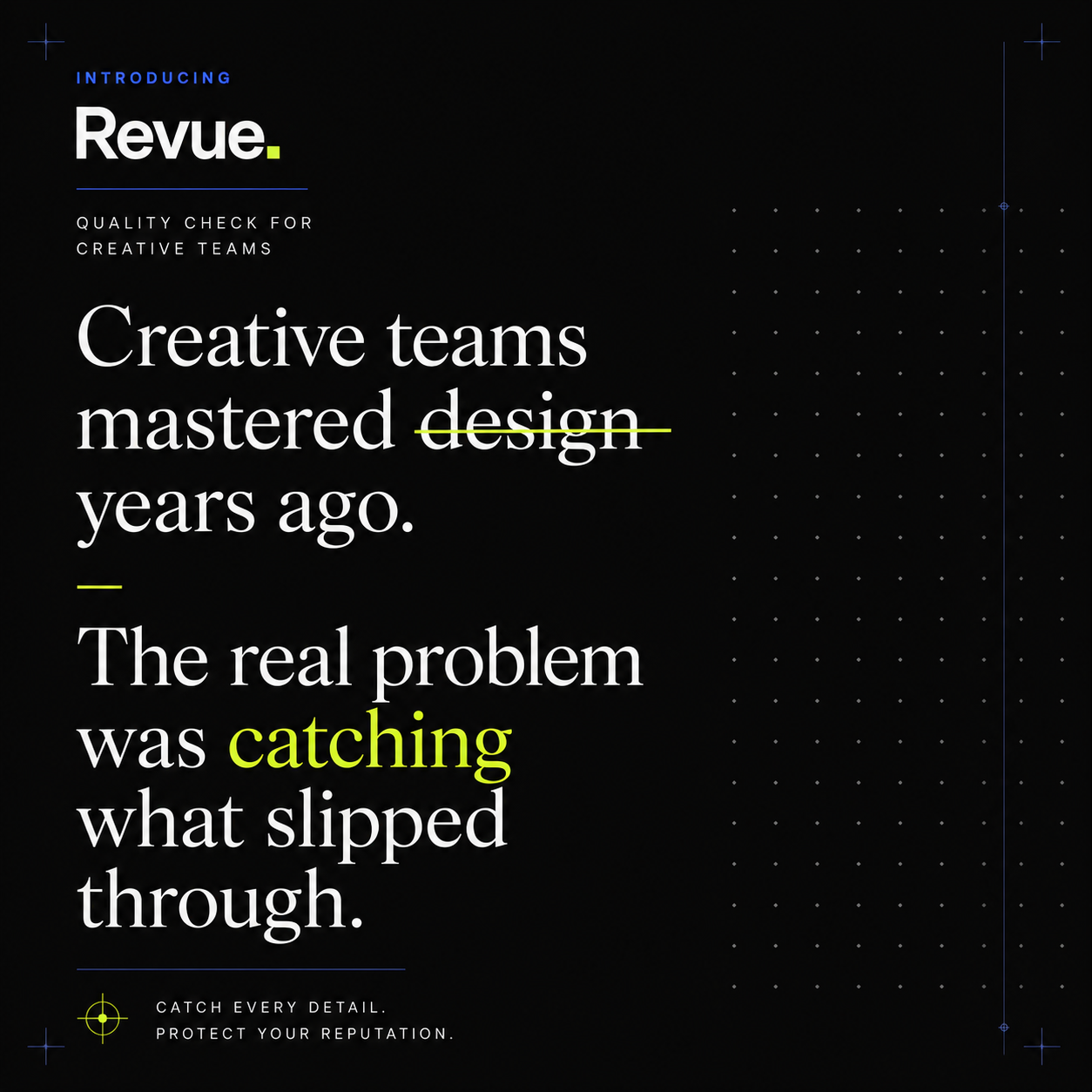
Platforms such as Revue help agencies centralize reviews, approvals, annotations, version comparisons, and quality workflows, reducing confusion before final delivery.
5. Accept That Perfect Doesn't Exist
Every successful project contains imperfections.
The objective is not flawlessness.
The objective is reducing meaningful risk.
Perfection is unattainable.
Professional quality is achievable.
What Elite Agencies Understand
Top-performing agencies don't trust memory.
They don't trust assumptions.
And they certainly don't trust luck.
They build systems.
Because the larger a creative operation becomes, the more dangerous it is to rely solely on human attention.
Great agencies recognize that quality assurance is not a final step.
It's a process embedded throughout the project lifecycle.
Conclusion
Designers don't fear final delivery because they're insecure.
They fear final delivery because they care.
They understand that a single overlooked mistake can overshadow weeks of excellent work.
But the answer isn't endless checking.
It's better systems.
The agencies that consistently deliver high-quality work aren't necessarily staffed by flawless designers.
They're staffed by teams that have created reliable processes for catching mistakes before clients do.
Because confidence at delivery doesn't come from believing nothing went wrong.
It comes from knowing you've done everything possible to prevent it.
Frequently asked questions
Why do designers get nervous before final delivery?
Designers often fear overlooked mistakes, client reactions, public scrutiny, and the loss of control that comes when work is finalized.
What causes delivery anxiety in creative teams?
Common causes include perfectionism, quality concerns, stakeholder pressure, and previous experiences with costly mistakes.
How can agencies reduce design errors before delivery?
Structured review processes, checklists, multiple reviewers, centralized approvals, and quality control systems significantly reduce risk.
Why do mistakes survive multiple review rounds?
Familiarity blindness causes reviewers to overlook errors because the brain begins seeing what it expects rather than what is actually present.
How can creative teams improve confidence during delivery?
By implementing repeatable quality assurance workflows, separating design reviews from error checks, and maintaining a single source of truth for feedback and approvals.