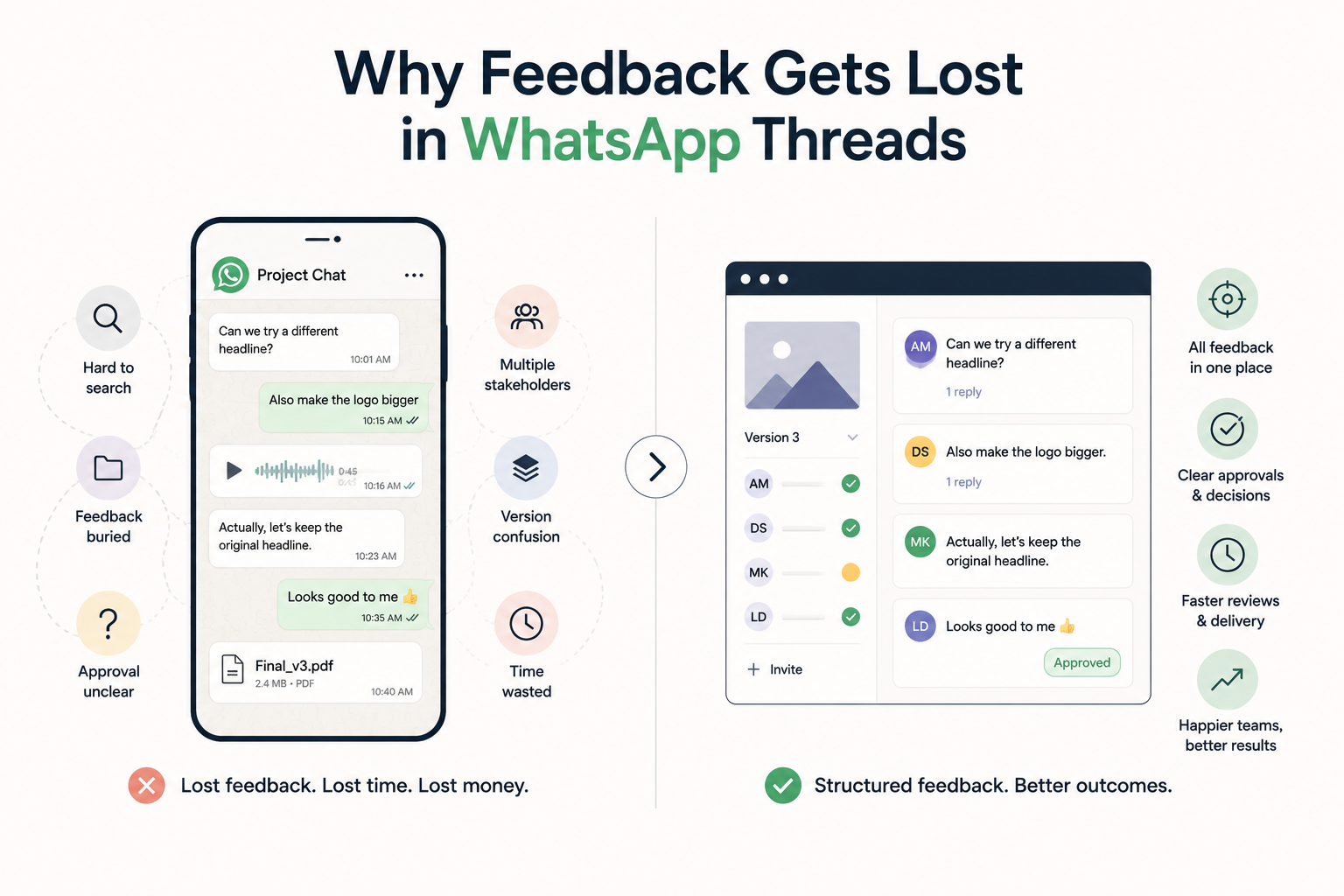
It Starts With a Simple Message
Every agency has experienced it.
A client sends feedback on WhatsApp:
"Looks good. Just make the logo slightly bigger."
A few hours later:
"Also change the headline."
The next morning:
"Actually, let's keep the original headline."
Later that week:
"Did we approve Version 3 or Version 4?"
Nobody knows.
The designer checks WhatsApp.
The account manager checks email.
The client checks an old PDF.
Everyone remembers a different version of events.
And just like that, a simple design review becomes a detective investigation.
The problem isn't the feedback itself.
The problem is where the feedback lives.
Why Agencies Love WhatsApp
To be fair, WhatsApp is incredibly convenient.
Clients already use it.
Teams already use it.
Responses are quick.
Communication feels informal and easy.
For small conversations, it's perfect.
But project feedback isn't a small conversation.
It's operational data.
And that's where problems begin.
WhatsApp Was Built for Communication, Not Collaboration
WhatsApp is excellent for:
Quick updates
Simple discussions
Fast decisions
Informal communication
It was never designed for:
Design approvals
Version tracking
Stakeholder reviews
Project documentation
Creative collaboration
Yet many agencies attempt to manage entire review processes inside a chat application.
The result is predictable chaos.
The Search Problem
Imagine a project lasting six weeks.
During that period, feedback arrives through:
Individual messages
Group chats
Voice notes
Shared images
Forwarded messages
Now imagine trying to answer:
"When did the client approve the final homepage design?"
The information exists somewhere.
Finding it is another story.
Teams spend valuable time searching instead of executing.
Feedback Has a Short Shelf Life in Chat
WhatsApp conversations move quickly.
A critical comment can disappear beneath:
Good morning messages
Status updates
Meeting reminders
New discussions
Important feedback becomes buried under unrelated communication.
The longer the project runs, the harder information becomes to retrieve.
The Voice Note Problem
Voice notes have become a favorite communication method.
Clients often send:
"I've got a few thoughts..."
Three minutes later:
The designer is listening to:
Revision requests
New ideas
Questions
Strategic changes
All mixed together.
The challenge?
Voice notes are difficult to:
Search
Reference
Organize
Track
Weeks later, nobody remembers exactly what was said.
Everyone remembers what they think was said.
Why Feedback Gets Distorted
Human memory is unreliable.
Psychologists call this reconstructive memory.
People don't remember conversations perfectly.
They reconstruct them.
This means:
The client remembers approving Version A.
The designer remembers approval for Version B.
The account manager remembers a conditional approval.
Everyone believes they're correct.
Because they're remembering different interpretations of the same conversation.
When feedback lacks structure, memory fills the gaps.
The Screenshot Culture Problem
Many agencies attempt to solve WhatsApp chaos with screenshots.
The process looks like this:
Client sends feedback.
Account manager screenshots it.
Screenshot gets shared internally.
Designer reviews screenshot.
Another screenshot confirms completion.
Soon there are dozens of screenshots.
Ironically, screenshots create a second layer of documentation chaos.
Now teams must manage:
Feedback
Screenshots of feedback
Responses to feedback
Screenshots of responses
The complexity multiplies.
The Hidden Cost of Lost Feedback
Most agencies underestimate how expensive lost feedback can become.
Let's examine the real costs.
Cost #1: Duplicate Work
A comment gets missed.
The client follows up later.
The team revisits completed work.
Hours are spent implementing changes that should have happened earlier.
Cost #2: Revision Loops
When feedback isn't centralized, teams often receive the same request multiple times.
Nobody is certain whether it was addressed.
So it gets reviewed again.
And again.
And again.
Cost #3: Approval Confusion
One of the most expensive questions in agency operations is:
"Was this approved?"
If nobody can answer confidently, projects stall.
Cost #4: Team Frustration
Designers hate searching.
Project managers hate chasing.
Clients hate repeating themselves.
Lost feedback creates frustration for everyone involved.
Why Version Confusion Happens
A client reviews:
Version 1 in email
Version 2 in WhatsApp
Version 3 in PDF
Version 4 in Google Drive
By the end of the project, nobody knows which file is current.
This creates one of the most common agency problems:
Feedback applied to the wrong version.
The result?
More revisions.
More confusion.
More delays.
The Stakeholder Visibility Problem
WhatsApp works reasonably well when two people communicate.
It becomes problematic when:
Designers
Account managers
Creative directors
Clients
Marketing managers
Founders
All need visibility.
Not everyone sees every message.
Not everyone joins every conversation.
Important decisions become fragmented across individuals.
Why Agencies Continue Using WhatsApp
If it's so problematic, why do agencies continue using it?
Because it feels faster.
And in the short term, it is.
Sending feedback through WhatsApp takes seconds.
Managing that feedback later may take hours.
The convenience is immediate.
The cost is delayed.
Which makes it difficult to recognize.
The Shift Toward Structured Feedback
High-performing agencies increasingly separate:
Communication
From
Review Management
Communication can happen anywhere.
Feedback should happen somewhere structured.
Modern creative review platforms such as Revue are designed to centralize:
Comments
Annotations
Approvals
Version history
Stakeholder discussions
The objective isn't replacing communication.
It's preventing important project decisions from disappearing into endless chat threads.
How Agencies Can Stop Losing Feedback
1. Create a Single Source of Truth
Every project should have one location where:
Feedback lives
Approvals are recorded
Decisions are documented
No exceptions.
2. Separate Discussion From Decisions
Conversations can happen anywhere.
Final decisions should be documented in one place.
3. Stop Approving Designs Through Chat
Quick comments are fine.
Formal approvals should occur within a review workflow.
4. Link Feedback to Assets
Feedback should be attached directly to:
Designs
Screens
Pages
Creative assets
Not hidden inside conversations.
5. Maintain Version History
Teams should always know:
Current version
Previous version
Approved version
Without searching through messages.
What Elite Agencies Understand
Top-performing agencies know something most agencies eventually learn the hard way:
Feedback is not communication.
Feedback is project data.
And project data deserves structure.
Because every lost comment creates:
Additional revisions
Additional meetings
Additional delays
Additional costs
The agencies that scale successfully treat feedback with the same discipline they apply to budgets, timelines, and deliverables.
Conclusion
WhatsApp is an incredible communication tool.
It is not a project management system.
It is not a review platform.
And it is certainly not a reliable approval workflow.
As projects become larger and stakeholders become more involved, the cost of scattered feedback increases dramatically.
The agencies that continue relying on chat threads eventually encounter the same problems:
Lost comments
Missed approvals
Revision chaos
Frustrated teams
The solution isn't less communication.
It's more structured communication.
Because feedback only creates value when people can actually find it.
Frequently asked questions
Why does feedback get lost in WhatsApp?
WhatsApp conversations move quickly, making it easy for important comments, approvals, and decisions to become buried beneath newer messages.
Is WhatsApp good for managing design reviews?
WhatsApp works well for communication but lacks version tracking, approval management, annotation tools, and structured review workflows.
What problems arise when agencies use WhatsApp for feedback?
Common issues include missed comments, duplicate revisions, approval confusion, version mismatches, and poor stakeholder visibility.
How can agencies organize client feedback better?
By centralizing comments, approvals, and version history within a dedicated review process rather than relying solely on chat applications.
What is a single source of truth for feedback?
A centralized location where all project comments, approvals, decisions, and revisions are stored and accessible to stakeholders.