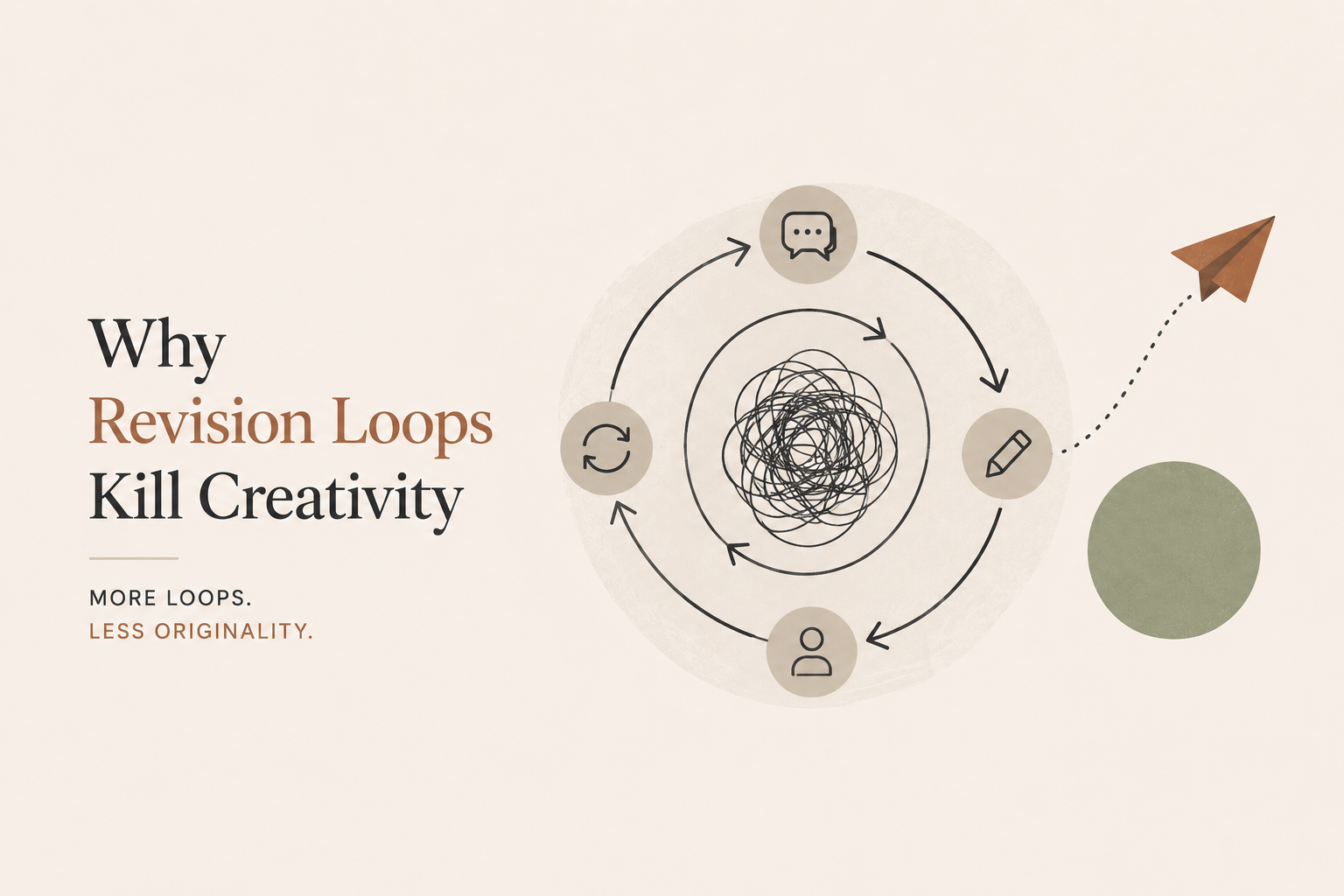
Every creative professional has experienced it.
A project starts with excitement.
The brief is clear.
Ideas are flowing.
The concept is strong.
Then the revisions begin.
One stakeholder wants a different color.
Another prefers a different layout.
A third wants to revisit an earlier version.
Soon, what started as a focused creative vision becomes a collection of compromises.
The project takes longer.
The team becomes frustrated.
The work loses its originality.
And creativity slowly dies under the weight of endless revisions.
Revisions Are Necessary. Revision Loops Are Not.
There is a difference between constructive feedback and endless revision cycles.
Healthy revisions:
Improve clarity
Refine execution
Align work with objectives
Strengthen outcomes
Revision loops do the opposite.
They create repeated cycles where feedback continues without clear direction or decision-making.
Instead of improving the work, the team spends its energy responding to conflicting opinions and changing requirements.
What Is a Revision Loop?
A revision loop occurs when creative work repeatedly moves between stakeholders without reaching a final decision.
Typical symptoms include:
Feedback arriving in multiple rounds
Stakeholders changing previous decisions
Contradictory comments
Reopening approved concepts
Constant "small tweaks"
The project appears active but makes little meaningful progress.
Why Revision Loops Happen
Most revision loops are not caused by poor design.
They are caused by poor process.
Unclear Project Goals
When success criteria are undefined, feedback becomes subjective.
Comments shift from:
"This doesn't meet the objective."
to
"I personally don't like it."
This creates endless debate.
Too Many Stakeholders
The more people involved in reviews, the more opinions enter the process.
Without clear ownership:
Feedback conflicts
Decisions get reversed
Approval becomes difficult
Creative work turns into committee-driven design.
Poor Feedback Systems
Feedback scattered across:
Emails
Meetings
Chat tools
Phone calls
creates confusion and duplication.
Teams spend more time interpreting feedback than acting on it.
Fear of Decision-Making
Some organizations avoid making final decisions.
Instead of approving work, they request another round of revisions.
This creates an illusion of progress while delaying outcomes.
How Revision Loops Damage Creativity
Many people assume more revisions lead to better work.
In reality, excessive revisions often produce the opposite effect.
Original Ideas Get Diluted
Strong concepts are built around a clear creative direction.
Every unnecessary revision introduces compromises.
Eventually, the work becomes a blend of stakeholder preferences rather than a coherent idea.
Creative Confidence Declines
Designers perform best when trusted.
Repeatedly revisiting approved work sends a different message:
"We're not confident in the direction."
Over time, creative teams become less willing to propose bold ideas.
Teams Start Designing for Approval
Instead of solving the problem, designers begin optimizing for stakeholder acceptance.
This leads to:
Safer solutions
Generic outcomes
Predictable designs
Innovation decreases.
Momentum Disappears
Creativity thrives on progress.
Revision loops create stagnation.
Projects become trapped in review cycles rather than moving toward completion.
The Hidden Cost of Revision Loops
Most agencies underestimate how expensive revisions actually are.
Every additional revision creates:
Lost Billable Hours
Time spent revising could have been spent on new projects.
Lower Profit Margins
Additional work often falls outside the original scope.
The agency absorbs the cost.
Delayed Project Delivery
Deadlines shift.
Schedules become unreliable.
Client expectations become harder to manage.
Team Burnout
Nothing drains motivation faster than repeatedly revisiting the same project.
Creative professionals want to create, not endlessly rework.
Why Revision Loops Hurt Clients Too
Clients often believe additional revisions improve outcomes.
In reality, excessive revision cycles create problems for everyone.
Clients experience:
Longer timelines
Delayed launches
Increased costs
Decision fatigue
Reduced confidence
The best client experiences come from clarity, not endless iteration.
How High-Performing Agencies Reduce Revision Cycles
The most efficient agencies don't eliminate feedback.
They structure it.
Start With Better Briefs
Clear objectives reduce subjective feedback.
When success is defined early, reviews become more productive.
Establish Approval Authority
Every project should have a final decision-maker.
This prevents conflicting stakeholder input from derailing progress.
Centralize Feedback
Comments should live directly alongside the work.
This improves clarity and reduces misunderstandings.
Limit Revision Rounds
Successful agencies define revision limits before projects begin.
Boundaries encourage better decision-making.
Improve Quality Control
Many revisions occur because preventable errors reach review stages.
Examples include:
Typography mistakes
Alignment inconsistencies
Missing assets
Brand guideline violations
Better quality control reduces unnecessary revision cycles before clients ever see the work.
The Difference Between Iteration and Revision Loops
Creative excellence requires iteration.
But iteration and revision loops are not the same thing.
Healthy Iteration
Purpose-driven
Strategic
Objective-focused
Progress-oriented
Revision Loops
Reactive
Opinion-driven
Repetitive
Progress-resistant
One strengthens creativity.
The other weakens it.
Why Creative Freedom Requires Structure
This may seem counterintuitive.
But the most creative teams often operate within the strongest processes.
Clear workflows provide:
Faster decisions
Better communication
Defined ownership
Efficient reviews
Structure protects creativity from operational chaos.
Without it, revision loops become inevitable.
Conclusion
Revisions are an essential part of creative work.
Revision loops are not.
When feedback lacks structure, decisions remain unclear, and approval processes become fragmented, projects become trapped in endless cycles of rework.
The result is diluted creativity, frustrated teams, delayed timelines, and reduced profitability.
The goal isn't fewer ideas.
It's fewer unnecessary revisions.
Because great creative work emerges from clarity, focus, and decisive execution—not endless rounds of "just one more change."
Frequently asked questions
1. What is a revision loop in creative projects?
A revision loop occurs when a project repeatedly goes through feedback and changes without reaching a final decision. Stakeholders continue requesting modifications, often revisiting previously approved work.
2. Why do revision loops reduce creativity?
Revision loops dilute original ideas by introducing excessive opinions, conflicting feedback, and repeated compromises. Over time, creative work becomes safer, less distinctive, and more focused on approval than problem-solving.
3. How do revision loops affect agency profitability?
Revision loops increase non-billable work, consume valuable team hours, delay project delivery, and reduce profit margins. Agencies often absorb the cost of excessive revisions without increasing project fees.
4. How can agencies reduce unnecessary revisions?
Agencies can reduce revision cycles by creating clearer briefs, defining approval authority, centralizing feedback, setting revision limits, and implementing stronger quality control processes before client reviews.
5. What's the difference between iteration and revision loops?
Iteration is a structured process that improves work toward a specific objective. Revision loops involve repetitive changes without meaningful progress, often driven by subjective opinions rather than strategic goals.