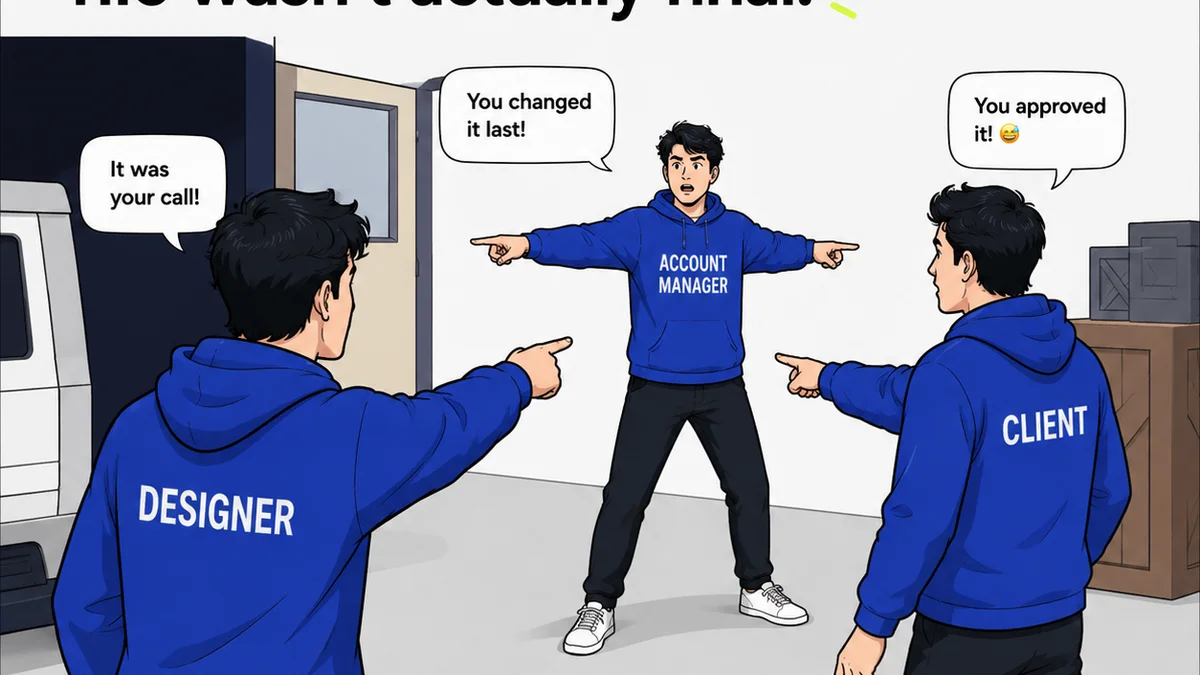
Everyone talks about efficient workflows. They say it’s about speed, about hitting deadlines, about clear communication. And none of that is wrong.
But it’s incomplete.
The real game-changer isn't just *having* a workflow. It’s making that workflow transparent. It’s about everyone involved – from the designer to the client – seeing the same progress, the same feedback, the same blockers, at all times.
This isn't about micromanagement. It’s about shared understanding and proactive problem-solving. When you pull back the curtain on your creative process, you unlock a level of delivery that simply isn’t possible when tasks and feedback live in silos.
1. The Illusion of Progress
You’ve got your project management tool. You’ve got your email threads. You’ve got your Slack channels. You think you’re on top of things.
But are you?
Often, what looks like progress is just a series of disconnected updates. A designer marks a task complete. An account manager sends an email. A client leaves a comment in a PDF. Each step feels like forward motion. But from a bird’s-eye view, it’s often a fragmented mess.
This fragmentation leads to:
- Delayed identification of bottlenecks.
- Misinterpretation of feedback.
- Unnecessary back-and-forth.
- Clients feeling out of the loop.
- Teams feeling overwhelmed and reactive.
The assumption is that if tasks are being checked off, the project is moving. The hard truth is that without visibility into the *entire* journey, you’re often just busy, not productive. You’re reacting to problems that could have been anticipated.
2. Unmasking the Real Bottlenecks
Where do projects *really* get stuck?
It’s rarely the creative work itself. Most creative teams are exceptionally good at their craft. The hang-ups usually happen in the handover points, the review cycles, the approval gates.
The Feedback Black Hole
A client provides feedback, but it’s buried in a long email chain or a scattered set of comments. The creative team receives it, interprets it, makes changes. Then the account manager asks for clarification, which is lost in another email.
Transparency means feedback isn't just received; it's logged, organized, and clearly linked to the specific asset. Everyone sees the feedback, its status, and the action taken.
The Approval Limbo
“Did they approve it?” You send a link. You wait. You follow up. You wait some more. This “limbo” is a massive time sink.
With a transparent workflow, the approval status is always clear. Stakeholders know when their input is needed, and project managers can see exactly who is holding up the process. No more guessing games.
The Revision Roundabout
A client requests revisions. The team makes them. The client asks for more, slightly different revisions. This can go on for days, even weeks.
Transparency helps here by clearly defining the scope of each revision round. It shows what has been addressed and what new requests are being made, making it harder for scope creep to go unnoticed.
3. Empowering Proactive Problem-Solving
When everyone sees the same roadmap, they can help navigate it.
Imagine a designer sees that a client has been slow to respond to a crucial piece of feedback for two days. Instead of waiting for an account manager to chase it, the designer might proactively ping the client directly (if protocol allows) or flag it to the PM via the shared system.
Or, a project manager sees that a copywriter is waiting on a design element before they can finalize their text. They can immediately see the dependency and ensure the design element is prioritized or that the copywriter is assigned a different, parallel task.
This shared visibility fosters a sense of collective ownership. It shifts the team from a reactive fire-fighting mode to a proactive, solution-oriented approach.
Benefits of Proactive Problem-Solving:
- Reduced delays and expedited timelines.
- Fewer missed deadlines and missed client expectations.
- Improved team morale and reduced burnout.
- Clients feel valued and informed, leading to stronger relationships.
4. Building Client Trust Through Clarity
Clients are often anxious. They’ve handed over a project, and now they’re waiting, hoping it’s being handled correctly.
Ambiguity breeds anxiety. Transparency breeds confidence.
When a client can log in and see exactly where their project stands – what feedback has been received, what revisions are in progress, what approvals are pending – they feel in control. They understand the process.
This reduces the need for constant status update emails, freeing up your team’s time. It also means that when you *do* need to discuss something, the conversation is grounded in objective reality, not subjective assumptions.
A transparent workflow is a powerful trust-building tool.
5. Where Revue Fits In
Managing creative projects without a centralized hub for feedback and approvals is like trying to build a house with scattered tools and no blueprint.
Revue is built to bring that transparency to your creative workflow.
It’s not just another task list. It’s a single source of truth for all client feedback and revision history.
- Centralized Feedback: All comments, annotations, and discussions live directly on the creative asset. No more digging through emails or chat logs.
- Clear Revision Tracking: See every version, every change, and every piece of feedback associated with it. Understand the evolution of the work at a glance.
- Visible Approval Status: Know exactly who needs to approve what, when it was requested, and when it was completed. Eliminate approval bottlenecks.
- Streamlined Quality Checks: Ensure that all feedback and requirements have been met before final delivery, reducing errors and client dissatisfaction.
By centralizing these critical aspects, Revue provides the visibility needed to transform your workflow from a series of disconnected steps into a coherent, transparent process.
6. Final Thought
How much time does your team *really* spend chasing down feedback, clarifying revisions, or simply figuring out the current status of a project?
If you can’t answer that question with certainty, you’re likely leaving efficiency, trust, and profitability on the table.
The assumption is that a functional workflow is enough. The hard truth is that transparency is the multiplier. It’s the secret ingredient that turns busy work into impactful delivery.
Are you ready to open the kimono on your creative process?
Frequently asked questions
What is workflow transparency in a creative agency?
Workflow transparency means making all stages of a project, from initial brief to final delivery, visible and accessible to relevant team members and clients. It includes clear tracking of tasks, feedback, revisions, and approvals in a centralized system.
How does transparency reduce project delays?
By providing a clear view of project status, feedback, and approvals, transparency helps identify bottlenecks early. This allows teams to proactively address issues, reallocate resources, and keep the project moving forward without getting stuck in communication black holes.
Can transparency really improve client relationships?
Yes. When clients can see the progress of their project and understand where their feedback fits in, it builds trust and reduces anxiety. This clarity leads to better communication and a more collaborative relationship, as clients feel informed and valued.
What are the biggest challenges to achieving workflow transparency?
Common challenges include relying on fragmented communication tools (email, chat), lack of standardized processes, resistance to adopting new tools, and the perception that transparency means micromanagement. Overcoming these requires clear communication, consistent tool adoption, and leadership buy-in.