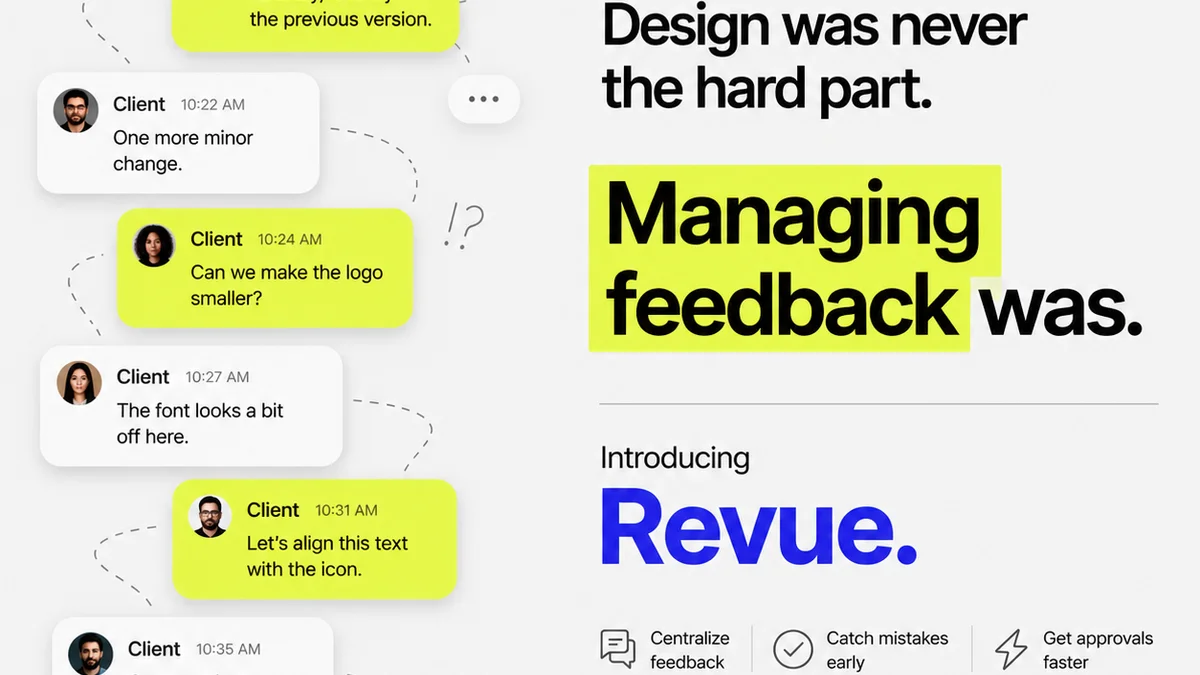
You're looking for a creative workflow tool. Maybe you're comparing Ziflow and Revue. You've probably got a spreadsheet open, ticking off features: annotation tools, version control, client portals, API integrations. You want to know which one has more bells and whistles.
None of that is wrong. But it’s incomplete.
The hard truth is, the *best* tool isn't the one with the longest feature list. It's the one that fundamentally improves how your team collaborates, how clients provide feedback, and how you manage the chaos of revisions. It’s about operational efficiency, not just point-and-click functionality.
1. The Illusion of Feature Parity
Most modern creative review and approval platforms offer a similar core set of features. They all promise to streamline feedback, manage versions, and get sign-offs faster. Ziflow does this. So does Revue. So do a dozen others.
This is where the comparison game gets tricky. It's easy to get lost in the weeds, debating the nuances of polygon annotation versus freehand drawing, or the exact structure of a client dashboard.
But these are table stakes. They are the minimum requirements for playing the game.
The Real Differentiators Aren't Always Obvious
What truly separates one platform from another isn't usually a single feature, but how that feature is implemented and, more importantly, how it impacts your day-to-day operations.
- Does the annotation tool feel intuitive to a client who's never used it before?
- How many clicks does it take to find the latest version of a file?
- Can you easily see the history of feedback on a specific element, or is it buried in email chains?
These are the questions that reveal the operational impact. A feature might exist on paper, but if it creates friction, it’s not a benefit.
2. Understanding Your Agency's Workflow Gap
Before you even look at Ziflow or Revue, you need to understand where your current process is breaking down. Are you…
- Constantly chasing feedback from clients via email and Slack?
- Struggling to keep track of which version is the *actual* final one?
- Wasting time compiling feedback from multiple sources?
- Having internal debates about what a client *really* meant in their comments?
- Experiencing delays because a crucial sign-off is stuck in someone's inbox?
These aren't just minor annoyances. They are operational inefficiencies that cost time, money, and can damage client relationships.
The goal of any review platform should be to *eliminate* these pain points, not just add another layer of technology on top of them.
Ziflow: A Focus on Broad Integration
Ziflow positions itself as a comprehensive creative workflow automation platform. Their strength often lies in their breadth of integrations and their focus on automating tasks across various creative tools and departments. For larger agencies or those with complex, multi-departmental workflows, Ziflow's ability to connect with other systems can be a significant draw.
Think about:
- Connecting to project management tools to automatically trigger review processes.
- Integrating with DAM systems for seamless asset retrieval.
- Automating file transfers and notifications across teams.
This approach is about embedding the review process into a larger ecosystem of tools.
Revue: A Focus on Centralized, Clear Feedback
Revue, on the other hand, hones in on the core problem: getting clear, actionable feedback and managing revisions efficiently. The emphasis is on making the feedback loop as frictionless as possible for both internal teams and external clients.
This translates to:
- A highly intuitive interface for clients, minimizing training and confusion.
- Clear, threaded conversations tied directly to specific design elements.
- Robust version control that makes tracking changes straightforward.
- Built-in quality assurance checklists to ensure nothing slips through the cracks before final delivery.
The philosophy is less about automating *everything* and more about perfecting the critical path of feedback and approval.
3. The Cost of Friction
Every extra click, every moment spent searching for information, every misinterpretation of feedback—these add up. They are the hidden costs of a suboptimal workflow.
Consider the cost of:
- A junior designer spending an hour trying to decipher vague client comments.
- A project manager chasing down a stakeholder for approval.
- An account manager explaining to a client why a change they requested wasn't implemented (because it was on an older version).
- A late delivery because a final QA check was skipped.
These aren't isolated incidents. They are symptoms of a system that isn't designed for clarity and efficiency.
A platform that introduces friction, no matter how powerful its features, will ultimately cost you more than it saves.
Client Experience is Paramount
Your clients don't care about your internal workflow tools. They care about getting their project done on time, on budget, and with minimal hassle on their end. If your feedback process is confusing, time-consuming, or requires them to learn a complex new system, it reflects poorly on your agency.
A platform that prioritizes a simple, clear client experience not only makes their life easier but also:
- Reduces the need for back-and-forth clarification.
- Increases the accuracy of feedback.
- Speeds up the approval process.
- Enhances client satisfaction and retention.
This is a critical area where platforms can diverge significantly.
4. Where Revue Fits In
Revue was built from the ground up to address the specific challenges creative agencies and in-house teams face with feedback and approvals. It’s not trying to be a do-it-all project management suite.
Instead, it focuses on being the best possible environment for:
- Centralized Feedback: All comments, markups, and discussions live in one place, directly on the creative asset. No more digging through emails or Slack channels.
- Revision Visibility: Every version is tracked. Stakeholders can easily compare changes, see what’s new, and understand the evolution of the work.
- Streamlined Approvals: Clear decision-making tools mean you know exactly when and by whom a piece of work has been approved.
- Quality Checks: Built-in checklists ensure that essential steps like proofreading, brand compliance, and technical checks are never missed before final delivery.
Revue aims to make the feedback and approval process so smooth, it fades into the background, allowing your team to focus on creativity and client delivery.
5. Making the Right Choice for Your Agency
The decision between Ziflow, Revue, or any other platform shouldn't be based on a feature checklist alone.
Ask yourself:
- What is the *single biggest bottleneck* in our current feedback and approval process?
- How much time do we *actually* spend managing feedback versus doing creative work?
- What is the *client experience* like when they provide feedback?
- Does a new tool add complexity, or does it simplify our lives?
If your primary pain points revolve around chaotic feedback, unclear revisions, and the need for a foolproof approval process that delights clients, then a tool focused on that specific problem space, like Revue, might be your most effective solution.
If your agency is deeply embedded in a complex ecosystem of existing tools and requires broad automation and integration across many departments, a more comprehensive platform like Ziflow might offer a different kind of value.
Final Thought
Ultimately, the goal isn't just to adopt new software. It's to improve your agency's operational performance and deliver better creative work, faster. Which platform truly helps you achieve that?
Frequently asked questions
What is the main difference between Ziflow and Revue?
Ziflow often focuses on broad creative workflow automation and integrations across many tools. Revue prioritizes a streamlined, centralized experience for feedback, revisions, and approvals, with a strong emphasis on client usability and internal QA.
Which platform is better for client feedback?
Revue is generally considered to offer a more intuitive and user-friendly experience for clients, minimizing confusion and speeding up feedback. Ziflow also offers client portals, but the ease of use can depend on specific configurations and integrations.
How do these platforms handle version control?
Both platforms offer version control. Revue's approach emphasizes clear visibility of changes between versions and easy comparison. Ziflow integrates version management within its broader workflow automation capabilities.
Is Ziflow or Revue better for internal QA?
Revue includes built-in quality assurance checklists designed to ensure all necessary checks are completed before final delivery. While Ziflow can support QA processes through its workflow automation, Revue offers more direct, integrated QA features.
Should I choose based on features or workflow impact?
You should prioritize the platform that best solves your agency's specific workflow bottlenecks and improves operational efficiency, rather than just comparing feature lists. Consider how each tool will impact your team's daily tasks and client interactions.